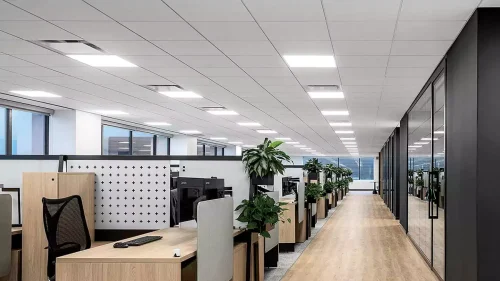
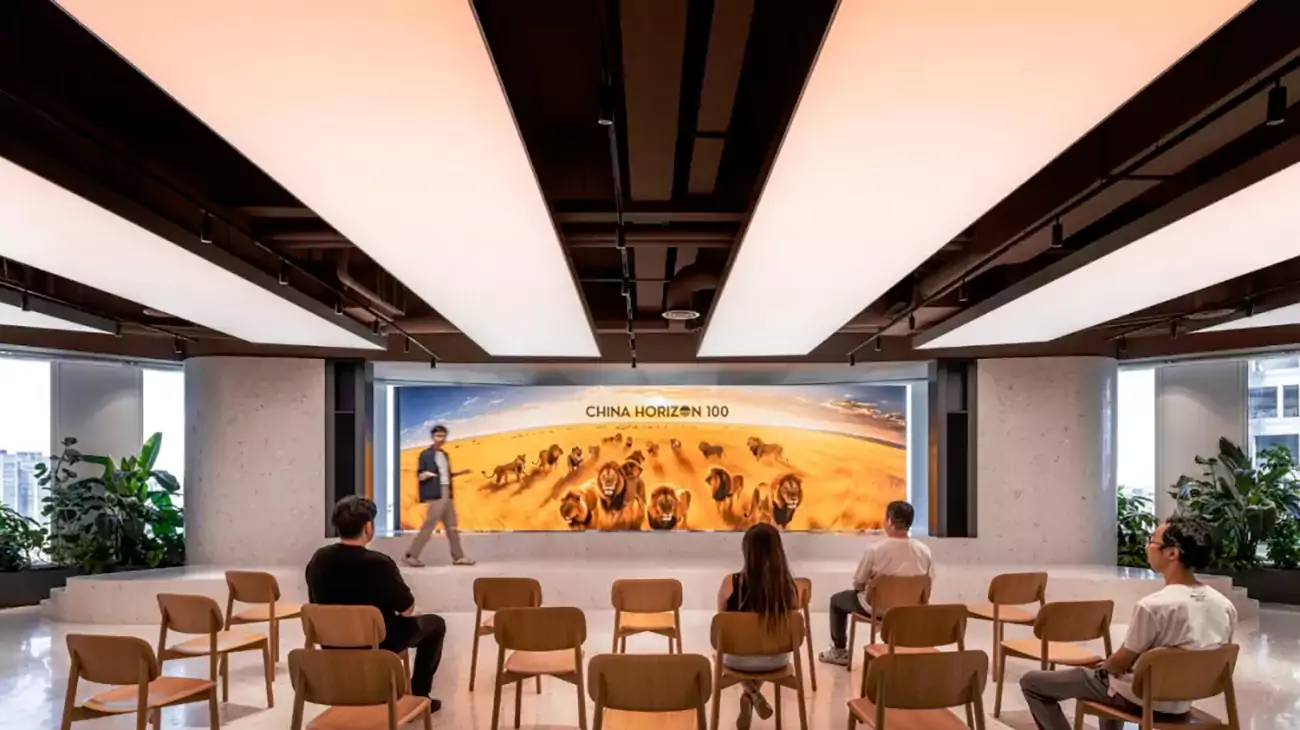
The project’s individual area length is approximately 3-8 meters, with some continuous splicing areas exceeding 15 square meters. This means the project is not fundamentally a problem of individual light panel performance, but rather a large-area system lighting issue. The first problem exposed during the client’s initial testing was insufficient uniformity. Due to the large spacing between light strips in early solutions, noticeable bright bands and dark areas appeared on the stretch ceiling surface. This type of problem is very common for stretch ceilings, but it most significantly impacts the final visual quality.
Many clients tend to focus on power and brightness during the selection phase, but in actual stretch ceiling projects, the true determinant of the effect is often the balance between the following factors:
- Beam angle.
- Light spacing.
- Cavity height.
- Light source density.
In this project, the available space inside the ceiling was limited, with the installation cavity only about 80-120mm. The thinner the space, the easier it is for the individual light particles to show through, further increasing the difficulty of achieving uniformity. Simultaneously, due to the project requiring long-distance parallel installation, the client also encountered significant voltage drop issues. If a problem such as “normal brightness at the front end, but significant brightness attenuation at the rear end” appears after project delivery, it will be very troublesome. Because the maintenance costs of stretch ceilings are very high, repairs often require partial disassembly.
Therefore, the client emphasized two requirements: first, to minimize the probability of rework; and second, to facilitate installation.
The client ultimately clarified their needs as follows:
| Requirement | Target |
|---|---|
| Uniformity | No visible bright/dark bands |
| Efficiency | ≥185 lm/W |
| Voltage Drop | Tail brightness deviation ≤10% |
| Installation | On-site cuttable |
| Driver | Constant Voltage |
| Supply | Stable long-term production |
| Power | 4W / 6W to accommodate the brightness needs of different areas. |
Challenges and Technical Difficulties.
The biggest challenge of this project wasn’t increasing brightness, but rather making the light “invisible” within a limited ceiling space. From our experience, a common pitfall in stretch film projects is prioritizing increasing LED strip density, attempting to solve uniformity issues by increasing the number of LEDs.
However, in situations with limited height, simply adding more LEDs doesn’t completely solve the problem; it only increases power consumption and cost.
In this project, the ceiling cavity was only 80–120mm. Our initial assessment indicated that continuing with a standard 120° light-emitting structure would still leave noticeable LED traces. Therefore, the first key aspect of the project wasn’t adjusting power, but rather adjusting the optical structure.
The second challenge was long-distance voltage drop. Due to the large continuous splicing area and long power supply distance, a standard single-sided connection would result in significant voltage drop, making it difficult to control brightness consistency at the tail end. These issues are usually not apparent in laboratory single-board testing but become very apparent after actual installation. Therefore, we prioritized power supply structure optimization from the outset, rather than trying to fix it later.
After clarifying the project’s structural limitations, we first re-evaluated the LED panel layout and emission angle. Considering the relatively thin cavity height, we negotiated with the client to adopt a diffuse reflection lens solution. With the addition of the diffuse reflection lens, the emission angle increased from 120° to 170°. This significantly expands the coverage area of a single LED, reduces hotspot concentration, and is more suitable for low-cavity flexible film applications.
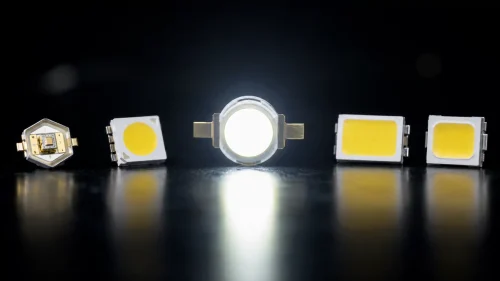
We ultimately chose 3030 6V high-efficiency LED chips instead of smaller packages. The main considerations were:
- Higher brightness per chip;
- Controllable number of LED chips;
- More suitable for high-efficiency designs;
LED chip parameters:
- 6500K
- CRI80
- 120mA
- 140 lm per LED
- chip efficacy 200 lm/W
In terms of structural design, we finally determined the module specifications:
| Item | Specification |
|---|---|
| PCB Size | 930 × 16.5 × 1.2 mm |
| Voltage | DC12V |
| LED Type | 3030 6V |
| Lens | Diffused Lens 170° |
To ensure installation flexibility, we employ a “2 LEDs per cut section” approach. This means cutting the strip every two LEDs. Customers can flexibly cut the strip to the desired length for on-site installation. Each section also has pre-installed solder pads for easy and quick wiring.
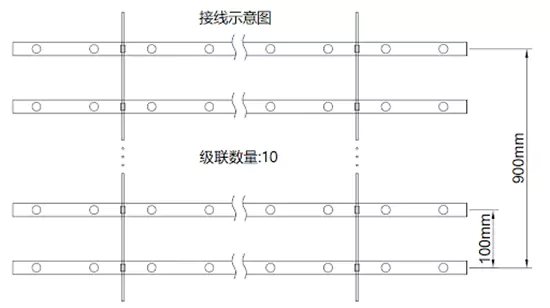
Regarding the power supply structure, conventional solutions typically use single-sided power. However, considering voltage drops over long distances, we use a “double-ended red and white double-row cable connection,” soldered to both sides of the LED strip. This effectively divides the voltage, reducing brightness attenuation at the tail end.
Furthermore, to improve installation efficiency, we pre-wire 10 strips per set. Customers do not need to solder each strip individually on-site. This seemingly small detail significantly enhances the efficiency of the customer’s installation project.
After the final sample was completed, the client focused on verifying three key aspects:
- Emitting light uniformity
- Long-distance brightness consistency
- System energy consumption
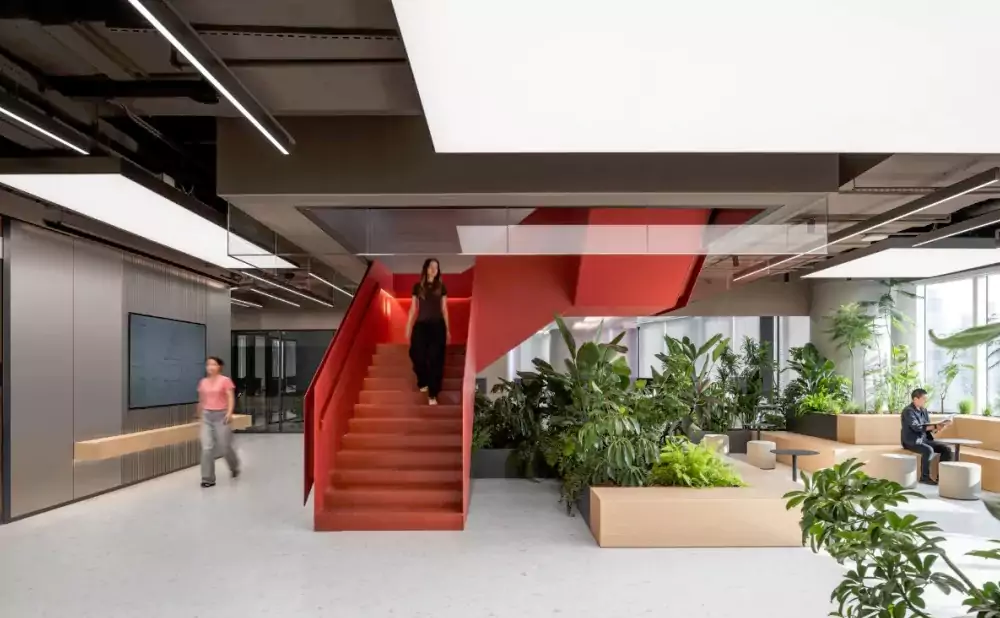
The most significant improvement was observed in the uniformity of the flexible film surface. The issues of bright bands and dark areas in the previous solution have been significantly improved. After actual illumination, the ceiling exhibited a more continuous and natural diffused light effect, with no noticeable LED traces.
Simultaneously, due to the adoption of a high-efficiency solution, the overall system energy consumption decreased by approximately 40%.
| Improvement | Result |
|---|---|
| Energy Saving | 40% |
| Performance Improvement | 20% |
| Tail Voltage Drop | ≤10% |
| Version | Power | Flux | Efficacy |
|---|---|---|---|
| 4W Module | 4W | 880 lm | 190 lm/W |
| 6W Module | 6W | 1300 lm | 192 lm/W |
For such a large-area, long-term operating space, energy saving is not only a cost issue but also directly impacts subsequent thermal management and system stability.
Why choose Higntek?
The reason the customer ultimately chose us for this project wasn’t simply because of higher specifications. It was because we participated in the entire project solution development, from ceiling structure analysis and lamp spacing assessment to optical diffusion design and long-distance power supply optimization. We offer more than just LED strip production; we help customers reduce the actual risks in the entire project:
Uneven lighting;
Voltage drop issues;
Inefficient installation;
Maintenance risks;
If you are developing similar projects such as extended ceiling lighting, office ambient lighting, reception lighting, or large-area diffused lighting, we can support complete customized mass production solutions.