
Ultra-high efficiency LED module manufacturer
High-efficiency LED modules are designed to maximize light output while minimizing energy consumption and heat loss. In the past, many standard LED module designs suffered from heat buildup, luminous flux decay, and unstable optical performance, leading to shorter lifespans and increased operating costs.
Higntek has always prioritized engineering in its LED module development. By employing ultra-efficient LED chips, optimizing PCB layout, thermal management, and LED configuration, we deliver superior luminous efficacy and brightness, along with better heat dissipation. From custom LED PCB design to precision assembly and comprehensive performance testing, our integrated capabilities ensure that each high-efficiency module achieves a balance between high light output, stability, and low energy consumption.
Engineering-customized high-efficiency LED module solutions.
Our R&D focus for high-efficiency LED modules is on optical performance, electrical stability, and thermal management. Through precise LED selection, optimized PCB materials (such as aluminum or copper substrates), and advanced circuit design, we ensure efficient energy conversion and minimal heat loss.
- Luminous efficiency: Up to 180–265 lm/W, depending on LED configuration.
- Lumen output stability: Less than 5% lumen decay after 1000 hours of continuous operation.
- Thermal resistance optimization: Reduced by 15% to 25% through optimized PCB layout and material selection.
- Power efficiency: Up to 90–95% electrical-to-light conversion efficiency.
- Operating temperature range: Stable performance from -20°C to 85°C.
- Color consistency (SDCM): ≤ 3-step McAdam ellipse for uniform light output.
- PCB material options: FR4/aluminum substrate/copper substrate (enhanced heat dissipation).
- Service life: up to 50,000 hours or more under standard operating conditions.
- Forward voltage tolerance control: ±3% to ensure stable electrical performance.
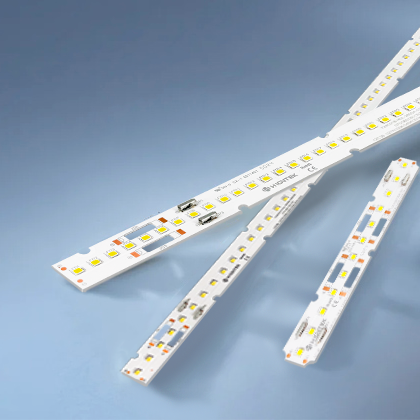
HUL Series Linear LED Modules
Optimized for uniform illumination and high lumen output, our linear LED modules are ideal for commercial lighting and backlighting applications. Designed with high-efficiency LEDs and thermally optimized PCB layouts, they deliver consistent brightness with reduced energy consumption. Clients benefit from improved lighting uniformity, lower operating costs, and extended product lifespan — making them a reliable choice for large-scale and continuous-use environments.
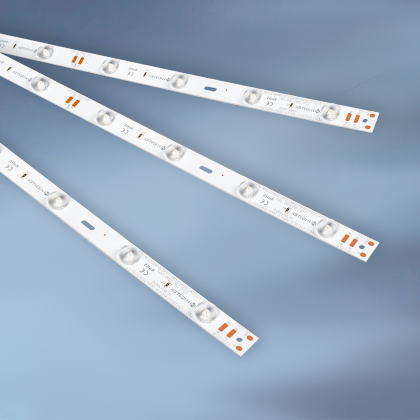
HUB Series Diffused LED Modules
Engineered for soft, evenly distributed light, our diffused LED modules combine high luminous efficiency with superior light uniformity. By integrating optimized LED spacing and diffusion design, they eliminate hotspots and glare while maintaining strong brightness. Ideal for signage and display applications, these modules help clients achieve better visual comfort, enhanced display quality, and energy-efficient performance in demanding lighting conditions.
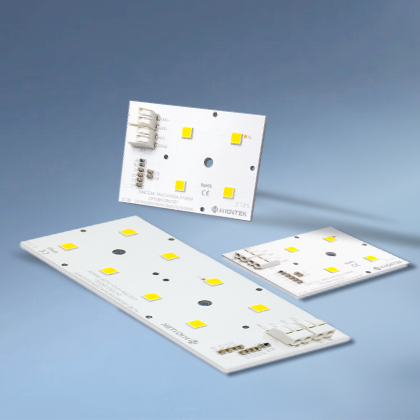
HUO Series Outdoor LED Modules
Built for durability and performance in harsh environments, our outdoor LED modules offer high lumen output with enhanced weather resistance. Featuring robust PCB materials, efficient heat dissipation, and stable electrical design, they ensure reliable operation under temperature fluctuations and long working hours. Clients gain long-term stability, reduced maintenance costs, and consistent lighting performance for outdoor and industrial applications.
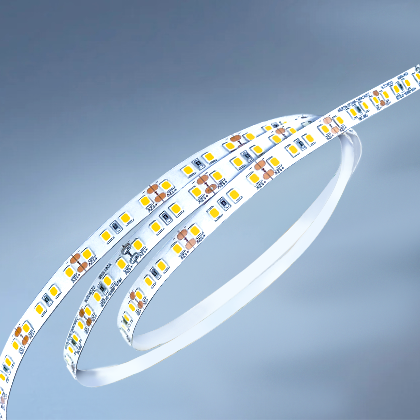
HUS Series Flexible LED Strips
Designed for adaptability and creative lighting applications, our flexible LED modules deliver high efficiency with excellent bendability. Using high-performance LEDs and flexible PCB materials, they maintain stable output even in complex installations. Ideal for architectural lighting and custom designs, these modules enable clients to achieve energy-efficient illumination with greater design freedom and reduced installation constraints.
Higntek’s engineering and manufacturing team achieves higher brightness output and precise color temperature & CRI through high-efficiency LED selection, optimized layout design, high-efficiency circuitry, and thermal management design. Ultimately, you can obtain a reliable, optically consistent lighting solution that achieves higher optical performance with lower power consumption and ensures stable operation over a long period of time.
Custom LED module sizes
Support for flexible PCB sizes, layouts, and materials, and optimized circuit routing to balance current distribution, heat dissipation, and component integration in product design.
Adjustable color temperature and high CRI
Select the appropriate LED specifications, brands, and models from our BOMs database based on customer requirements to achieve precise luminous efficacy. Available color temperatures range from 2200K to 6500K+, with CRIs up to 90+.
Brightness customization
We use high-performance LEDs from leading brands such as Cree, Osram, and Lumileds to provide customized lumen output, achieving system efficiencies of 180–265 lm/W depending on configuration and application requirements.
Electrical performance optimization
Customizable voltage and current designs (constant current/constant voltage) with efficiencies up to 95% ensure stable operation and reduce power loss. Stable and durable performance with the overall module system architecture.
Protection and waterproof solutions
LED modules can be designed for specific protection ratings, including IP65/IP67, and offer conformal coating, sealing, or encapsulation options to ensure durability in harsh environments.
Advanced customization features
We also support additional customization services such as DOB, connector integration, optical lenses, electronic component selection, and OEM silkscreen printing—making the lighting modules you need in one stop.
.webp)
.webp)


Application of high-efficiency LED modules
Explore real-world applications of our high-efficiency LED modules in commercial lighting and industrial projects. From improving luminous efficiency to optimizing energy consumption, each case demonstrates our ability to provide reliable, energy-efficient LED module solutions tailored to the needs of lighting projects.
Commercial Lighting Systems
Commercial Lighting Systems
Outdoor Lighting Applications
Outdoor Lighting Applications
Industrial Lighting Projects
Industrial Lighting Projects
View our high-efficiency LED module video
Watch our in-depth video to understand the design principles, PCB structure, LED selection, and thermal optimization behind our high-efficiency LED modules. Learn how we achieve higher lumen output, better energy efficiency, and longer lifespan through engineering-driven R&D and precision manufacturing.
Why Choose HIGNTEK ?
One-stop professional engineering-customized LED module supplier. Reduce the risk of development failures and get to market faster.
Comprehensive One-Stop Service
From requirement concept, light source selection, solution design, sample production, component procurement/PCB manufacturing, LED PCBA packaging, soldering, functional testing, LED module assembly to delivery, we provide complete prototyping and mass production services. Shorten development time and ensure stable and rapid delivery.

Advanced Manufacturing Equipment
We have an advanced fully automated production line equipped with 25 Samsung SMT placement machines, and possess in-house AOI, X-ray inspection, and testing capabilities. From production and assembly to testing, we ensure high-precision, consistent, and reliable LED module manufacturing for demanding lighting applications.
Traceable Quality Control System
From raw materials to final testing, every process is traceable. Production processes are certified to ISO 9001 and ISO 13485 quality management systems, ensuring consistent performance and complete quality traceability. A 5+95 prototype service validates designs and materials before mass production, reducing risk.
Stable & Scalable Supply Chain
We collaborate with thousands of suppliers worldwide, including renowned LED brands, optical lenses, and drivers. Leveraging our established component sourcing network, we offer complete BOMs, replacement component recommendations, and bill of materials cost optimization solutions. Ensure stable materials, high cost-effectiveness, and timely delivery for both prototyping and mass production of LED modules.
Experienced Engineering Team
HIGNTEK assigns a dedicated account manager to each client. Each project is supported by a team of experienced engineers and technical experts. We provide systematic engineering solutions in areas such as thermal management, optical design, and PCB layout to help customers optimize performance and manufacture high-performance LED modules suitable for specific applications.
Meets global standards
We incorporate international certifications (CE, RoHS, and UL, etc.) and our clients’ local standards from the design stage, making compliance a core aspect of product development. This ensures that the quality and manufacturing technology of our LED modules meet international market safety and reliability standards, helping customers successfully complete product certification and enter the application market.
What is a High Efficiency LED Module?
High-efficiency LED modules integrate advanced, high-specification LED chips from reputable brands onto a PCB, achieving an output power >140 lm/W. Some suppliers define >140 lm/W as high luminous efficacy, but we consistently adhere to a standard of >160 lm/W to help customers achieve greater energy savings.
Luminous efficacy (expressed in lumens per watt (lm/W)) is often considered an indicator of lighting fixture efficiency, but in engineering, it directly determines how much energy is converted into heat and how much into usable light. We’ve found that many claims of “high efficiency” for LED modules are based on the specifications of the LED chips, rather than the actual performance of the entire lighting module, leading to an overestimation of luminous efficacy. While the LED chip determines the maximum light output per watt, factors such as light loss, thermal resistance, and driver efficiency must be considered during actual LED module engineering development.
Features and advantages of high-efficiency LED modules.
- Reduced power consumption: The increased luminous flux per watt in high-efficiency LED modules minimizes energy consumption. At the same lumen output, increasing system luminous efficacy from 130 lm/W to 160 lm/W typically reduces total power consumption by approximately 15% to 20%.
- Reduced thermal load: Higher efficiency means less energy is wasted as heat. Under good thermal design conditions, a 20% increase in efficiency can lower the junction temperature by 5-10°C.
- Longer lifespan: LED performance degradation is closely related to temperature; a 10°C reduction in junction temperature can extend LED lifespan by up to 2 times (L70 standard).
- Versatile design: High efficiency enables more compact luminaire designs and higher lumen output per unit area.
- Long-term cost-effectiveness: While high-efficiency modules have a higher initial cost, they reduce power costs, cooling costs, and maintenance frequency over time.
How to Design High Efficiency LED Modules for Better Performance?
Designing high-efficiency LED modules is a system-level outcome, not just the characteristic of a single component. It requires comprehensive development in terms of LED selection, PCB materials, thermal management, and optical design losses.
- LED Selection: While the LED chips determine the module’s maximum luminous efficacy, don’t blindly pursue the most efficient LED chips listed in the datasheet. In engineering practice, LEDs typically achieve their most stable and efficient operating state when running at around 50% to 70% of their rated current. Excessive current driving may increase brightness but also increase heat generation, thus impacting the overall module efficiency.
- PCB Materials: The PCB is not just a mechanical support; it’s also part of the heat dissipation system. At low power levels, a standard FR4 board may be sufficient, but once the energy efficiency target of high-efficiency LED modules exceeds 180 lm/W, aluminum-based PCBs must be used to achieve high heat dissipation, while high-end applications may require copper substrates with significantly better thermal conductivity. In thousands of production cases over the past, we have documented that improving the heat dissipation performance of the PCB alone can increase the efficiency of the entire LED module by 5% to 8% or more. The principle is to reduce the heat accumulation at the junction.
Material Thermal Conductivity Use Case FR4 ~0.3 W/m·K Low-cost, low power Aluminum PCB 1–3 W/m·K Standard high-efficiency LED modules: 160-200 lm/W Copper / Advanced MCPCB 3–8 W/m·K Ultra-high-efficiency LED modules: 200-265 lm/W - Thermal Management: Thermal management is a major limiting factor in the design of high-efficiency LED modules. Once the luminous efficacy target exceeds 150 lm/W, even a small loss in heat dissipation efficiency can cause a decrease in the theoretical data of the LED chip. Our engineers’ design focus is no longer on how to emit light, but on how to dissipate heat efficiently and stably. We need to conduct system engineering design based on the customer’s electrical requirements such as current and voltage, including the selection of thermal interface materials, PCB layout design, heat dissipation structure, and the selection of PCB and LED chips. Without sufficient comprehensive consideration, even using high-quality LED chips can lead to a system efficiency drop of more than 10%, and may even seriously affect the lifespan of the lighting module.
- Optical Design: Optical design introduces another layer of complexity, which is often overlooked in the early planning stages. Lenses and diffusers are necessary components for controlling light distribution (light angle and light uniformity), but inevitably cause luminous efficacy loss. Depending on the configuration, these losses can range from 5% to as high as 20%. This means that even if the module is designed to be highly efficient at the LED board semi-finished product level, if the optical components are not carefully optimized and adapted, its final luminous efficacy performance may still not meet expectations.
Our engineering team, drawing on years of project experience, wants to share this valuable lesson: high-efficiency LED modules cannot be achieved by maximizing any single parameter. Instead, they require balancing LED performance, thermal stability, and optical efficiency within specific application environments. Neglecting any of these factors typically leads to decreased luminous efficacy, or worse, long-term performance instability.
High Efficiency vs Standard LED Modules.
The difference between high-efficiency LED modules and standard LED modules is often simply described as an improvement in luminous efficacy (lm/W), but in reality, the differences go far beyond that. It affects heat dissipation, system stability, maintenance requirements, and ultimately, the total cost of ownership.
| Parameter | High Efficiency LED Module | Standard LED Module |
|---|---|---|
| System Efficacy | 160–265 lm/W | 100–140 lm/W |
| Energy Saving | Highest (40-70% brighter at same power) | general |
| Heat Generation | Lower | Higher |
| Junction Temperature | Lower | Higher |
| Lifetime (L70) | Longer | Shorter |
| Initial Cost | Higher | Lower |
| Total Cost of Ownership | Lower | Higher |
- Energy Consumption: High-efficiency LED modules can reduce energy consumption by 15-30% for the same luminous flux.
- Brightness and Power Input: Higher luminous efficacy of LED modules means lower power consumption for the same brightness, and higher brightness for the same power.
- Lifespan and Reliability: The stable operating temperature of high-efficiency LED modules slows down luminous flux decay and reduces failure rates.
- Maintenance Costs: In commercial projects, the maintenance costs of high-efficiency LED modules can be reduced by more than 30-50%, especially in inaccessible installation environments. This is one of the reasons why high-efficiency solutions are becoming increasingly popular in large-scale or long-term deployments.
High-efficiency LED modules are strongly recommended in the following situations:
Energy costs are critical / Longer lifespan is required / Thermal conditions are limited.
How to Choose a Reliable High Efficiency LED Module Supplier?
On paper, many suppliers seem very similar. Almost every factory claims advantages such as high lumen efficiency, long lifespan, consistent quality, and fast delivery. However, after years in the LED module manufacturing industry, I can tell you a hidden truth:
A reliable supplier isn’t one with the most impressive product specifications, but rather one who can still provide solutions when projects become complex.
High-efficiency LED modules are more than just increasing lumen/watt efficiency. It requires a balance between optical design, thermal control, driver compatibility, PCB layout, material selection, and mass production consistency. If a supplier only provides module production and shipping but cannot support engineering design, the buyer often pays the price later—for example, thermal failures, inconsistent brightness, delayed certification, or hefty warranty costs. Choosing a reliable high-efficiency LED module supplier requires a comprehensive evaluation of their system engineering capabilities, thermal management experience, OEM & ODM support, and a clear testing and quality management system.
Engineering Design Capabilities: Countless factories can package LEDs onto PCBs, but only a handful can truly design high-efficiency LED modules. A truly high-efficiency LED module supplier understands that LED chip selection, PCB thermal conductivity, optical lens or diffuser matching, drive current optimization, power factor, and overall system efficiency are all interconnected.
Thermal Management Experience: Thermal management cannot be overstated. According to the U.S. Department of Energy Solid-State Lighting resources, thermal management remains one of the core factors affecting LED lifetime and efficiency. As a professional manufacturer of engineering-driven high-efficiency LED modules, we manage thermally from multiple aspects, including PCB copper thickness, aluminum substrate quality, thermal resistance paths, soldering reliability, and heat dissipation structures.
OEM & ODM Customization Capabilities: LED module production is not a completely standardized product. When lighting projects are adjusted or upgraded, suppliers with ODM capabilities can quickly respond with strong engineering expertise to implement new PCB layouts, optical redesigns, or power optimizations.
Testing and Quality Control System: Ensuring product consistency and reliability before high-efficiency LED modules leave the factory is a fundamental requirement for qualified suppliers. Suppliers lacking testing standards can still ship, but your project becomes a testing environment. I hope all LED module suppliers can have a complete testing and quality management system like ours, including integrated sphere testing, power parameter testing, aging test processes, internal AOI, X-ray inspection, temperature rise validation, and reliability inspection records.
I’ve noticed many buyers make a mistake: they select suppliers solely based on luminous parameters such as unit price, lm/W, color rendering index, and color temperature, ignoring the underlying factors that define LED module parameters. Our goal is simple: to help customers launch efficient, reliable, and lower-risk LED lighting products. Because lighting efficiency is only valuable when it remains stable over the long term.
Why do some high-efficiency LED modules fail prematurely?
Common causes of premature failure of high-efficiency LED modules include: poor heat dissipation design, unstable driver, poor PCB material quality, electrical problems, and insufficient aging test.
How does high efficiency affect LED module lifespan?
High efficiency usually means more light output with less wasted energy as heat. Less heat helps keep LED junction temperatures lower, which slows lumen decay and material aging. In my experience, thermal design often matters as much as chip quality. A well-designed high efficiency LED module can maintain stable performance longer and reduce early failure risk.
What factors impact luminous efficiency in LED modules?
Several factors affect LED efficiency, including LED chip quality, driver current, PCB thermal design, optical loss, and operating temperature. Even a strong chip can lose efficiency in a poor thermal system. We usually evaluate the full design—from PCB layout to heat dissipation—to improve actual system efficacy, not just lab numbers.
How much power consumption can a high-efficiency LED module reduce?
A high efficiency LED module can often reduce power consumption by around 20%–40% compared with conventional designs, depending on application and module design. This happens because you need less power to achieve the same lumen output. For commercial lighting projects, this usually means lower energy bills and improved long-term operating ROI.
Do you provide custom high efficiency LED module design?
Yes. We support both OEM and ODM projects based on customer requirements. This includes PCB layout, optical design, thermal optimization, driver matching, and assembly support. Many clients come to us when standard products do not fit their structure or performance targets. We can help turn early concepts into manufacturable LED module solutions.
What is your typical lead time for prototype and mass production?
Prototype lead time is usually around 5–7 days, depending on design complexity and material availability. Mass production commonly takes 10–15 weeks after sample approval. In real projects, early engineering review often saves more time than rushing production, so we prefer confirming technical details before scaling.
How do you ensure quality consistency in large orders?
We control quality through incoming material checks, aging tests, electrical testing, photometric validation, and batch traceability. Every production stage follows a documented QC workflow. For large orders, consistency matters more than one good sample, so we focus heavily on process stability and repeatable manufacturing standards.
Can you support small batch orders for testing?
Yes, we support small batch trial orders for product evaluation, engineering testing, and pilot runs. I know many buyers prefer validating compatibility before larger commitments. Small batch support helps reduce sourcing risk, test real-world performance, and speed up project decisions with lower initial investment.
What certifications do your LED modules comply with?
Our LED modules commonly comply with CE, RoHS, and UL-related requirements based on target market needs. Certification scope depends on product design and application. If your project requires additional approvals for Europe, North America, or other regions, we can support technical preparation and certification application accordingly.
Should I choose the cheapest LED module supplier?
Price is important, but the total project cost is more crucial. The LED lighting module manufacturing industry is currently a transparent market, and it’s difficult to create significant differences in technological barriers in the short term. Cheap LED module manufacturing often involves cutting corners on materials and production processes, leading to higher failure rates, rework rates, and warranty costs. We absolutely reject this practice and do not want our customers to choose cheap materials to reduce costs.
Need a custom high efficiency LED module solution?
If you are developing a new lighting product or upgrading energy performance, feel free to contact Higntek. We provide engineering support from design and thermal analysis to prototyping and mass production, helping customers reduce development risk and improve project efficiency.
Each high-efficiency LED module is quality guaranteed
Higntek is an ISO 9001:2015 certified company. Our quality management oversight covers every stage of production and testing. From component sourcing and PCB design to SMT assembly and final testing, each LED module is manufactured strictly according to established processes and standards. Our multi-stage 100% inspection includes appearance testing, aging testing, and functional testing such as AOI and X-ray, to ensure stable high luminous efficiency, energy saving, and longer service life of LED modules.
With stable production volume, traceable production data, and a rigorous quality control system, we improve LED module performance, helping customers reduce failure risks and quickly and safely reach the market.
Learn more about our production environment and equipment in our Production Gallery.
Other LED module series
On-Time Delivery 99.38%
Consistent production & reliable global delivery
End-to-End Engineering Support
From design optimization to production guidance
3-Day Rapid Prototyping
Fast sampling to accelerate product validation
100% Quality Inspection
Full testing ensures stable and reliable performance