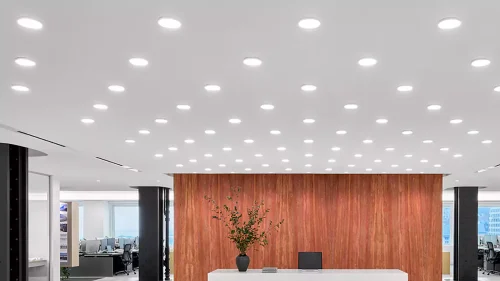
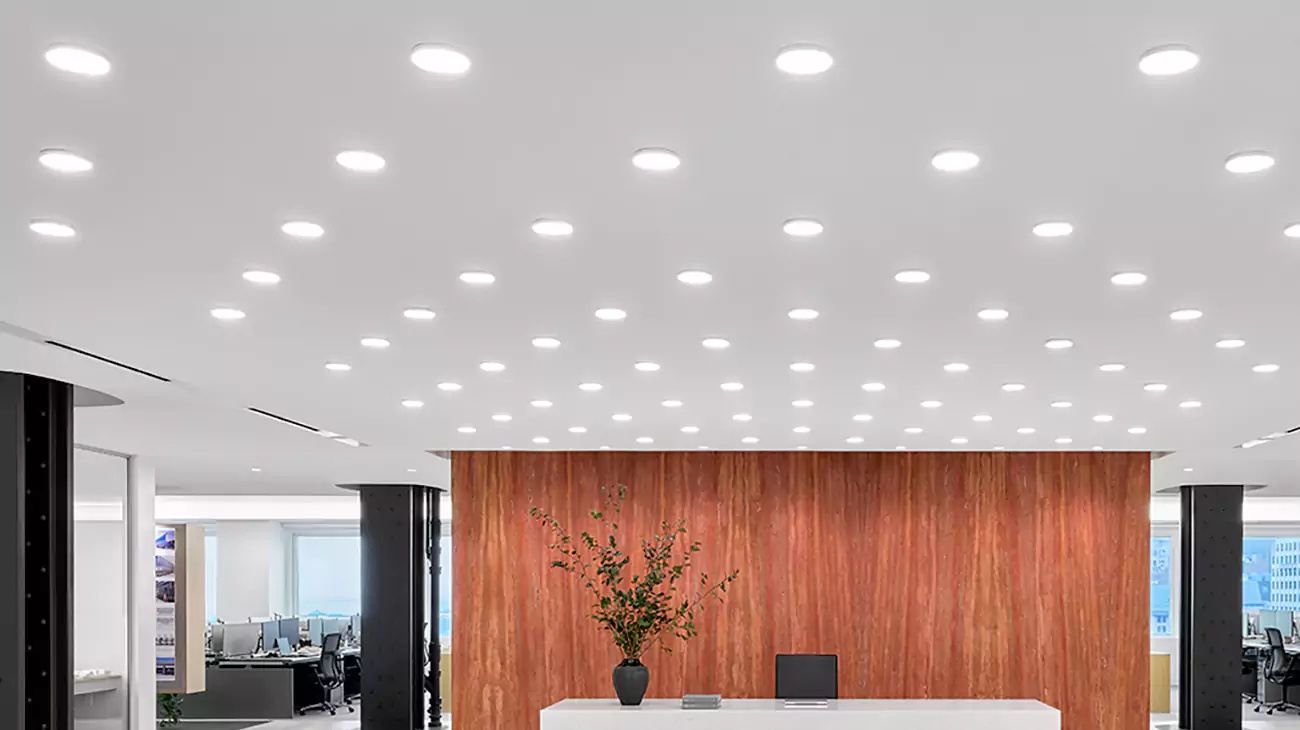
Location
Chicago, IL
Time
2025
Architect
HOK
Application Scenarios
Office Area / Meeting Room / Lounge Area
Product
Recessed Downlight
LED module solutions
High CRI Anti-Glare LED Module
Project Background:
The client was a Chicago-based diversified design firm with core expertise in interior architecture and lighting design. The office relocation marked a transformation and reinvention for the firm. They are able to apply their expertise to a variety of diverse business environments. At the heart of their design philosophy lies the interplay of light, shadow, and texture to create depth, contrast, and a powerful sensory experience. Prioritizing employee experience, the new office layout offers panoramic city views, creating a fully functional studio.
Unlike typical office clients, Polymath Design typically has a deeper understanding of lighting. They focus not only on brightness but also on the accurate representation of materials, the comfort of the work environment, and the clean, restrained, and professional nature of the lighting.
Early in the project communication phase, the client clearly stated that they did not want the office lighting to have the feel of “ordinary commercial office lighting.” They wanted a more sophisticated and restrained visual atmosphere—one that would meet the needs of long hours of work while reflecting the professional image of the design firm.
This meant the project could not simply pursue high brightness. Simply making the lights bright can easily lead to:
- Glare discomfort,
- Harsh shadows,
- Poor material rendering.
This is unacceptable to clients specializing in architectural design.Therefore, this project was not essentially a typical downlight module development, but rather a commercial lighting optimization project balancing visual comfort, color reproduction, and system efficiency.
Customer Needs:
The client stated that Polymath Design Architects needed to develop a high-performance white LED module for 6-inch recessed commercial office downlights, while simultaneously meeting several high standards.
First, Polymath Design Architects highly values the visual comfort of the office space. Architectural firm employees need to spend long hours looking at architectural drawings, material samples, and screen content. Therefore, the client required the entire light fixture to have excellent anti-glare performance, with a target of: UGR ≤ 19.
This already meets relatively stringent office lighting requirements. Simultaneously, because employees frequently involve judging materials and colors in their work, the client wanted the fixture to more accurately reproduce the materials in the space, therefore requiring:
- CRI ≥ 90.
- SDCM ≤ 3.
Especially SDCM ≤ 3, which means that batch consistency and color tolerance control must be extremely stable. The client’s core objectives were ultimately as follows:
| Requirement | Target |
|---|---|
| Light Color | White Light |
| CCT | 4000K |
| CRI | ≥90 |
| SDCM | ≤3 |
| Anti-glare | UGR ≤19 |
| Fixture Output | 1000–1400 lm |
| Fixture Efficacy | 110–130 lm/W |
| Lifetime | L80 ≥50,000h |
| Dimming | Supported |
These lighting requirements, individually, are not extreme, but when they coexist, the engineering complexity increases significantly.
Challenges and Technical Difficulties.
The real challenge of this project lay in the client’s desire to simultaneously achieve high CRI, high luminous efficacy, and anti-glare.
From industry experience, when the CRI exceeds 90, system luminous efficacy typically decreases significantly. Meanwhile, downlights are high-light-loss luminaires. This is because LED light, after being emitted from the module, needs to pass through multiple stages:
- LED module output → diffuser layer → reflector chamber → anti-glare structure → fixture output.
Each optical structure at which light passes results in luminous efficacy loss. Especially since the client required a UGR ≤ 19, it meant the need for a deeper reflector and anti-glare structure. These components further increased light loss. Therefore, the client required an overall luminous efficacy of 110–130 lm/W. However, working backward from a systems engineering perspective, we quickly determined:
The lamp panel itself must achieve at least 175 lm/W; otherwise, the overall lamp target could not be met.
This was a crucial technical judgment made at the outset of the project. Many customers only provide the final target parameters, but neglect to calculate system losses. We need to proactively help clients break down the feasibility of their targets.
Higntek's Solutions:
After confirming the objectives, we first worked backward from the overall module’s optical efficiency to design the module. Because optimizing only at the PCB level would hardly solve the fundamental problems.
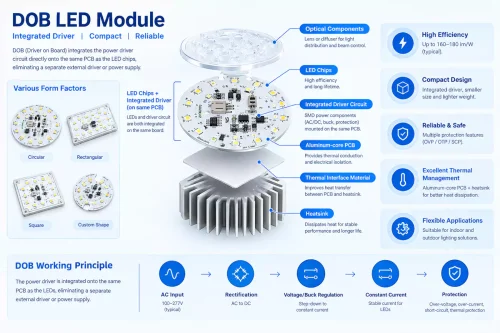
- Module Structure Design: To accommodate the client’s requirement of a 6-inch recessed downlight, our final LED PCB size was designed to be Ø84mm × 1.2mm.
- Driver Architecture Selection: The client wanted dimming support while ensuring office comfort. Therefore, we adopted a Constant Current Driver + High Power Factor + DALI Dimming driver solution. Although the cost is higher than standard LED modules, it significantly reduces flicker risk and provides better dimming consistency and compatibility.
Item Spec Input AC100–277V Output 9–42V LED Board Voltage 36V Current 200–300mA - LED Circuit Design: Due to the client’s high long-term operational requirements, we had to pay particular attention to thermal stability and electrical reliability.
We adopted a 12S3P structure: 12 LEDs in series and 3 parallel circuits. 36V board voltage, 10W power. Maintaining long-term thermal balance and stability. - LED Light Source Selection: To ensure the final system performance, we ultimately chose Cree 2835 J-series LEDs. The main reason for choosing this brand of LED chips is their superior high efficiency and stable color tolerance control.
Item Specification LED Brand Cree Package 2835 J Series Voltage 3V Power 0.2W SDCM ≤3
The most critical trade-off in this project was maintaining high efficiency at 90 CRI. Generally, a decrease in luminous efficacy is unavoidable when CRI increases. We determined the final production solution through continuous adjustments to the BOM materials and optimization of the thermal path through simulation testing.
The final circuit board luminous efficacy was approximately 185 lumens/watt, leaving sufficient margin for achieving over 110 lm/W in the subsequent overall lamp.
Project Results:
After the sample was completed, we collaborated with the client to conduct focused testing on the finished light unit’s LED module’s power, brightness, and color quality. We further optimized beam control and anti-glare performance using a mirror-polished reflector.
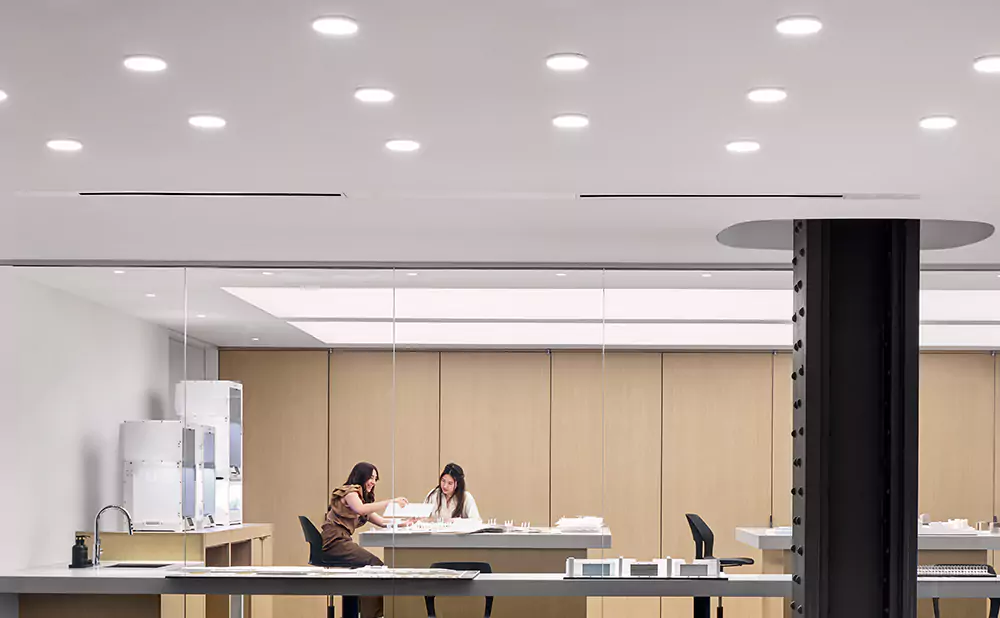
The final light achieved a UGR ≤19, meeting high standards for office visual comfort.
| Metric | Final Result |
|---|---|
| Board Flux | ~1850 lm |
| Board Efficacy | ~185 lm/W |
| Fixture Efficacy | Up to 120 lm/W |
| CRI | 90 |
| UGR | ≤19 |
| SDCM | ≤3 |
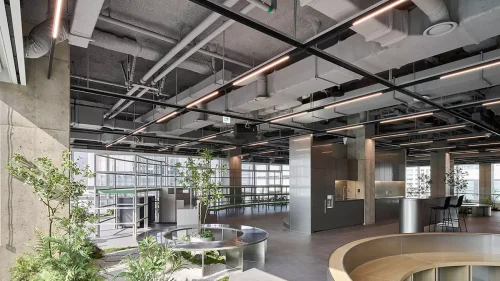
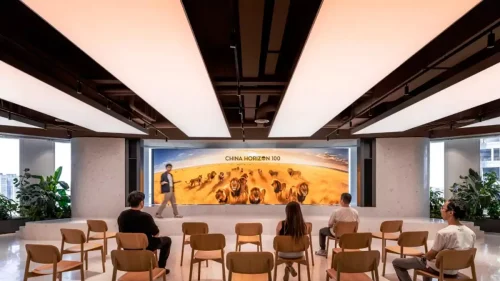
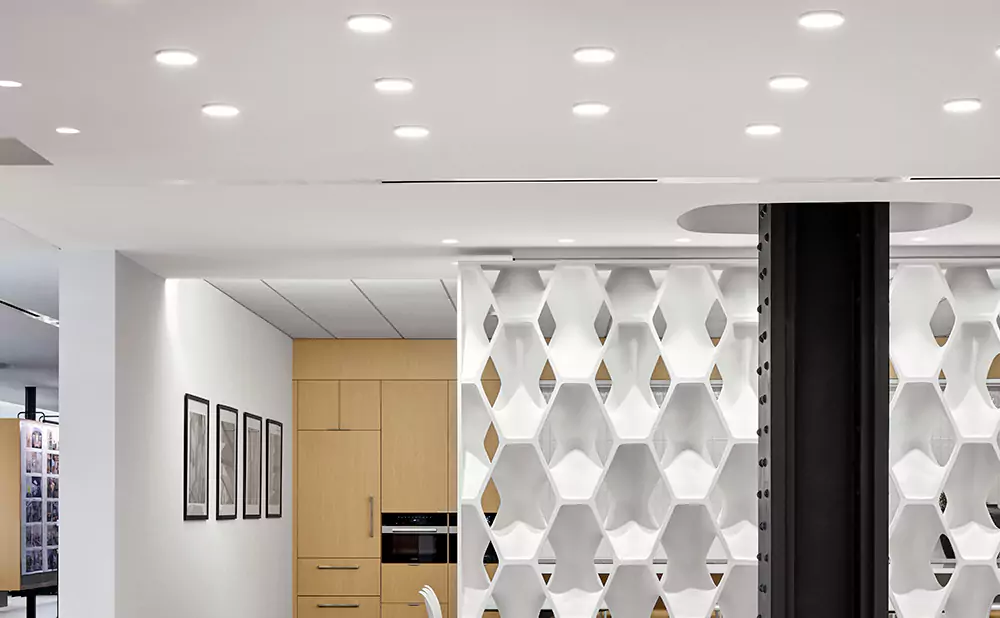
In the meeting area and open office space, the final lighting achieved clean beam distribution, a soft visual comfort, and precise material rendering.
Why Choose Higntek?
The client ultimately chose to work with us for this project not because we simply provided a light panel. What truly impressed them was our proactive approach in helping them break down the system objectives early in the project. This included:
- Determining the module PCB efficiency requirements corresponding to a total light output of 110–130 lm/W;
- Identifying system losses caused by 90 CRI and anti-glare structures in advance;
- Proactively suggesting a driver architecture more suitable for commercial office scenarios.
In these types of projects, clients don’t really need a typical OEM factory, but rather a partner who understands the application scenario and participates in engineering decision-making.
Higntek supports:
- Custom Office Lighting LED Modules
- High CRI LED Module Design
- Anti-glare Downlight Solutions
- DALI Dimmable Commercial Lighting Modules
- OEM / ODM Manufacturing
Our engineering team can provide comprehensive support for your project from conceptual design to mass production.
Start Your Custom LED Module Project
Contact Higntek for custom LED module consultation.
Share:
More Posts:
Post Category:

Dai Shunli
Founder & CEO
I founded the Higntek brand in 2013. Driven by technology, we provide high-efficiency LED module customization, development, and manufacturing for professional lighting applications. Leveraging over a decade of expertise in the LED lighting field, we offer one-stop OEM lighting solution manufacturing services, from theoretical design to production, including: requirements analysis, solution design, prototype development, testing and verification, and mass production. We are committed to providing customized manufacturing for the unique lighting needs of different industries, application scenarios, and customers.
Through continuous development, Higntek now has a 3,000-square-meter factory and over 200 employees, providing more than 1,500 customized LED solutions to customers worldwide. In the future, we will continue to uphold the principles of efficiency, excellence, and innovation, making the development and manufacturing of professional lighting modules simpler and more reliable.
Send Us A Message
On-Time Delivery 99.38%
Consistent production & reliable global delivery
End-to-End Engineering Support
From design optimization to production guidance
3-Day Rapid Prototyping
Fast sampling to accelerate product validation
100% Quality Inspection
Full testing ensures stable and reliable performance