High-efficiency solar LED lighting project for farms in Johor, Malaysia
Outdoor industry
Location
Kota Tinggi, Johor, Malaysia
Time
May 2026
Architect
unseenbird
Application Scenarios
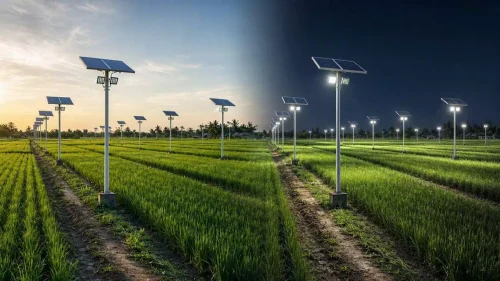
Farm roads, agricultural land, remote area lighting
Product
Solar LED street
LED module solutions
High Efficiency Outdoor LED Module
Project Background:
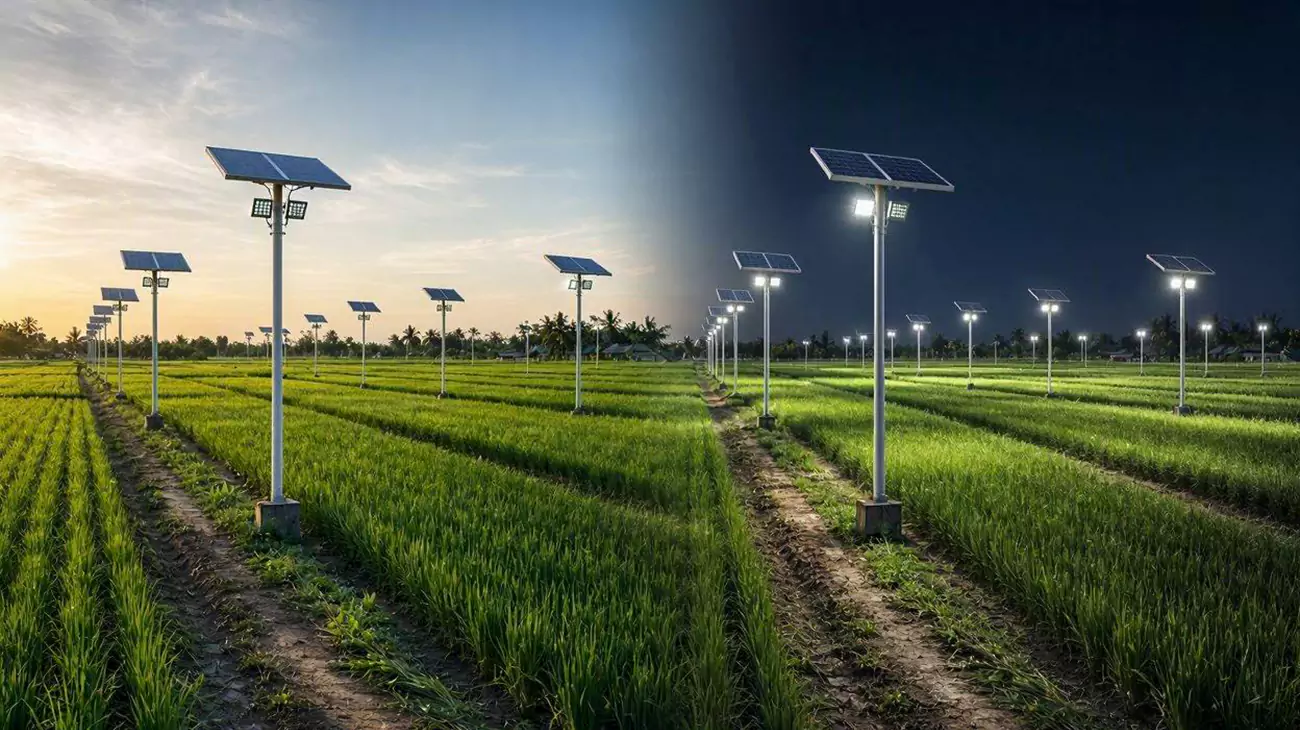
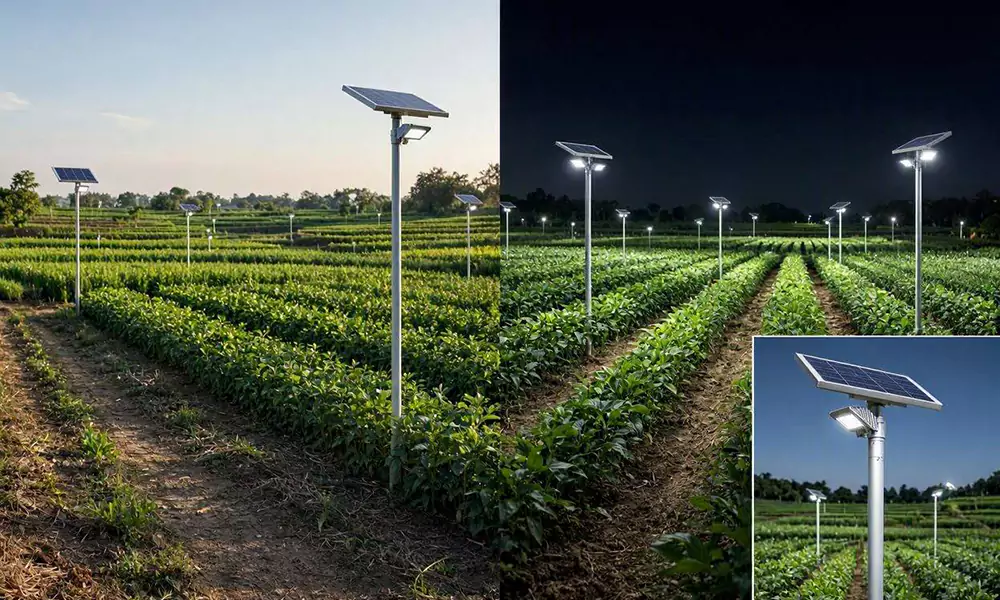
In May 2026, Higntek was involved in a solar outdoor lighting project developed for agricultural areas in Kota Tinggi, Johor, Malaysia. The project was designed for farm roads and open agricultural areas where conventional grid-connected lighting was not practical. In these locations, extending AC power infrastructure would require additional investment in underground cables, distribution equipment, and long-term maintenance.
For this type of environment, solar lighting provides a more flexible solution. However, during our initial technical discussion with the customer’s engineering team, we identified that the main limitation was not the solar panel or battery technology itself. The real challenge was how to maximize every watt of stored solar energy.
A solar lighting system only has limited energy available each night. If the LED module requires too much power to achieve sufficient brightness, the entire system needs:
- larger batteries;
- larger solar panels;
- higher product cost.
Therefore, improving LED module efficiency became the most direct way to improve the overall solar lighting system.
The client is a solar outdoor lighting manufacturer specializing in stand-alone lighting products for areas without reliable grid access. Their products are primarily used in agricultural farms, rural roads, plantations, industrial outdoor areas, and remote communities.
The client had prior experience developing complete solar lighting systems, including solar panels, battery management, and smart controllers. However, they consistently encountered a thorny issue when trying to improve the brightness and runtime of their products: increasing LED power could increase brightness, but it also increased energy consumption and reduced nighttime operating time.
Based on our experience handling outdoor lighting applications, this is a classic system-level conflict. Traditional lighting suppliers often focus solely on LED output power: “More watts, more brightness.”
But for solar lighting, this approach isn’t always correct. The real goal is: “More lumens produced per watt consumed.“
Therefore, our engineering team, when tackling this project, first evaluated LED efficiency, controller output, battery voltage, outdoor thermal performance, and optical utilization. This is the key reason the client approached Higntek. They needed more than just a brighter LED panel; they needed an LED module specifically designed to address the limitations of solar-powered systems.
Customer Needs:
During the technical discussion, the client’s product engineering manager explained that their existing LED solutions could achieve acceptable brightness, but the luminous efficiency of the lighting modules was insufficient to meet the energy-saving requirements of large-scale agricultural applications. This sometimes affected their competitiveness in project bidding. The customer wanted to develop a higher-end solar lighting product with three main improvements:
1.First, the LED module needed to provide higher brightness under limited power conditions. The target was:
- brightness above 10,000 lm;
- power consumption below 100W;
- high luminous efficiency.
This was important because every watt saved by the LED module directly reduces pressure on the battery and solar charging system.
2.Second, the LED module needed to work reliably with their existing solar controller. Their system used a low-voltage battery architecture combined with an MPPT boost controller. The controller specifications were:
| Parameter | Specification |
|---|---|
| Battery Voltage | 3.2V |
| Output Voltage | 9V-30V |
| Charging Current | Maximum 30A |
| Output Mode | Constant Current / Constant Power |
| Maximum Output Power | 100W |
Therefore, the LED module could not simply copy a standard 12V or 24V lighting design. The electrical architecture had to match the solar system.
3.Third, the product needed long-term outdoor reliability. Farm environments are different from indoor lighting applications. The module must withstand:
- continuous nighttime operation;
- outdoor temperature changes;
- moisture exposure;
- long service cycles.
For the customer, reducing maintenance frequency was just as important as improving brightness.
Higntek's Solutions:
Engineering Challenges and Technical Considerations.
From the outset, we recognized that the biggest challenge wasn’t reaching 10,000 lumens. Increasing the number or power of LEDs would relatively easily achieve the target high lumen output. However, we didn’t recommend doing so. Based on the client’s needs, we required simultaneous high brightness, low power consumption, compatibility with the solar controller, and stable thermal performance.
Challenge 1: Matching LED Architecture with Low Voltage Solar System
The customer’s battery voltage was only 3.2V. A conventional low-voltage LED design would create higher current demand, resulting in:
- increased electrical loss;
- lower conversion efficiency;
- more stress on components.
Therefore, we redesigned the LED circuit architecture based on the controller output characteristics instead of using a traditional lighting module structure.
Challenge 2: Managing Heat in High Output Outdoor Applications
The customer required more than 10,000lm output from a compact LED module. High brightness means higher thermal density. Based on our previous outdoor lighting projects, we know that insufficient thermal design often does not immediately appear during initial testing. The real problems usually appear after months of operation:
- accelerated lumen depreciation;
- color shift;
- reduced lifetime.
Therefore, thermal management was considered from the PCB design stage.
Challenge 3: Balancing Optical Coverage and Efficiency
Farm lighting requires broad illumination coverage. A narrow beam wastes light by creating uneven lighting areas.
However, a very wide beam reduces illumination intensity. Therefore, we optimized not only the LED source but also the optical distribution.
Solution & Technical Implementation.
Instead of increasing power blindly, our engineering team redesigned the module around system efficiency. The final solution combined:
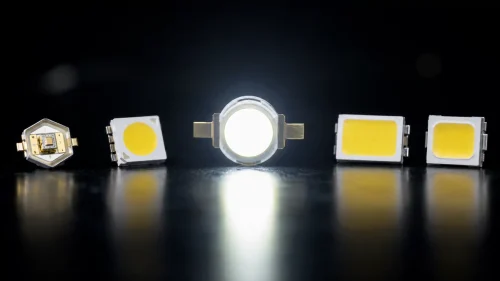
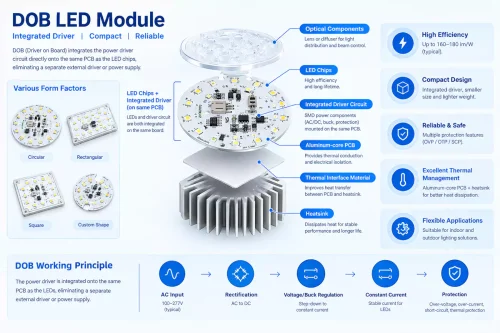
- high efficiency 5050 LED package;
- high thermal conductivity aluminum PCB;
- optimized electrical architecture;
- integrated optical lens.
High Conductivity Aluminum PCB.
Considering the outdoor operating environment and high lumen output requirement, we recommended an aluminum PCB structure. The final PCB design:
| Parameter | Specification |
|---|---|
| PCB Size | 236 × 50 mm |
| Thickness | 1.6 mm |
| Material | Aluminum PCB |
| Thermal Conductivity | 2.0 W/m·K |
For outdoor lighting, maintaining stable junction temperature is more important than achieving the highest initial brightness. A module that performs well on day one but loses output quickly is not a successful engineering solution.
High Efficiency 5050 LED Configuration.
We selected our self-developed, fully tested and verified high-efficiency 5050 LED package.The LED specification:
| Parameter | Specification |
|---|---|
| Package | 5050 |
| CCT | 5700K |
| CRI | Ra70 |
| Maximum LED Efficiency | 265 lm/W |
The larger 5050 package provided higher optical output while maintaining good efficiency for outdoor applications.
Electrical Design: 5S10P Constant Current Structure
To match the MPPT boost controller output, we designed: 5 LEDs in series + 10 parallel branches. The final electrical structure:
| Parameter | Result |
|---|---|
| Circuit Structure | 5S10P |
| Working Voltage | 30V |
| Power Design | 45W Constant Current |
This design allowed the module to operate efficiently with the customer’s solar controller while reducing unnecessary current loss.
Optical Optimization.
For agricultural applications, the goal wasn’t just maximum brightness, but effective ground coverage. Therefore, we custom-molded an integrated 5050 optical lens. This provided wider illumination coverage while maintaining useful lighting intensity.
| Optical Parameter | Specification |
|---|---|
| Lens Type | Integrated 5050 Lens |
| Beam Angle | 70° × 145° |
Project Results:
After prototype testing, the final module exceeded the customer’s original efficiency expectations. The final measured performance:
| Parameter | Result |
|---|---|
| CCT | 5700K |
| LED Quantity | 50 pcs |
| Input Voltage | 30V |
| Power Consumption | 45W |
| Luminous Flux | 11,000 lm |
| Module Efficiency | 245 lm/W |
| Optical Distribution | 70° × 145° |
Compared with the customer’s previous solution, the biggest improvement was not only higher brightness but a better-balanced solar lighting system. The optimized LED module helped the customer:
| Improvement Area | Project Value |
|---|---|
| Lighting Output | Increased beyond 10,000 lm target |
| Energy Utilization | Higher lumens per watt |
| Battery Requirement | Reduced system pressure |
| Solar Panel Requirement | Reduced potential system size |
| Product Cost | Lower overall BOM pressure |
From our engineering perspective, the most valuable achievement of this project was helping the customer rethink the entire solar lighting architecture. A solar lighting product is not competitive because it uses the most powerful LED. It is competitive because it can provide reliable lighting with the smallest energy input.
This project once again demonstrates that the luminous efficiency of LED modules directly impacts the lifespan, operating energy costs, and market competitiveness of the finished lighting fixtures.
Why Choose Higntek?
The reason the customer selected Higntek was not simply because we could manufacture a high-lumen LED module. During this project, we participated in the engineering decisions behind the product:
- evaluating solar system limitations;
- selecting LED architecture;
- designing thermal structure;
- matching controller requirements;
- optimizing optical performance.
This is the difference between a conventional LED supplier and an engineering-driven LED module partner.
A traditional supplier usually follows: Customer drawing → LED board production.
But Higntek works differently: Application requirement → Engineering analysis → Custom LED module solution → Mass production.
For solar LED lighting manufacturers facing challenges such as insufficient nighttime operating time, high battery costs, and low luminous efficiency of LED modules, Higntek can provide customized LED module development services from prototype to mass production.
Build More Efficient Solar Lighting Solutions with Higntek
Improve solar lighting performance with high-efficiency LED modules engineered for longer runtime, lower system cost, and reliable outdoor operation.
Share:
More Posts:
Post Category:

Dai Shunli
Founder & CEO
I founded the Higntek brand in 2013. Driven by technology, we provide high-efficiency LED module customization, development, and manufacturing for professional lighting applications. Leveraging over a decade of expertise in the LED lighting field, we offer one-stop OEM lighting solution manufacturing services, from theoretical design to production, including: requirements analysis, solution design, prototype development, testing and verification, and mass production. We are committed to providing customized manufacturing for the unique lighting needs of different industries, application scenarios, and customers.
Through continuous development, Higntek now has a 3,000-square-meter factory and over 200 employees, providing more than 1,500 customized LED solutions to customers worldwide. In the future, we will continue to uphold the principles of efficiency, excellence, and innovation, making the development and manufacturing of professional lighting modules simpler and more reliable.
Send Us A Message
On-Time Delivery 99.38%
Consistent production & reliable global delivery
End-to-End Engineering Support
From design optimization to production guidance
3-Day Rapid Prototyping
Fast sampling to accelerate product validation
100% Quality Inspection
Full testing ensures stable and reliable performance