Location
Ontario, Canada
Time
2025
Architect
Eureka / Mark Architectural Lighting™ / nLight®
Application Scenarios
Open Office Lighting
Product
600×600 Backlit Panel Light
LED module solutions
High-efficiency, low-glare Panel Light LED Module
Project Background:
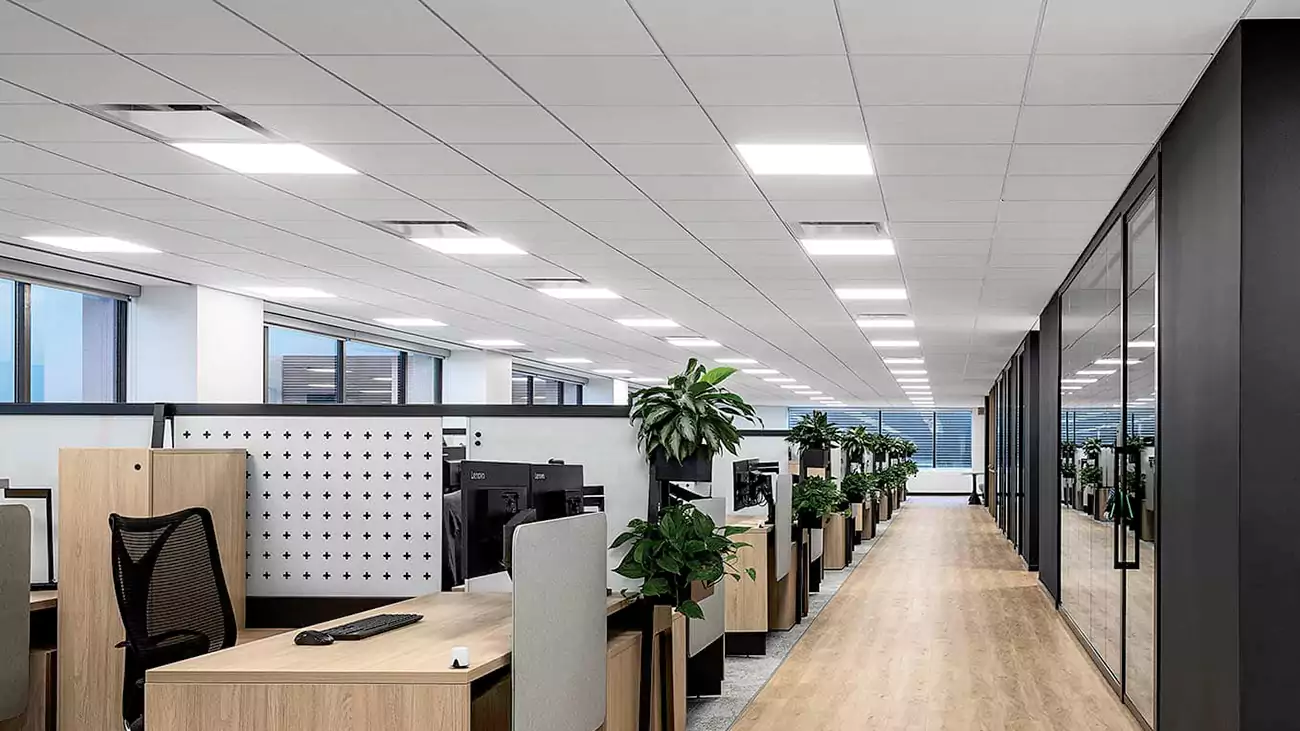
In 2025, our engineers collaborated with the client on the office lighting upgrade portion of the renovation project at the Toronto Lawrence Allen Centre office space in Ontario, Canada. What impressed us most about this project wasn’t its sheer size, but rather the client’s very clear understanding of the “real-world user experience” of office lighting. The office space design for this project involved multiple teams, including Eureka, Mark Architectural Lighting™, and nLight®.
Many office projects prioritize brightness or budget, but this project focused from the outset on finding a balance between a business-like atmosphere, long-term office comfort, and system energy efficiency.
Driven by RioCan REIT, a large Canadian real estate investment trust, the overall office space features an open-plan layout, extensive use of dark commercial finishes, black structural elements, and natural wood materials, aiming to create a more modern and technologically advanced office environment while retaining a certain degree of business formality.
However, this type of space design places very high demands on the lighting system. Because dark materials absorb more light, even if the illuminance meets standards, an inefficient lighting fixture can still make a space feel visually oppressive. Simultaneously, some high-brightness areas may exhibit noticeable bright spots, resulting in uneven lighting throughout the space. This is especially problematic in large open-plan office areas, where prolonged exposure to dim lighting significantly impacts visual comfort and the overall spatial experience for employees.
The client wanted to retain the existing 600×600 panel light structure but optimize the internal light source system to achieve:
- Higher system luminous efficacy;
- Lower energy consumption;
- More uniform surface light emission;
- A lower glare lighting experience more suitable for long-term office work.
From the project’s inception, we treated it not merely as a “light panel replacement” project, but rather as a comprehensive office lighting application, re-analyzing the fixture structure, optical path, and driver matching logic.
Customer Needs:
The client’s core requirement was: “To maximize system efficiency without sacrificing office comfort.”
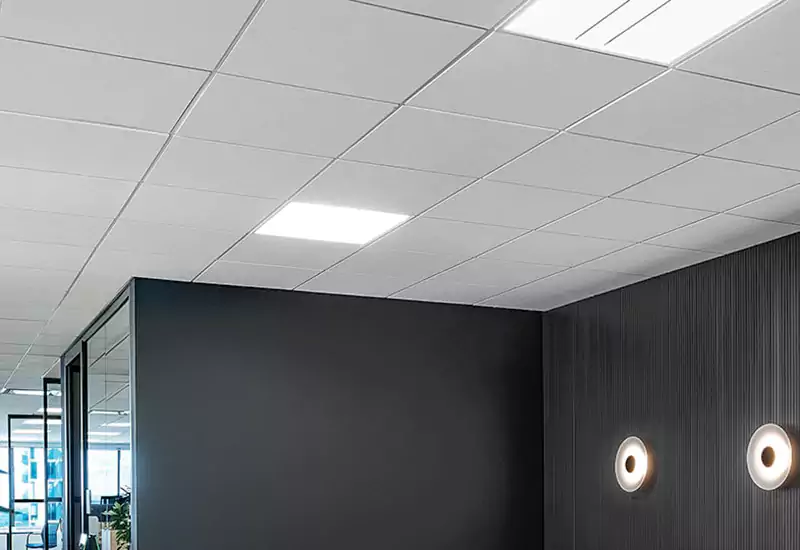
The client’s initial hard target was at least 30% energy savings for the overall system. However, they did not accept achieving energy savings through “reduced brightness.” This was because the office space already featured extensive dark-toned decor; further dim lighting would make the space feel even more oppressive. Therefore, the client wanted the new LED module solution to not only be energy-efficient but also offer better actual brightness performance in the real-world environment than the existing solution.
The client also explicitly requested: UGR ≤ 19; flicker-free operation; and uniform surface emission. These conditions significantly increased the complexity of the solution.
From our experience, many high-efficiency solutions ultimately struggle to achieve UGR control, as increased brightness often translates to a stronger sense of direct light. This issue cannot be solved simply by increasing the lumen output; it is related to LED arrangement, lens diffusion, light emission angle, and light mixing within the panel.
Therefore, in this project, we did not simply pursue high parameters from the outset, but rather focused on the long-term user experience in a real office environment.
| Requirement | Target |
|---|---|
| Energy Saving | ≥30% |
| System Efficacy | 150–160 lm/W |
| UGR | ≤19 |
| Flicker | Flicker-Free |
| Uniformity | No hotspots / dark areas |
| Driver Compatibility | 9–42V Constant Current |
| Color Tolerance | ≤5 SDCM |
Challenges and Technical Difficulties.
The unique aspect of this project is not achieving high brightness, but rather maintaining the comfort required for office lighting while maintaining high efficiency.
The client is using a direct-lit backlight panel light. Compared to edge-lit solutions, this structure is more efficient and simpler, but it also more easily exposes LED light source issues. If the light source arrangement or lens design is not properly optimized, noticeable bright spots and dark areas will appear on the panel surface. In particular, the client wants to control UGR ≤ 19.
This means we not only need to make the lights bright, but also provide employees with a comfortable, non-glaring lighting environment during extended work hours.
In addition, there is another issue with this project that is easily overlooked: the space itself is decorated in a dark color. This means that with the same lumen output, the visual perception in the space will be darker than in a light-colored office. Therefore, we had to reconsider light utilization, light diffusion efficiency, and panel internal uniformity. Experience shows that simply increasing LED density, while increasing brightness in the short term, easily leads to heat concentration, localized high brightness, and increased long-term light decay.
Furthermore, the client requires compatibility with 9–42V constant current drives. This means that module design must consider broader driver compatibility, not just fixed parameters in the laboratory. Therefore, the entire LED module development process needs to comprehensively consider driver compatibility, current fluctuations, and long-term thermal degradation.
Thus, we actually spent a lot of time on “balancing” in this project. We couldn’t just focus on parameters alone; we had to ensure that luminous efficacy, uniformity, glare control, and long-term thermal degradation were all achieved simultaneously.
Higntek's Solutions:
After analyzing the client’s lighting fixture structure, we ultimately opted against using standard low-voltage constant-current LED strips and redesigned a lens-type constant-current module solution. For office panel lights, the true determinant of the final experience isn’t simply LED brightness, but rather how evenly the light is utilized within a limited space.
| Item | Specification |
|---|---|
| PCB Type | Aluminum PCB |
| PCB Size | 520 × 18 × 1.0 mm |
| Structure | Constant Current |
| Circuit | 3S4P |
| LEDs per Module | 12 pcs |
The reason for using an aluminum substrate instead of a standard FR4 board is that office lighting involves continuous illumination over extended periods. Insufficient thermal management will lead to noticeable issues later:
- Accelerated light decay;
- Color temperature drift;
- Decreased uniformity.
Light Source and Lens Solution.
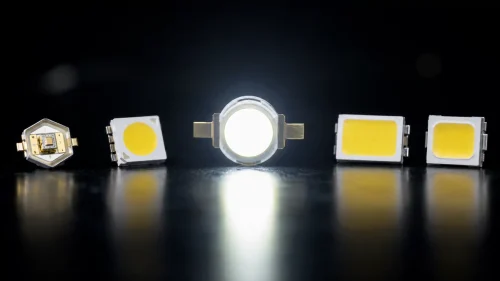
For the light source, we ultimately chose UHE 2835 9V LEDs. This LED model can achieve a maximum luminous efficacy of 235 lm/W.
However, high-efficiency LED beads alone are not enough; the light also needs to be made more uniform. Because the client used a direct-lit structure, without light diffusion optimization, even highly efficient LEDs can easily create noticeable bright areas within the panel. Therefore, after adaptation testing, we ultimately paired it with a 170° diffuse reflection lens.
By diffusing light at a large angle, the light is mixed more evenly within the panel, thus avoiding bright spots and dark areas. In the final lighting test, the continuity of the entire surface-emitting area was significantly better than the standard solution previously tested by the customer.
| Parameter | Result |
|---|---|
| Voltage | 27V |
| Current | 0.13A |
| Flux | ~768 lm |
| Module Efficacy | ~225 lm/W |
| LED Type | UHE 2835 9V |
| Beam Angle | 170° Diffuse Lens |
The entire lamp uses 6 modules connected in series and parallel via connectors. Final lamp parameters:
| Parameter | Final Result |
|---|---|
| System Voltage | 27V |
| System Current | 0.78A |
| Total Flux | ~3600 lm |
| System Efficacy | ~160 lm/W |
| Total Power | ~23W |
Project Results:
After the sample was completed, the client focused on verifying three key aspects:
- Actual spatial brightness;
- Emitting uniformity;
- Long-term office comfort.
From the final results, the biggest improvement of this solution wasn’t a particularly high value for any single parameter, but rather a more balanced overall lighting experience.
- Firstly, regarding spatial brightness. Because dark materials absorb a lot of light, if the system efficiency is insufficient, even if the theoretical illuminance is met, the space can still feel oppressive. Although the total power of the entire lamp is only 23W, due to the significant improvement in system luminous efficiency, the overall visual brightness of the office area is still about 8% higher than the original solution.
- At the same time, the overall system power consumption is reduced by about 30%. The client particularly appreciated this, as office lighting is a long-term operating system, and the subsequent energy-saving value is very significant.
- With 170° lens diffusion, the entire surface-emitting area has no obvious dark areas or graininess, and the light transition is more natural.
- The final UGR is controlled at ≤19. The transition across the entire surface-emitting area is more natural, and employees do not experience noticeable glare during long hours of work.
| Item | Final Result |
|---|---|
| Total Power | 23W |
| Total Flux | 3600 lm |
| System Efficacy | 160 lm/W |
| Energy Saving | 30% |
| Brightness Improvement | 8% |
| UGR | ≤19 |
| Flicker | Flicker-Free |
Why Choose Higntek?
The client ultimately chose to work with us for this project not because we simply offered higher luminous efficacy LED panels. The real key was that from the outset, we didn’t approach it from a “module-selling” perspective, but rather from the perspective of a real-world office lighting application, re-analyzing the problem.
We believe that in office lighting projects, the truly valuable solution is never about having a single higher parameter. It’s about finding a reasonable balance between luminous efficacy, comfort, uniformity, glare control, and long-term stability.
If you are developing Office Panel Lights, Low UGR Office Lighting, High Efficiency Commercial Lighting, or Architectural Office Lighting, we can help you with a complete evaluation, from luminaire structure and driver compatibility to optical solutions and mass production stability, not just providing standard LED panels.
Start Your Office Lighting Project with Higntek
Share your fixture structure, driver information and lighting goals — our engineering team can help you develop a more efficient and reliable LED module solution.
Share:
More Posts:
Post Category:

Dai Shunli
Founder & CEO
I founded the Higntek brand in 2013. Driven by technology, we provide high-efficiency LED module customization, development, and manufacturing for professional lighting applications. Leveraging over a decade of expertise in the LED lighting field, we offer one-stop OEM lighting solution manufacturing services, from theoretical design to production, including: requirements analysis, solution design, prototype development, testing and verification, and mass production. We are committed to providing customized manufacturing for the unique lighting needs of different industries, application scenarios, and customers.
Through continuous development, Higntek now has a 3,000-square-meter factory and over 200 employees, providing more than 1,500 customized LED solutions to customers worldwide. In the future, we will continue to uphold the principles of efficiency, excellence, and innovation, making the development and manufacturing of professional lighting modules simpler and more reliable.
Send Us A Message
On-Time Delivery 99.38%
Consistent production & reliable global delivery
End-to-End Engineering Support
From design optimization to production guidance
3-Day Rapid Prototyping
Fast sampling to accelerate product validation
100% Quality Inspection
Full testing ensures stable and reliable performance