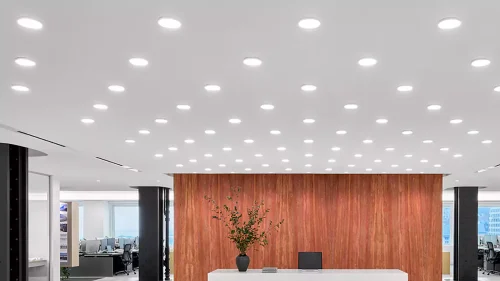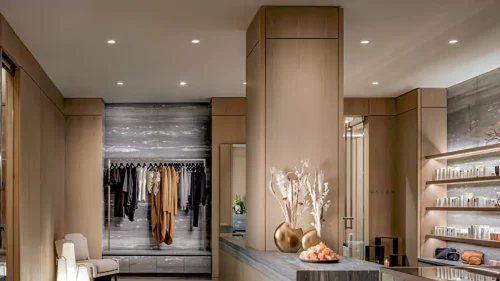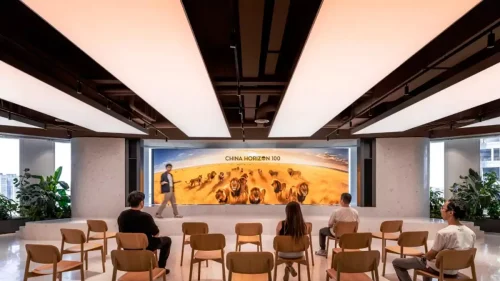
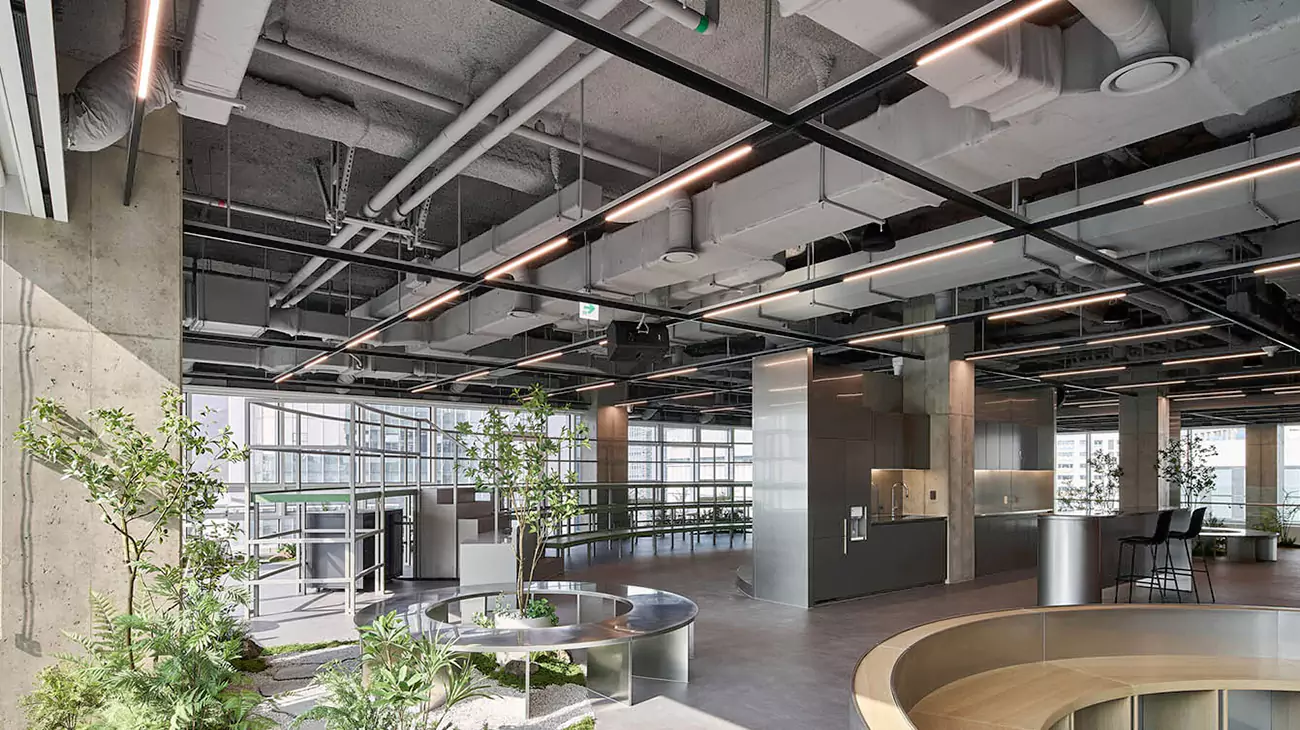
The client’s initial requirements seemed extensive, but after communication, we discovered it was essentially a typical commercial office lighting balance issue: the client wanted higher brightness without compromising spatial comfort.
In this project, some linear luminaires were installed relatively high. The sample panels previously tested by the client had good parameters in a laboratory environment, but after installation, the actual illuminance on the work surfaces was significantly insufficient, making the entire space appear dark, especially in the office areas, directly impacting employee visual experience.
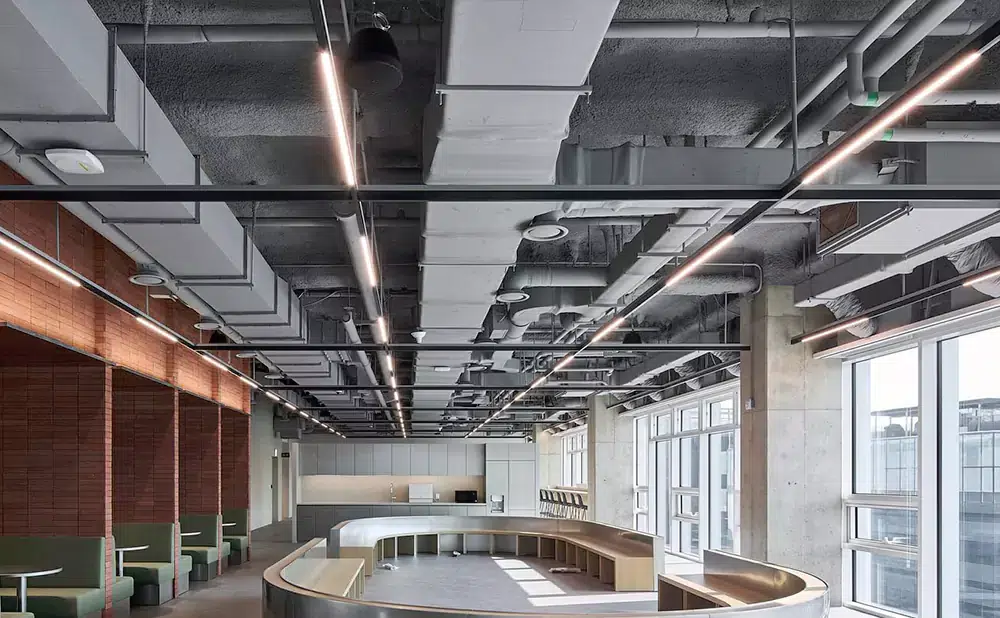
At the same time, the client had very specific requirements for the spatial atmosphere. The same set of luminaires needed to cater to both daytime office and break area scenarios, therefore, they wanted to provide different lighting experiences at different times through dual color temperature switching between 3000K and 6500K. 6500K is used to maintain a clearer and more focused visual experience during daytime office work, while 3000K is used in rest areas and at night to create a softer atmosphere.
Besides brightness and dimming, the client also emphasized uniform light emission. Because the project uses industrial-style ultra-narrow linear luminaires with a very simple structure, this design style can amplify light emission defects. If the LED arrangement is not properly optimized, the pixelation of the LED beads and light spots will be very noticeable, directly affecting the overall quality of the space.
We ultimately summarized the client’s needs into the following core objectives:
| Requirement | Target |
|---|---|
| Tunable White | 3000K / 6500K switching |
| Brightness | Higher lux output for high installation |
| Uniformity | No visible hotspots |
| Efficiency | Around 180 lm/W |
| Installation | Cuttable module design |
| Reliability | Stable electrical performance & long lifespan |
Technical Challenges.
The real complexity of this project wasn’t achieving a single function, but simultaneously meeting multiple lighting effect goals within a limited LED PCB size.
- The linear luminaires used by the client had a very slim structure, so we knew from the beginning that this wouldn’t be a project that a standard module could handle. The final PCB size was determined to be 1170mm × 9.5mm × 1.0mm. The board width of only 9.5mm significantly limited the circuit design.
- Because this module not only needed to support independent control of 3000K and 6500K dual color temperatures, it also needed to reserve cutting positions, input pads, and necessary safety clearances. With such a narrow board width, using a conventional dual-line layout would result in very crowded wiring, affecting manufacturing and stability.
- Furthermore, to achieve the spotless effect required by the client, we had to increase the LED density. However, the direct problem with high density is heat accumulation.
From our experience, these long, high-density linear modules, if poorly designed for heat dissipation, are prone to accelerated brightness decay and color temperature drift over time. This is especially true in office settings where lighting fixtures often operate for extended periods, where these problems will be rapidly amplified after several months of use.
Therefore, this project truly required balancing several inherently conflicting requirements:
| Design Challenge | Potential Risk |
|---|---|
| Higher brightness | Increased power and heat |
| Higher LED density | Thermal concentration |
| Cuttable structure | Circuit complexity |
| Dual CCT control | Limited PCB routing space |
Many LED module projects don’t struggle to achieve two or three of these requirements, but the client wanted all conditions to be met simultaneously. This is why our engineering team spent a significant amount of time on solution development in the early stages of the project, rather than immediately starting design drawings and production.
After clarifying the client’s needs, we didn’t immediately begin PCB design. Instead, we first re-examined the electrical architecture of the entire LED module, focusing on the driving logic and application methods. This is our consistent approach when handling customized projects. Many projects appear to be about the luminaire board, but in reality, if the initial architecture is wrong, even continuous PCB modifications later won’t truly solve the application problem.
Considering the client’s need for cutting and using the luminaires, and the existence of various luminaire lengths on-site, we ultimately recommended a DC 24V constant voltage solution. The advantages of this solution are significant: the cut luminaire segments can be used independently or connected in parallel with other segments, all powered by a unified 24V driver. This not only improves installation flexibility but also helps the client reduce the number of different SKUs, resulting in greater efficiency from a supply chain management perspective.
For the light source design, we used 3V 2835 dual-chip LEDs and an 8-string circuit structure based on a 24V input. Since 3000K and 6500K require independent control, we designed each color temperature as an independent 8-string circuit.
Due to board width limitations, a conventional layout could not meet space requirements, so we adopted a common anode and independent cathode structure. Switching between different cathodes allows for the switching between warm and cool white light. This solution effectively reduces wiring pressure in narrow board structures and improves overall stability.
Regarding the number of LEDs, we did not simply pursue “the more the better.” Theoretically, increasing the number of LEDs could further reduce graininess, but the cost would increase significantly. Considering the customer’s luminaire cavity distance, cost budget, and final effect requirements, we ultimately chose 80 LEDs per color temperature, totaling 160 LEDs.
This is the solution after multiple balancing steps.
| Item | Specification |
|---|---|
| PCB Type | Aluminum PCB |
| Size | 1170 × 9.5 × 1.0 mm |
| Input Voltage | DC24V |
| LED Package | 2835 |
| Total LEDs | 160 pcs |
| CCT | 3000K + 6500K |
| Control | Tunable White Switching |