
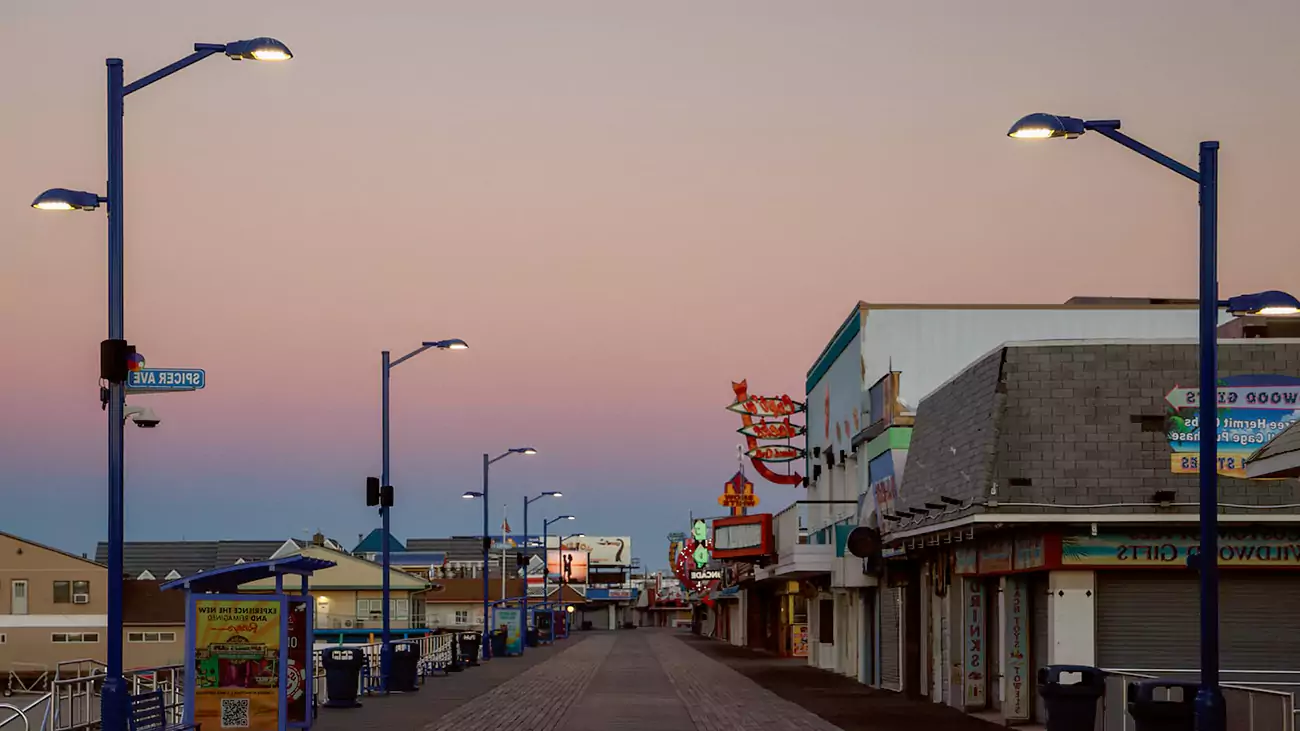
Location
New Jersey, USA
Time
2025
Architect
Acuity Brands
Application Scenarios
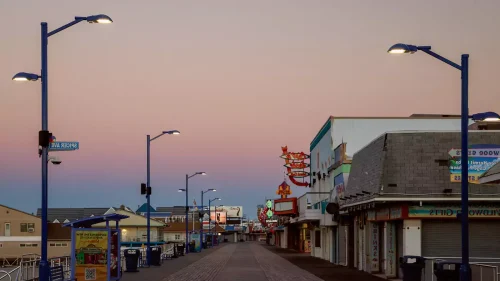
Coastal Boardwalk & High Mast Street Lighting
Product
High-Efficiency Outdoor LED Modules.
LED module solutions
High Efficiency Constant Current LED Module
Project Background:
The client primarily provides innovative intelligent lighting fixtures in North America. Wildwood Boardwalk itself is a typical seaside tourist area. It is densely populated with tourists during the day, and at night, road lighting is crucial for maintaining safety and the overall scenic atmosphere. This project was ultimately implemented in a high-mast street lighting system for the seaside tourist area. Unlike ordinary urban street lighting, the requirements for LED lighting systems in a seaside environment are much more demanding. Beyond standard brightness and energy efficiency metrics, the client is more concerned with long-term operational stability, as the high humidity, salt spray, and sustained high temperatures at the seaside significantly accelerate the aging of outdoor lighting systems.
The project area is a tourist scenic road. The client not only wants to meet basic road lighting needs but also desires a softer, more comfortable overall lighting atmosphere, rather than the harsh, high color temperature effect commonly found in traditional road lighting.
Customer Needs:
The real complexity of this project lies in the fact that the client’s needs weren’t a single metric, but rather multiple long-term operational goals coexisting.
First, there’s the reliability pressure from the coastal environment. The salt and moisture in the seaside air continuously adhere to the surface and internal structure of the lighting fixtures. If the LED lighting module materials, protective structures, or heat dissipation design are inadequate, solder joint oxidation, circuit corrosion, and localized failures are very likely to occur later.
Based on our past experience with coastal lighting projects, many outdoor lighting fixtures appear fine for the first two years, but over time, brightness differences begin to appear between different fixtures. These problems aren’t just due to LED chip failure itself, but may also be the result of long-term heat accumulation and environmental corrosion.
Therefore, the client specifically emphasized at the project’s inception:
- They wanted the LED modules to maintain consistent brightness over long-term operation;
- They wanted to reduce the frequency of later maintenance and replacements;
- They required at least a 3-year warranty.
At the same time, the project also needed to consider the lighting atmosphere of the tourist area. Compared to traditional 6000K street lighting, while 3000K warm white light is more visually comfortable, it naturally sacrifices some luminous efficacy. Therefore, the client wanted to achieve a brightness output of 10,000-15,000 lm in warm light environments while keeping the system power consumption below 150W.
This meant the project couldn’t simply rely on increasing power to solve the brightness problem; it was essential to truly improve the luminous efficiency of the lighting modules.
The client’s core objectives were as follows:
| Requirement | Target |
|---|---|
| Luminous Flux | 10,000–15,000 lm |
| Power Consumption | <150W |
| Color Temperature | 2700K–3000K |
| Protection Rating | IP65+ |
| Tc Temperature | <75°C |
| Warranty | 3 Years |
| Lighting Style | Warm & Comfortable |
Challenges and Technical Difficulties.
The real challenge of this project wasn’t achieving 10,000-15,000 lm brightness, but rather maintaining a stable brightness within that range over a long period in a coastal environment. Many outdoor lighting modules can achieve high brightness initially, but maintaining stable luminous efficiency after several years of continuous operation is the true test of module design capabilities.
At the beginning of the project, our primary focus was on thermal management. Based on the client’s power constraints and brightness requirements, we determined that the entire LED module needed to have very high luminous efficiency. However, high luminous efficiency also easily leads to another problem: concentrated hot spots.
Especially in high-mast streetlights, the fixtures typically need to operate continuously throughout the night, and summer ambient temperatures are already quite high. If the LED arrangement is not optimized, prolonged high-temperature operation in localized areas will significantly accelerate:
- Lumen depreciation.
- Color shift.
- Solder fatigue.
These problems may not be obvious in the short term, but they will gradually become apparent after a few years.
Another challenge came from the salt spray environment of the coast. Many ordinary outdoor modules pass IP testing in the laboratory, but in actual coastal environments, long-term salt spray will continuously erode the solder layers and connection structures. Based on our past project experience, in high salt spray environments, the first thing that often causes problems in LED modules is not the LED chips themselves, but rather oxidation of the PCB solder layer and increased contact resistance.
Therefore, in this project, we placed even greater emphasis on the reliability of materials and protective coatings than in typical road lighting projects.
Higntek's Solutions:
During communication with the client, based on the project assessment, we concluded that for this seaside lighting project, the real factors affecting long-term costs are not initial brightness, but rather thermal stability, corrosion resistance, and lumen consistency.
First, we redesigned the LED lighting module dimensions according to the client’s luminaire structure. The final PCB size is 225 × 152 mm, with a thickness of 2.0 mm.
Considering the long-term heat and humidity effects of the seaside environment, we ruled out the standard FR4 solution and instead chose a 2.0 W/m·K high thermal conductivity aluminum substrate. We also incorporated a Lead-Free Hot Air Solder Leveling process to improve overall corrosion resistance.
While this decision increased material costs, it better aligns with long-term reliability. Especially for seaside projects, we prefer to address stability issues early on rather than relying on frequent later maintenance.
Regarding LED layout, we used 48 5050 LEDs evenly distributed with lenses, rather than a concentrated high-density arrangement. The core purpose of doing this is to minimize local hot spots and avoid affecting light efficiency and causing light attenuation.
Regarding the LED chips, after repeated electrical design and planning based on customer needs, our engineers adopted the following:
- Cree 5050 high-efficiency LEDs;
- EMC bracket structure;
- 3000K Ra80.
A 3C16B series-parallel structure was used. The module operating voltage was controlled at 72V, and the operating current at 1040mA. The final module power was controlled at approximately 72W.
| Item | Specification |
|---|---|
| PCB Size | 225 × 152 mm |
| PCB Thickness | 2.0 mm |
| PCB Material | Aluminum PCB |
| Thermal Conductivity | 2.0 W/m·K |
| LED Type | Cree 5050 |
| LED Quantity | 48 pcs |
| CCT | 3000K |
| CRI | Ra80 |
| Module Voltage | 72V |
| Current | 1040mA |
| Power | ~72W |
Regarding the driving solution, we adopted a mainstream constant current approach and optimized the power factor and flicker performance:
| Driver Parameter | Value |
|---|---|
| Output Voltage | DC180–260V |
| Operating Current | 750–1100mA |
| Power Factor | >0.95 |
| Flicker | Flicker-Free |
| Driver Capacity | Up to 3 Modules |
In addition, we added a waterproof gasket to the lens structure and, combined with the heat sink design, ultimately controlled the module’s Tc temperature to <55°C. This is significantly lower than the customer’s requirement of 75°C, providing more safety margin for complex outdoor high-temperature environments. This ensures the long-term stability of the LED module’s lifespan.
Project Results:
After receiving our samples, the customer focused on verifying three key aspects:
- Actual brightness output;
- Temperature control;
- Long-term stability.
The final test results largely met and even exceeded the customer’s expectations.
Firstly, regarding the LED lighting module efficiency, although the LED module uses a 3000K warm white light scheme to suit the mood of tourists in the resort area, the final module still achieved a system luminous efficacy of approximately 195 lm/W, which the customer was very satisfied with. Because warm white light is generally more difficult to achieve high luminous efficacy than high color temperature schemes.
The final test results are as follows:
| Item | Result |
|---|---|
| Module Voltage | 72V |
| Current | 1040mA |
| Power | ~72W |
| Luminous Flux | ~14,000 lm |
| Efficacy | ~195 lm/W |
| Tc Temperature | <55°C |
| Lifetime | >50,000 Hours |
Besides the parameters themselves, the client was particularly impressed with our overall stability approach. Compared to some ordinary module solutions they had previously used, the new solution was significantly more stable in terms of brightness consistency, thermal performance, and corrosion resistance.
For the client, this not only means a better lighting experience but also lower maintenance frequency and more stable operating costs over the next few years.
Why Higntek?
This project was ultimately brought to fruition not just because we provided a high-efficiency LED module. More importantly, our involvement from the project’s early stages included:
- Coastal environmental risk assessment;
- Thermal management analysis;
- Material selection;
- Driver compatibility;
- Long-term reliability assessment.
For many outdoor lighting projects, the true determinant of their value is often not “how bright it is immediately after installation,” but rather its stable operation years later.
This is a crucial aspect we consistently prioritize when undertaking outdoor LED lighting module projects.
If you are developing:
- Streetlights
- Coastal lighting
- High-mast lighting
- Boardwalk lighting
- Outdoor landscape lighting
Our team of professional engineers can help you assess aspects from the early stages of the project, including thermal risk, environmental reliability, module efficiency, and long-term maintenance costs, rather than simply providing standard LED lighting modules.
Start Your Outdoor Lighting Project with Higntek
Tell us your fixture structure, environmental conditions and lighting goals — our engineering team can help you develop a more reliable LED module solution for long-term outdoor applications.
Share:
More Posts:
Post Category:

Dai Shunli
Founder & CEO
I founded the Higntek brand in 2013. Driven by technology, we provide high-efficiency LED module customization, development, and manufacturing for professional lighting applications. Leveraging over a decade of expertise in the LED lighting field, we offer one-stop OEM lighting solution manufacturing services, from theoretical design to production, including: requirements analysis, solution design, prototype development, testing and verification, and mass production. We are committed to providing customized manufacturing for the unique lighting needs of different industries, application scenarios, and customers.
Through continuous development, Higntek now has a 3,000-square-meter factory and over 200 employees, providing more than 1,500 customized LED solutions to customers worldwide. In the future, we will continue to uphold the principles of efficiency, excellence, and innovation, making the development and manufacturing of professional lighting modules simpler and more reliable.
Send Us A Message
On-Time Delivery 99.38%
Consistent production & reliable global delivery
End-to-End Engineering Support
From design optimization to production guidance
3-Day Rapid Prototyping
Fast sampling to accelerate product validation
100% Quality Inspection
Full testing ensures stable and reliable performance