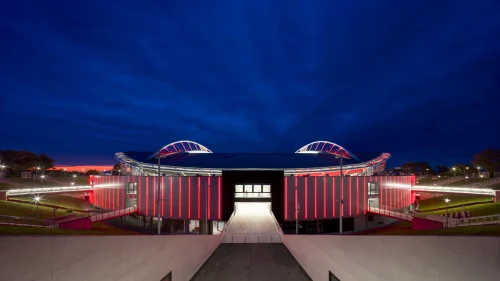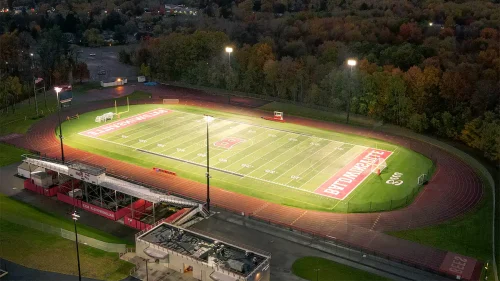
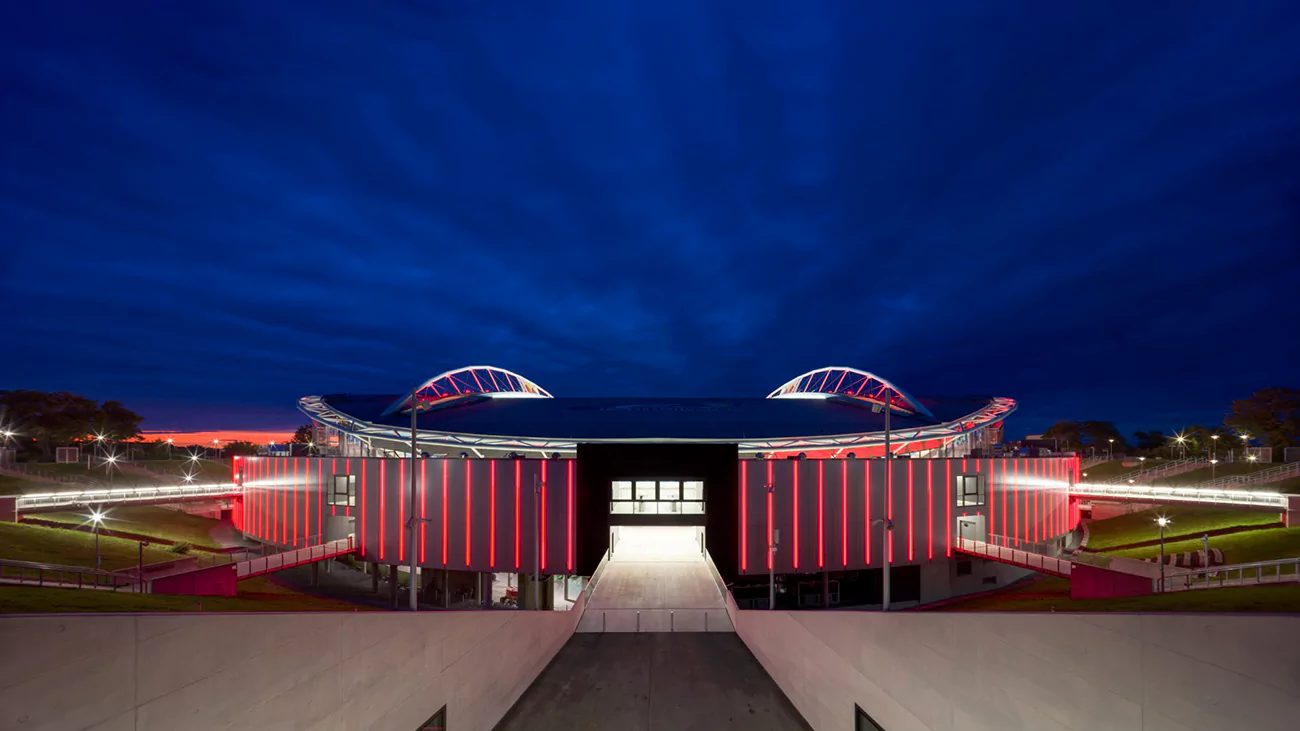
When we reviewed the project requirements with the customer team, we found that the application demanded a completely different approach from normal decorative LED lighting.
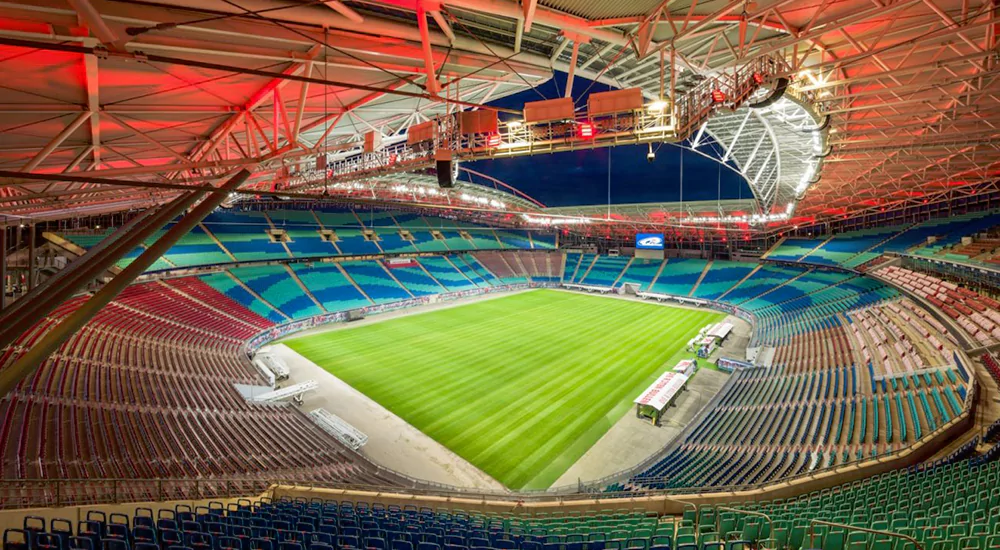
The first challenge was visual consistency over long viewing distances. For indoor applications, small variations between LED points are usually difficult to notice. However, on a stadium facade, the audience observes the entire building as one lighting surface. If the LED spacing is too large, individual light points become visible, creating a dotted appearance instead of a smooth architectural glow. Therefore, the customer required a solution that could provide:
- Dynamic RGBW color effects
- High brightness visibility from long distances
- Smooth color transitions
- Continuous and uniform light appearance
Another major concern was system stability. The stadium lighting system needed thousands of RGBW LEDs to operate simultaneously during programmed lighting shows. Any delay, flickering, or synchronization issue would become immediately visible across the facade. For large-scale DMX-controlled lighting projects, signal stability and power management are often overlooked during early design stages. However, based on our previous experience with long-distance LED applications, we knew these factors would directly determine the final lighting quality.
The customer also required the module to fit different facade installation areas. Standard LED strips could not perfectly match the curved and segmented structure of the stadium, so a customized modular design was necessary.
| Key Requirement | Engineering Objective |
|---|---|
| Dynamic lighting | RGBW color-changing effects |
| Visual quality | Smooth, continuous facade illumination |
| Control | DMX512 programmable system |
| Installation | Adapt to curved and segmented structures |
| Outdoor reliability | Stable operation throughout the year |
Engineering Challenges.
During the design phase, our engineering team identified several key risks.
The first consideration was the balance between LED density and heat dissipation. A common method for reducing costs and heat in RGB lighting is to increase LED spacing. However, for this large stadium facade lighting application, we believed this approach would negatively impact the final visual effect.
Because the lighting effect is viewed from a distance, a significant reduction in LED spacing is needed to eliminate visible light spots and create a continuous beam. But increasing LED density also increases heat concentration. This creates a typical engineering trade-off: higher LED density improves visual uniformity, but without proper thermal management, it can reduce reliability and accelerate light decay.
Therefore, we decided that thermal design must be considered from the initial LED layout, electrical design, and PCB material selection, rather than treating it as a secondary improvement.
The second challenge was long-distance power transmission. A stadium facade can require tens or even hundreds of meters of continuous lighting installation. Without proper power distribution, voltage drop can cause:
- brightness differences between beginning and end sections;
- inconsistent color output;
- unstable operation.
The third challenge was DMX512 signal management. Dynamic architectural lighting is not only about turning LEDs on and off. It requires thousands of pixels to respond accurately according to programmed lighting sequences. Any communication delay or signal attenuation could affect the overall visual performance.
Based on these considerations, we developed the module architecture around three priorities:
- Optical uniformity
- Stable electrical performance
- Long-term outdoor reliability
We did not modify our existing standard LED strips, but instead developed a custom outdoor RGBW linear LED module structure specifically for the client’s current requirements. At the initial design stage, we analyzed the stadium’s viewing distance, facade structure, and expected lighting effects. Our conclusion was that high-density LED lighting modules were more suitable than traditional low-density strip solutions. I engineered and manufactured the module from the following four perspectives:
Custom Linear Module Structure.
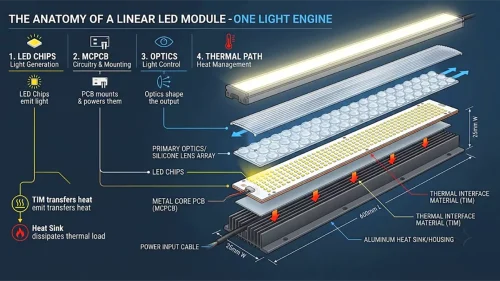
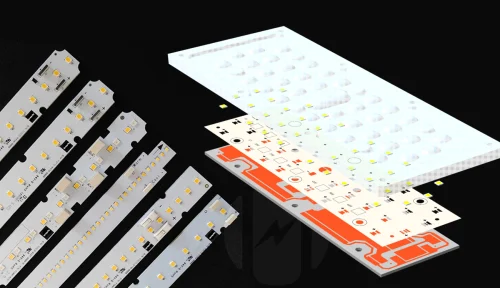
To balance flexibility and thermal reliability, we designed the module using an aluminum-based PCB combined with flexible PI material. This structure offers two key advantages: the aluminum PCB improves heat dissipation during long-term operation; and the flexible PI structure better adapts to curved facade installation areas. The final module structure is as follows:
| Parameter | Specification |
|---|---|
| Input Voltage | DC24V |
| PCB Structure | Aluminum PCB + Flexible PI |
| Thermal Conductivity | 2.0 W/m·K |
| Module Width | 35mm |
| Module Length Options | 300mm / 1200mm |
| Maximum Combined Length | 10.8m |
High-Density RGBW Optical Design.
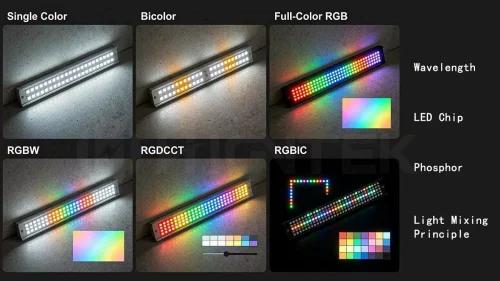
Because this building facade required maintaining visibility and smooth color blending at long distances, our engineering team selected 5050 RGBW (4000K) LED packages.
| Item | Specification |
|---|---|
| LED Package | 5050 RGBW |
| Color Channels | Red + Green + Blue + 4000K White |
| LED Quantity | 96 LEDs |
| Control Segment | 6 LEDs per segment |
Compared with standard RGB solutions, the higher LED density significantly reduced visible pixel effects when viewed from a distance.
Integrated DMX512 Control Design.
For a large-scale architectural lighting project, independent control capability is essential. We designed each 6-LED segment with an integrated DMX512 decoding IC. This allowed the system to achieve:
- precise color control;
- synchronized lighting effects;
- programmable lighting sequences.
Additional electronic components, including capacitors and resistors, were added to balance voltage and power distribution across the module. This design helped improve stability during continuous operation.
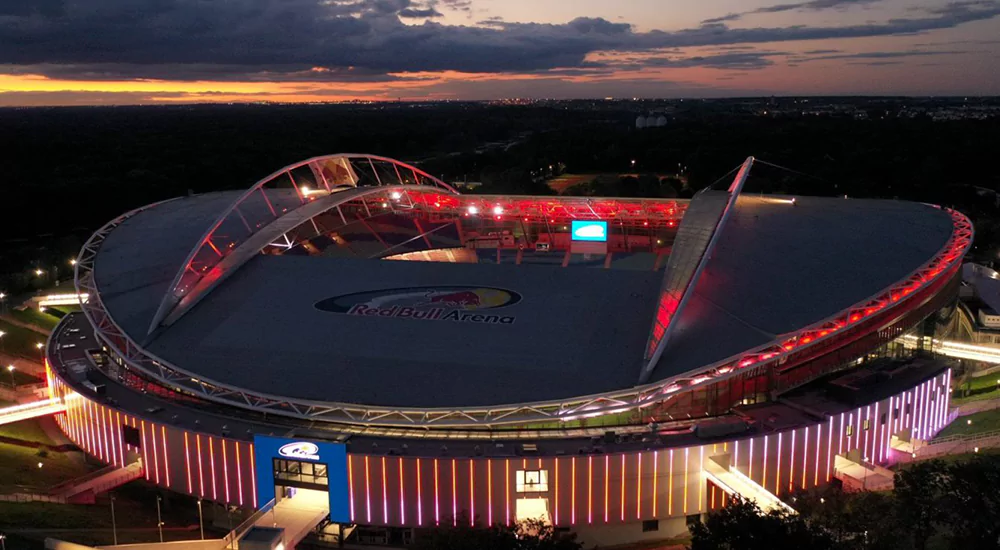
Outdoor Protection & Long-Distance Operation.
Since the modules were installed outdoors and required year-round operation, we applied a silicone coating process. Compared with traditional plastic sleeve protection, the encapsulated structure provided:
- better waterproof protection;
- improved heat dissipation;
- stronger environmental resistance.
For system deployment, each 20-meter lighting section was matched with a constant voltage power supply. The DMX512 control system supported up to 160 meters per controller. For longer communication distances, optical fiber transmitters and receivers were used to maintain stable signal transmission.
This allowed the stadium lighting partner, Signify, to program and coordinate complex lighting effects through computer-based control or standalone operation.