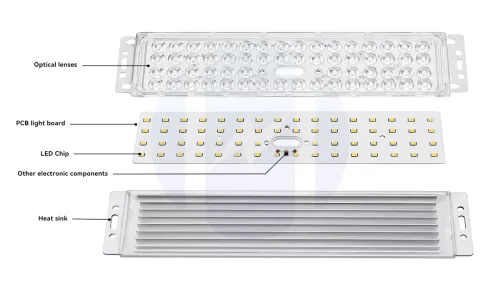
DOB technology is often described simply as placing the LED driver and LEDs on the same board, but that definition does not tell us much about how a DOB LED actually works. Two DOB modules may look similar from the outside while using very different driver architectures inside.
The clearest way to understand DOB technology is to separate two technical questions. One is whether the DOB LED circuit is isolated or non-isolated. The other is whether the DOB LED driver regulates current through a linear or switching method. These are different classification dimensions, which is why a linear DOB is not automatically the same as a non-isolated DOB, and a switching DOB is not automatically isolated.
This distinction becomes important when we start matching a DOB LED module to a real lighting application. Board space, power level, thermal conditions, dimming requirements, safety targets and cost can all point toward a different architecture. Smart DOB adds another layer by integrating functions such as dimming, sensor control and IoT communication on top of the underlying driver design. At Higntek, we look at DOB design from this system-level perspective because the driver, LED array, PCB layout and thermal path all affect the final module together.
What Are the Different Types of DOB Technology?
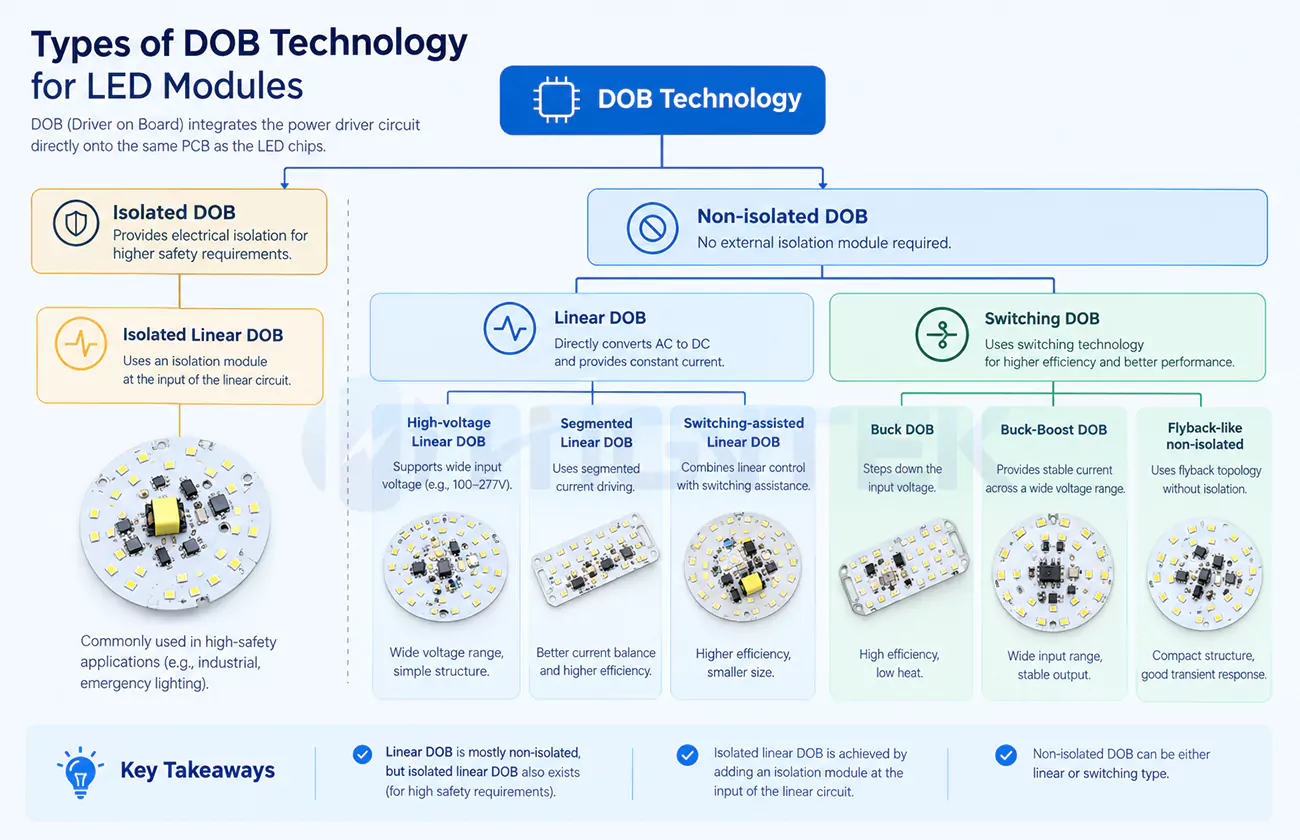
DOB technology falls into two different classification dimensions. Isolated and non-isolated DOB describe electrical isolation, while the Linear and Switching DOB describe how the LED current is regulated. Keeping those two questions separate prevents one of the most common mistakes in DOB LED discussions: treating Linear DOB as another name for Non-isolated DOB.
In practice, most compact AC DOB LED modules do use non-isolated linear circuits, which is why the terms often appear together. But they are not interchangeable. A DOB LED can be non-isolated and switching, while an isolated design can also use linear or switching regulation. Industry LED-driver guidance likewise separates the linear and switching power architectures according to efficiency, cost, dimming, power factor, flicker, EMI and isolation requirements.
Non-Isolated DOB.
Non-isolated DOB removes the galvanic isolation stage, which keeps the module compact and reduces circuit complexity. The point worth remembering is that non-isolated describes safety architecture, not driver topology. A non-isolated DOB may be linear, but it may also use switching conversion. Official AC LED-driver designs, for example, demonstrate non-isolated buck circuits rather than linear regulation, so the two terms should never be treated as synonyms.
This architecture makes sense when the luminaire itself prevents access to hazardous live parts and the project places strong pressure on board area, component count or assembly cost. That is why non-isolated DOB frequently appears in enclosed lamps, ceiling lights and other integrated fixtures.
Its main constraint is electrical safety. Without galvanic isolation, creepage, clearance, insulation materials, PCB layout and mechanical protection have to work together. A low BOM count does not remove those requirements; it shifts more responsibility onto the complete luminaire design.
Isolated DOB.
Isolated DOB adds electrical separation between the mains input and the LED-side circuit. That extra barrier becomes useful when the product architecture calls for stronger separation from hazardous voltage, especially where accessible conductive parts or the intended installation make non-isolated construction less attractive. Isolation can sit ahead of either a switching or, less commonly, a linear current-regulation stage.
The added safety architecture is not free. Isolation normally introduces additional components, PCB area and power-conversion loss. For that reason, we would not choose Isolated DOB simply because it sounds more robust. It earns its place when the safety requirement justifies the extra circuit. And the isolated Linear DOB does exist, but it is much less common than the familiar non-isolated linear approach.
What Is the Difference Between Isolated and Non-Isolated DOB?
Isolated DOB has a galvanic isolation barrier between the AC mains and the LED-side circuit, while Non-isolated DOB does not. For a DOB LED module, that difference affects where electrical protection is created, how the PCB is laid out, how much board space the driver needs and what the finished luminaire must do to keep users away from hazardous voltage.
A quick “isolated is safer, non-isolated is cheaper” comparison misses too much. A properly protected Non-isolated DOB can be an appropriate engineering choice for an enclosed luminaire, while an isolated output should not automatically be assumed safe to touch. The real difference is structural.
Is a Linear DOB LED the Same as a Non-Isolated DOB LED?
No. Linear DOB and Non-isolated DOB are not the same classification. Linear DOB describes how LED current is regulated, while Non-isolated DOB describes whether galvanic isolation exists between the mains input and the LED-side circuit.
Can a DOB Module Be Both Linear and Isolated?
Yes. A DOB module can combine galvanic isolation with linear LED current regulation.
An isolated power stage first creates a separated DC supply, and a linear constant-current stage then regulates the LEDs. This architecture is less common because the linear stage still dissipates excess voltage as heat, so isolated switching solutions are often more practical as power or voltage range increases.
Which DOB Architecture Fits Your LED Module?
Not sure whether your project needs an isolated or non-isolated design, or a linear or switching topology? Share your basic electrical requirements with us and discuss the options with an engineer.