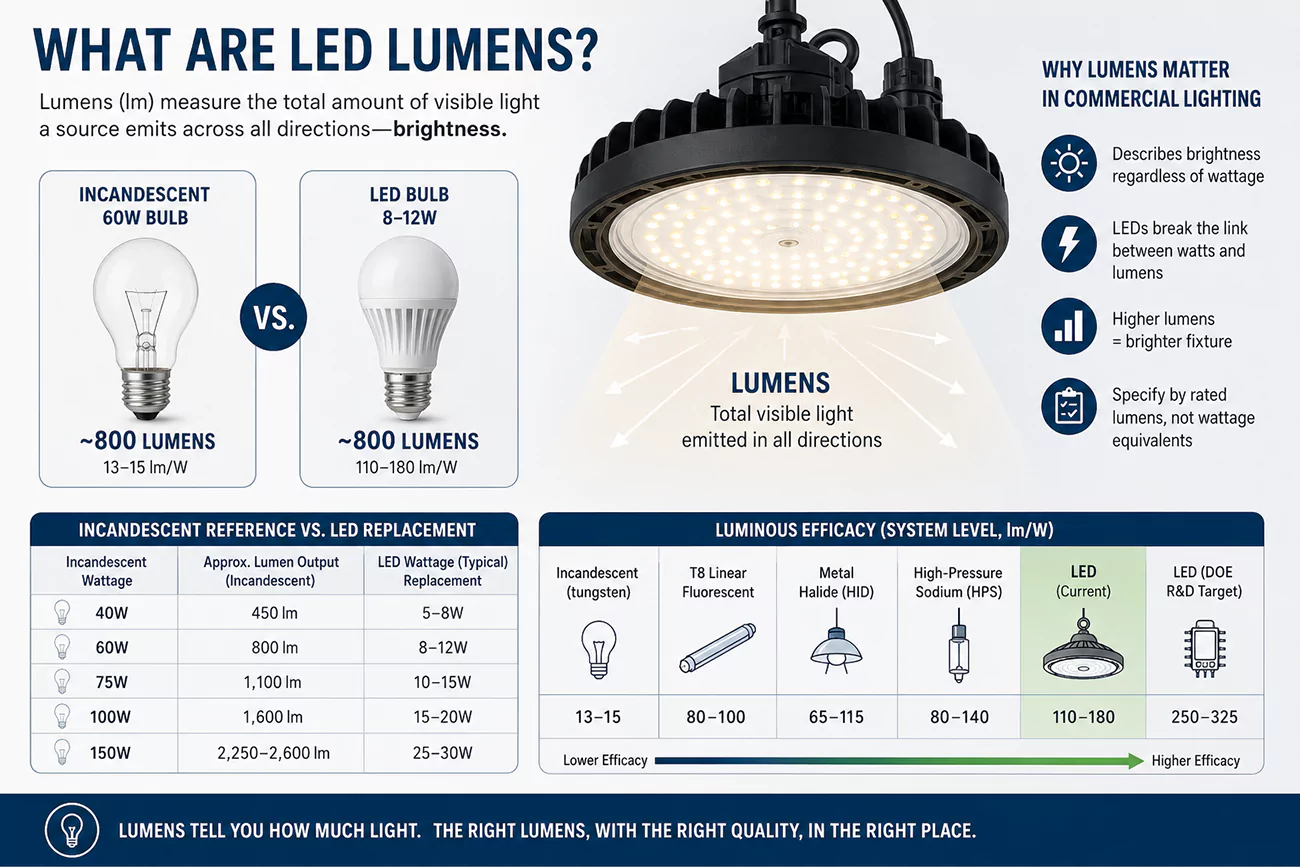
A lumen (lm) is the unit of luminous flux. In plain terms, lumens measure the brightness of a source: the total amount of visible light it emits across all directions, weighted against the human eye’s spectral response. In commercial procurement, lumens describe the light a fixture delivers, while watts describe the electricity it consumes.
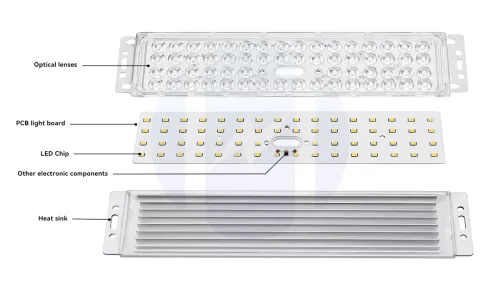
Under incandescent technology the two tracked each other because the physics was locked. A tungsten filament at roughly 2800K produced 13 to 15 lm/W, with the rest lost as infrared heat, which is why incandescent light bulbs were sold by wattage and a “60W bulb” became shorthand for “around 800 lumens” in legacy specifications. LED technology breaks that link. The lumens per watt LED fixtures deliver now depends on chip binning, driver topology, optical assembly, and housing thermal performance, and varies substantially between products that look identical on a procurement form. Two 40W LED panels from different manufacturers, tested in the same integrating sphere, can read close to 3,800 lm and under 2,900 lm respectively. The lumens of an LED light are now independent of its input power. The higher the lumen value, the brighter the light, and the higher the luminous efficacy, the higher the lumen value at the same wattage. LED lamp lumens should therefore be specified by rated output, not by wattage equivalence.
The LED lumens chart below maps the legacy incandescent reference most buyers still carry mentally against the LED wattage that actually replaces it. An LED light lumens chart like this is a planning anchor, not a substitute for the photometric file.
| Incandescent Wattage | Approximate Lumen Output | LED Wattage (2024 typical) |
|---|---|---|
| 40W | 450 lm | 5–8W |
| 60W | 800 lm | 8–12W |
| 75W | 1,100 lm | 10–15W |
| 100W | 1,600 lm | 15–20W |
| 150W | 2,250–2,600 lm | 25–30W |
For commercial specification, the more useful comparison is luminous efficacy: the lumens per watt an LED source actually delivers across source families, since most retrofits replace an entire technology category rather than a single fixture.
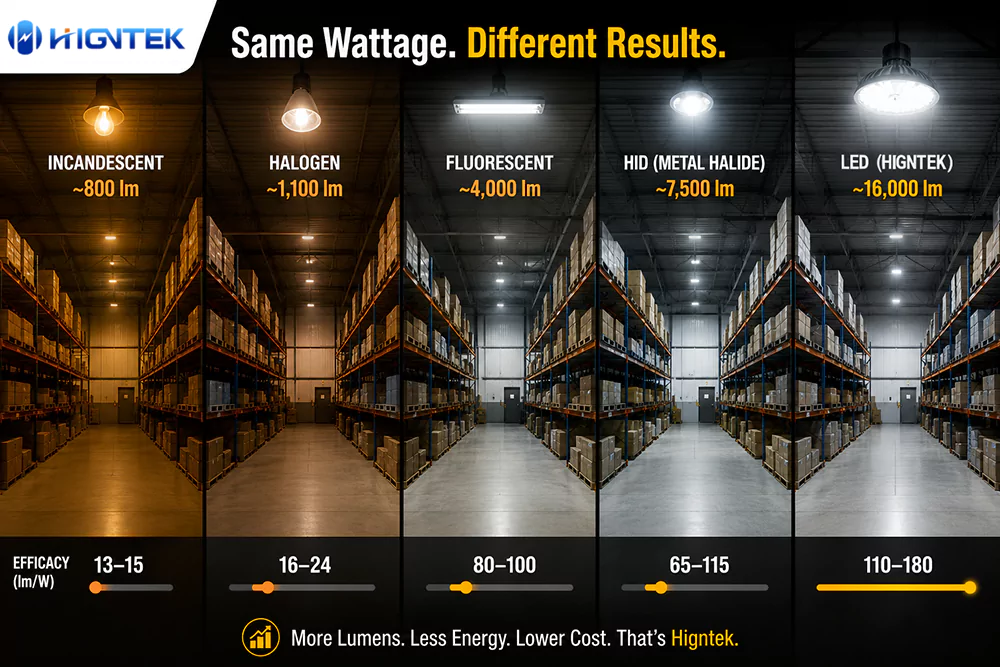
| Source | Typical Efficacy (lm/W) | Notes |
|---|---|---|
| Incandescent (tungsten) | 13–15 | Phased out under most commercial codes |
| Halogen | 16–24 | Roughly 90% heat |
| T8 linear fluorescent | 80–100 | System efficacy after ballast losses |
| T5HO fluorescent | 90–105 | Common in high-bay pre-LED |
| Compact fluorescent (CFL) | 50–75 | Mercury content, ballast failures |
| Metal halide (HID) | 65–115 | Severe lumen depreciation, long restrike |
| High-pressure sodium | 80–140 | Monochromatic, useless for color tasks |
| LED (2026 current commercial fixtures) | 130–200 | System efficacy, not chip |
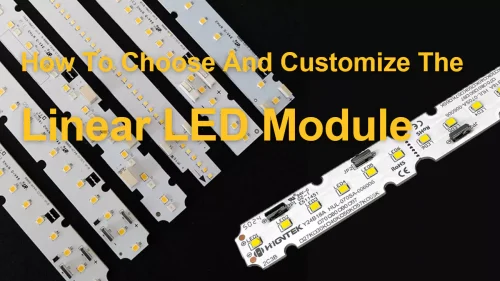
The theoretical maximum at 555 nm, the peak of human photopic sensitivity, is 683 lm/W. No white-light fixture approaches it, because a usable spectrum must include red wavelengths the eye perceives less efficiently. Higntek’s current top-of-the-line modern LED lighting modules boast luminous efficacy ranging from 180 to 265 lm/W. The same physical principle explains why a luminaire with a nominal luminous efficacy of 180 lm/W and a color rendering index (CRI) of 70 cannot be directly compared to one with a nominal luminous efficacy of 130 lm/W and a CRI of 90: there is a natural trade-off between luminous efficacy and CRI; deliberately increasing luminous efficacy → lowering the CRI.
Distribution warehouses can use luminaires with a luminous efficacy of 180 lm/W; while showrooms and food processing plants require luminaires with a luminous efficacy of 130 lm/W and a CRI (CRI > 90). One further spec-sheet trap is total lumens versus useful lumens. Total lumens is the integrated output across all directions under LM-79 photometry. Useful lumens, defined under the EU Ecodesign Directive, counts only light within a 90-degree forward cone. For downlights, trough lights, high bay lights, and panel lights, illuminance calculations should use the actual lumen count provided by the LED in the photometric file, rather than the lumen count of the bare LED package. This is because the difference between the two is 20% to 40% due to thermal management and optical and electrical design considerations.
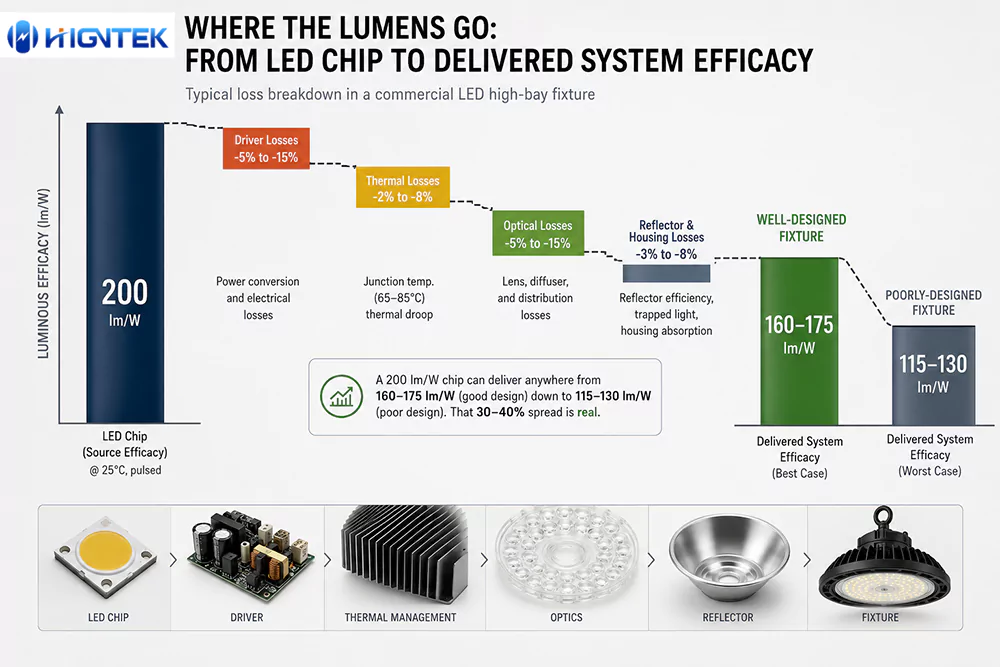
Luminous efficacy connects optical performance to the utility bill, and it gets gamed harder than almost any other spec. Two numbers float around. Light source efficiency is measured on an LED package on a 25°C thermal test bench, typically using rated voltage and current measurements. This is also the source of high luminous efficacy data such as 270+ lm/W for LED chips. That number describes the chip in a lab, not in a fixture. System efficacy, also called luminaire efficacy, is what leaves the housing after the full chain of losses.
In our bench measurements, driver losses pull off 5 to 15% depending on topology and load point, thermal droop comes in at 2 to 8% at a real 65 to 85°C junction, and optical losses through lens and diffuser run 5 to 15% depending on beam angle and haze level. Reflector geometry and trapped light inside the housing eat more. By the time photons leave the aperture, a 200 lm/W chip ships 160 to 175 lm/W from a well-designed fixture, and 115 to 130 lm/W from a poor one. That 30 to 40% spread between two fixtures carrying the same headline number is the entire reason efficacy belongs in the spec rather than the marketing copy, and it is why the high efficiency LED modules we specify are quoted at delivered LED lighting modules efficacy, not chip-level figures.
A representative case: a 280,000 sq ft cold-storage and dry warehouse, 312 fixtures of 400W metal halide, connected load over 130 kW. Retrofit to 150W LED high-bays at roughly 155 lm/W brought load down to about 47 kW, with annual savings north of $140,000. The utility rebate, keyed to DLC Premium listing, came to about $62 per fixture, roughly $19,000 off the project. Payback landed under 18 months before the cold-storage HVAC offset, which the facilities team put at another $11,000 to $14,000 a year.
The DesignLights Consortium (DLC), whose Qualified Products List most US utility rebate programs are keyed to, maintains two tiers. Per its technical requirements, DLC Premium products must meet higher efficacy and lumen maintenance requirements than DLC Standard products, currently around 150 lm/W minimum plus L70 of at least 50,000 hours for high-bay categories. Miss the tier and the rebate disappears, leaving a $200,000 retrofit to absorb $60,000 to $80,000 of incentive money baked into the proposal. California’s Title 24 Section 140.6 adds lighting power density caps on top: office 0.65, retail 0.84, warehouse 0.48 W/sq ft. Anything under about 130 lm/W system efficacy fails the load calculation before the plans go out for stamp.
These four terms get used interchangeably on purchase orders, and the confusion costs real money on commercial retrofits. Brightness is the subjective visual perception of light, whereas lumens are the objective, scientific measurement of the total amount of visible light emitted by a source. The other two metrics describe entirely different properties: CCT is the tone of the light, and CRI is the accuracy of the colors it reveals. A spec that pins down lumens but leaves CCT and CRI to the supplier’s default is a spec that will be argued about after installation.
Luminous efficacy.
Luminous efficacy is the number of lumens emitted by an LED per watt of energy consumed. It is also a measure of electricity bill consumption. It says nothing about what the light looks like or how things look under it.
Color temperature.
CCT, correlated color temperature, is measured in Kelvin and describes whether the light reads warm or cool. The industry bands are stable across manufacturers, and for commercial application the mapping is functional rather than aesthetic:
| CCT range | Appearance | Typical commercial application |
|---|---|---|
| 2700–3000K | Warm white | Hospitality, premium residential, fine dining |
| 3000–3500K | Warm-neutral | Retail, apparel, food display |
| 3500–4000K | Neutral white | Offices, conference rooms, classrooms |
| 4000–4500K | Cool-neutral | Healthcare, specialty retail |
| 5000–6500K | Cool white / daylight | Warehouses, parking, industrial floors |
The warm end is the residential and hospitality default, which is worth knowing because it is the reference point most clients arrive with before a commercial project pulls them cooler. A frequent and expensive myth is that a higher CCT means a brighter light. It does not. Brightness is the number of lumens emitted, and it is fully independent of CCT and CRI. A 5000K fixture with low lumen output is dim, and a 3000K fixture with high output is intense.
Color Rendering Index.
CRI, the color rendering index, is a 0 to 100 score for how accurately a source reveals true colors against a reference. The practical bands: 70+ is the minimum acceptable base, 80+ is good and is the floor for most general commercial work, 90+ is excellent and required where color decisions are made, and 95+ closely tracks natural daylight.
The number that gets missed is R9, a CRI sub-score for deep red rendering. Standard CRI (Ra) can post a respectable number while R9 is poor, which is why food looks grey under a fixture that claims CRI 85, and why printed proofs, paint chips, and apparel colors get rejected under nominally compliant lighting. For any space where color is a decision and not a backdrop, R9 has to be called out separately on the spec, because the headline Ra figure hides it.
There is a trade-off between Color Rendering Index (CRI) and luminous efficacy. Higher luminous efficacy usually comes at the cost of a lower CRI/Ra; conversely, a higher CRI requires a reduction in luminous efficacy. To increase lumens per watt, high-efficiency LED lighting module designs utilize wavelengths most sensitive to the human eye (green-yellow band), which narrows the spectral range and naturally results in a lower CRI. Achieving a CRI of 95 or higher requires a more complex phosphor system to convert blue light into a broader spectrum including deep red, but this conversion reduces efficiency. A luminaire with a nominal luminous efficacy of 170 lm/W and a color rendering index (CRI) of 70 is not a superior or inferior version of the same product, while a luminaire with a nominal luminous efficacy of 130 lm/W and a CRI of 95 is not. They are two different engineering solutions for different lighting needs, and the specifications must clearly state the problem being solved.

The recommended commercial CRI and CCT pairings are tighter than most procurement teams realize:
Space type | CRI | CCT |
General offices | 80–90 | 3500–4000K |
Fashion and apparel retail | 90+ | 3000–3500K |
Galleries and high-value display | 95+ | 3000–3500K |
Premium hospitality and high-end residential | 90+ | 2700–3000K |
Warehouses and industrial floors | 80 | 5000–6500K |
Specifying 95+ CRI on a bulk storage warehouse wastes efficacy and money; accepting 80 CRI on a paint-matching line generates returns and rework.