Linear LED Module Components, Applications, Efficiency and Performance Factors.

Linear LED Module Components, Applications, Efficiency and Performance Factors

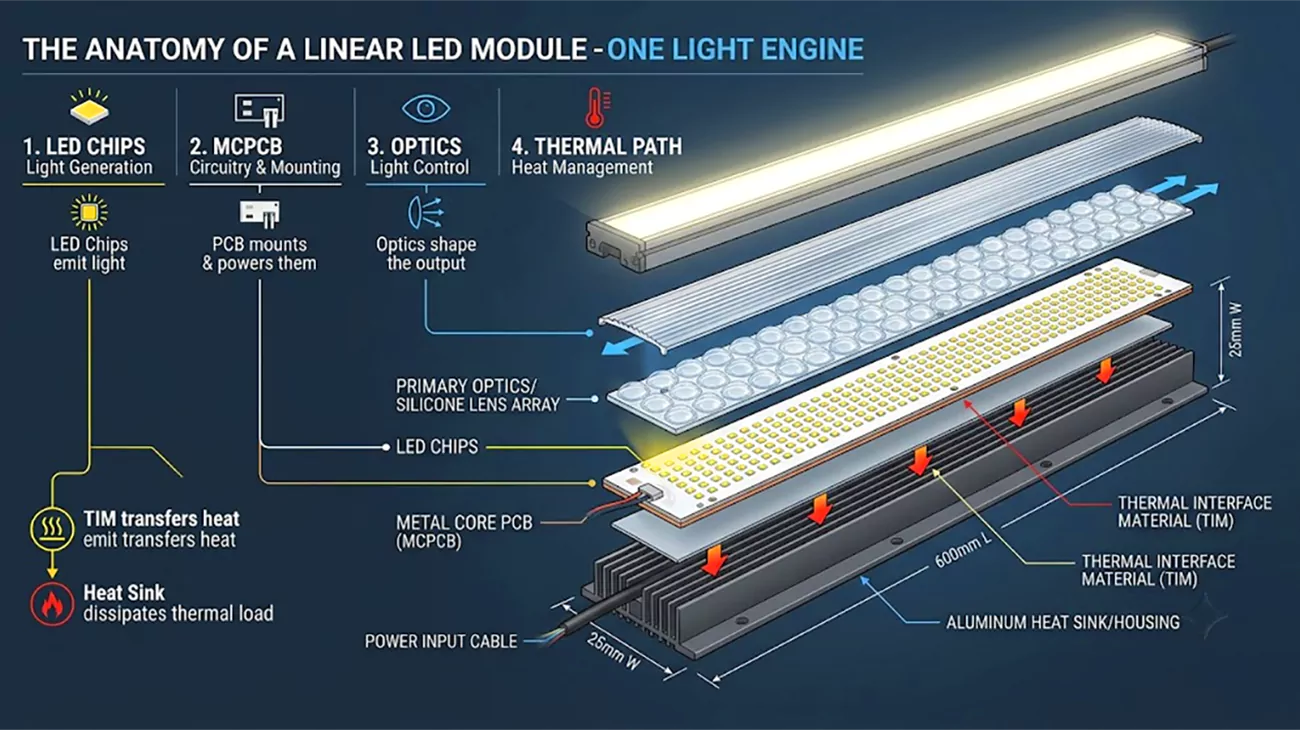
A linear LED module looks deceptively simple — a row of LEDs on a circuit board — but that board is only the substrate; the module itself is the complete light engine, and six layers of engineering decide whether it performs across a wide range of lighting applications: what sets it apart from older lighting and which standards govern it ; the components it is built from; the luminaire types it has to fit; how it is driven and dimmed; the factors that set its real efficiency; and the specs buyers use to compare one against another.
Treating it as a bag of parts is where most lighting problems start — uneven color across a run, output that fades early, a board that will not seat in the fixture. The short answer up front: a linear LED module is a standardized, driver-fed unit whose real performance depends on how its chip, PCB, optics, driver, and thermal design are matched to the job.

What is a Linear LED Module?

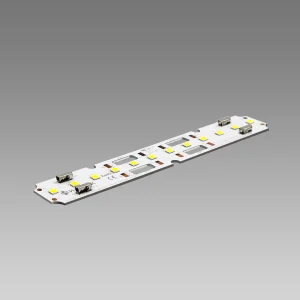
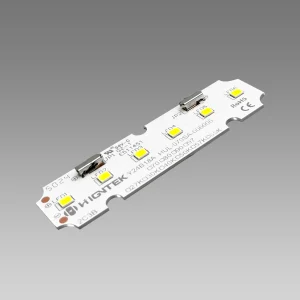
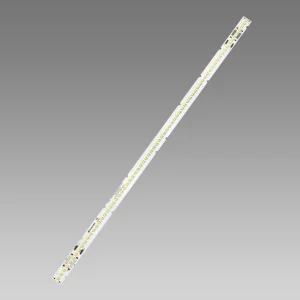
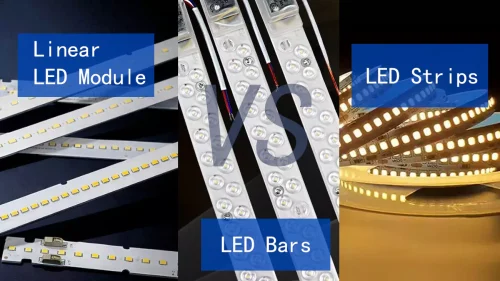
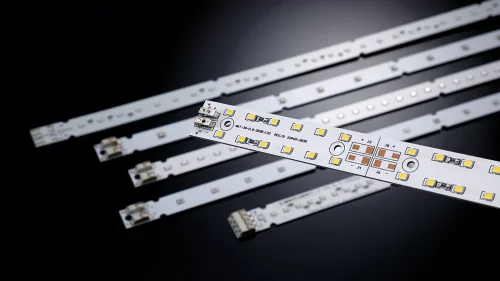
A linear LED module is a rigid, pre-assembled circuit board with a row of LED chips, optical lenses, and connectors. It serves as the core light source in linear luminaires and architectural lighting installations, driven by an independent LED driver. It replaces the fluorescent tubes used in traditional linear luminaires, converting electrical energy into continuous, uniform light with higher efficiency and a longer lifespan. A similar flexible LED strip is a flexible tape that uses constant voltage power and is fixed with adhesive. The module, however, is rigid, designed for precise mechanical installation, and uses constant current drive in most professional luminaires. This rigidity is crucial because it ensures the LEDs are aligned in a straight and repeatable line and maintains strong thermal contact with the heatsink on the back of the circuit board. The differences between flexible LED strips and linear LED modules can be explored in detail in another blog post.

Linear lighting did not start with LEDs. Offices, retail floors, and warehouses ran for decades on fluorescent tubes, first T12 and later the more efficient T8. As LED chips caught up on output and price, the first wave of replacements were retrofit LED tubes that dropped into existing fittings. They worked, but a one-for-one swap often changed the light quality of the space, and the early market was crowded with uneven products. The industry moved on to purpose-built linear LED modules engineered for the fixture rather than the old tube socket, and that shift is what made modern modular linear led lighting possible — standardized boards that any qualified luminaire maker can design around.

Comparison of Linear LED Modules with Traditional Lighting.

Against a fluorescent tube, a linear LED module wins on the numbers that matter to a building owner. An LED board replacing a 32W fluorescent typically draws 15–18W for the same useful light, contains no mercury, and tolerates cold starts that leave fluorescents flickering. Because LEDs are directional, the light lands where it is aimed instead of scattering in every direction, so a module can deliver the required foot-candles with fewer fixtures. The trade-offs are an upfront cost and a market full of uneven options — which is exactly why standards and a credible supplier matter.

FeatureLinear LED moduleFluorescent tubeHalogen lamp
Efficacy130–265 lm/W60–100 lm/W16–24 lm/W
Lifespan50,000+ hours10,000–15,000 hours2,000–4,000 hours
ReplaceabilityField-replaceable moduleTube replacementBulb replacement
Dimming range0.1–100% (protocol-dependent)10–100% (ballast-dependent)1–100% (smooth)
CustomizationHigh (OEM/ODM)LimitedMinimal
Hazardous materialsNoneMercuryNone (high heat)

Set against these traditional sources, the linear LED module’s edge goes beyond raw efficacy. A fluorescent tube carries mercury and dims only to about 10 percent; a halogen lamp wastes most of its energy as heat and burns out within a few thousand hours. The module replaces both with a mercury-free, high-efficacy light source that dims smoothly across a wide range and, because the module itself is field-replaceable, keeps a building’s lighting current over its life instead of forcing a full re-lamp.

This is where serious linear led modules separate from generic ones. 

  • On the interface side, the Zhaga Consortium publishes the relevant rulebooks: Book 7 defines a family of linear and square modules and has been adopted as IEC standard 63356-2, while the newer Book 26 and Book 21 cover socketable linear modules so a certified board can be swapped or upgraded years later without compatibility worries. 
  • Digital dimming follows IEC 62386, the standard behind DALI control. 
  • On the manufacturing side, the credentials sit with the maker: ISO 9001 for quality management, ISO 13485 for medical-grade process discipline, and ISO 14001 for environmental management, alongside product marks such as UL, RoHS, and REACH. 
  • Long-term light output is verified through LM-80/TM-21 lumen-maintenance testing.

A linear LED module, then, is less a “bulb” and more a standardized light engine — a rigid LED board built to a known interface and backed by testable certifications. That combination of repeatable form factor and verified compliance is what lets lighting designers specify it with confidence. Higntek builds its HUL, HUB, HUS, and HUO lines to exactly this logic, with an ISO-certified process and Tier-1 chips behind every board.

What are the Main Components of a Linear LED Module?

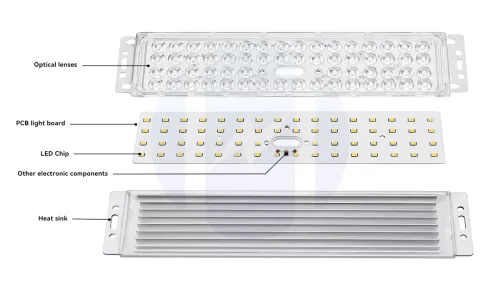
A linear LED module is built from six core parts: the LED chips that make the light, the PCB that carries and cools them, a driver that feeds them stable power, connectors that link the boards and the supply, optics that shape the beam, and the structural and thermal hardware that holds it all together. Each part decides a different slice of how the finished light performs, so the module is best read as one engineered system rather than a loose collection of parts.
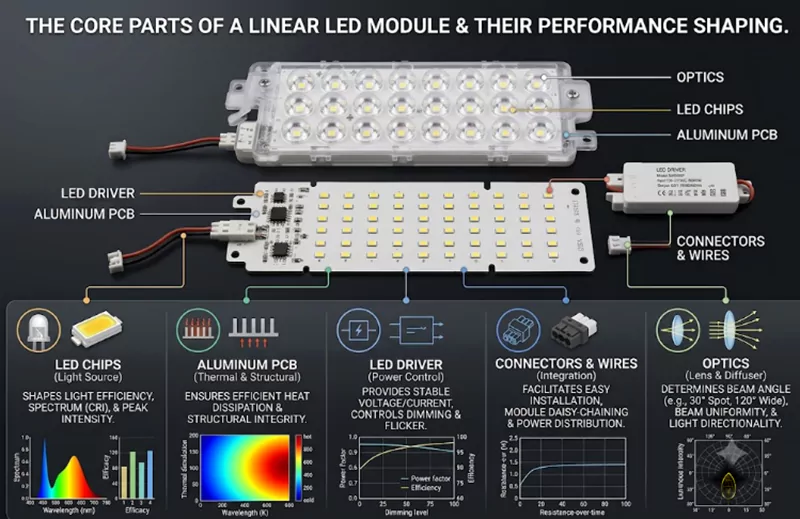
main components of a linear LED module

LED Chip.

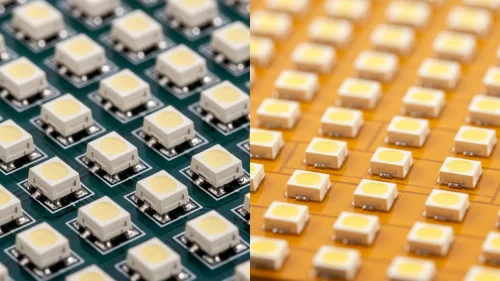
The LED chip is the light source of a linear LED module and the single biggest lever on its quality. Get the chip right and brightness, efficiency, and color all start from a solid base; get it wrong and no optics or thermal design can fully recover the result.
The model and brand of the chip matter most. Together they set the module’s brightness, luminous efficacy, color temperature, color rendering index (CRI), and rated lifespan — which is why two modules that look identical on a drawing can perform very differently once the chip is named. Higntek sources to each customer’s spec from the major international brands — Lumileds, Nichia, Cree, Samsung, Osram, Bridgelux, and Seoul — whose tight tolerances keep brightness and color stable from batch to batch. We also develops its own high-efficacy LEDs, built with a near-zero thermal-resistance package for cooler junctions and a silver-free, anti-sulfuration construction that resists the blackening which dims and shortens the life of ordinary chips in humid or corrosive air.
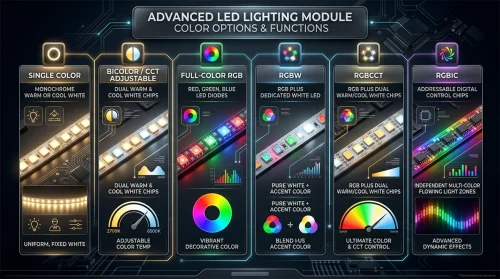
The LED chip determines the final effect. Larger chips can carry more current, and the volume of the light-emitting area also increases, directly increasing the maximum luminous flux that can be emitted. Forward voltage and drive current determine the series connection of the chips; the chip model determines the available colors and dimming options—depending on application requirements, different chips can be used for single-channel white light, adjustable white light, or multi-channel control, such as three-channel RGB.

PackageTypeTypical use
SMD 2835Mid-powerHigh-efficacy linear runs, general and office lighting
SMD 3030Higher-powerHigh-flux output, high-bay and industrial fixtures
SMD 3535High-powerOutdoor, floodlight and spotlight fixtures at high drive currents
SMD 5050High-power, high-efficacyHigntek’s flagship efficacy chip; also 3-in-1 RGB color
SMD 2020Compact mid-powerTight pitch, slim profiles, signage
COBChip-on-boardDense, spot-free uniform output

Higntek’s high-efficacy positioning centers on the 5050. At the top of the series, the chip reaches up to 280 lm/W under ideal drive conditions, about 265 lm/W once built into a module, and roughly 225lm/W in the finished fixture — well above the typical linear-module range.

PCB Substrate.

The PCB carries current to the LEDs and moves heat away from them, and 2 separate things decide how well it does that: the substrate material, and the fabrication process.

  • Material comes first — what the board is actually made of. FR-4, a glass-fiber epoxy laminate, is the lowest-cost option used in LED lighting modules, but it conducts heat poorly and behaves more like an insulator, so it suits low-power decorative or backlight work rather than bright commercial runs. An aluminum (metal-core) substrate stacks a copper circuit layer, a thermal dielectric, and an aluminum base, so it doubles as a heat spreader and pulls heat straight off the LED junction — the mainstream choice for commercial led linear module designs. A copper base conducts heat roughly twice as well as aluminum, which earns it a place in high-power or high-density designs where the thermal load justifies the higher cost.
    MaterialThermal conductivityMax module powerRelative costTypical application
    FR-40.3–0.4 W/m·K≤6W / LowestLowestLow-power decorative, indicator modules
    Aluminum (MCPCB)1.0–3.0 W/m·K6–50WMediumStandard commercial linear modules
    Copper3.0–8.0 W/m·K50W+HighUltra-high-power, high-bay, thermal-critical OEM
  • Process is a separate axis — how the board is fabricated — and it shapes performance as much as the material. Every board, whatever its base material, carries a copper circuit layer for the current, and the weight of that layer is a process choice: standard strips often use 0.5oz (18μm) copper, while professional modules run 1–2oz (35–70μm), which lowers resistance, reduces self-heating, and carries higher current over a long run. Trace width and spacing serve the same purpose: reducing voltage drop and maintaining end-to-end uniformity. Adding thermal vias further improves heat transfer from the LED pads to the metal core or the back of the circuit board. Circuit board thickness and thermal conductivity determine rigidity and heat dissipation efficiency. Surface treatments (solder resist color for increased reflectivity and conformal coating for moisture protection) protect the circuit board and affect light output and field reliability.

From the moment a customer’s lighting-module requirements come in, Higntek selects the material — FR-4, aluminum, or copper — to the project’s lighting and electrical needs, then tunes the on-board process — trace width and spacing, copper weight, board thickness, and coating — for the best heat dissipation behind stable, long-life lighting.

LED driver.

A linear LED module can be powered three ways — constant-current drive, constant-voltage drive, or a driver built onto the board (DOB). Most professional modules use a constant-current driver, which holds output steady against small voltage swings and keeps brightness even down a long run. A DOB design instead integrates the power stage on the board as an AC linear LED module, dropping the external driver for a simpler, lower-cost install. Because drive method and dimming shape so much of how a module behaves, they get their own section below.

Connectors.

Connectors do two jobs — feed power into the module and link board to board — and a few types cover most needs: plug-in push terminals, solder joints, and power terminals, each trading assembly speed against permanence. End-to-end connectors let modules butt together into a seamless line with no dark gaps, and reputable terminal brands such as WAGO, Molex, and JST keep the contact reliable over years of service. Boards built to Zhaga interfaces use defined contact pads instead of soldered leads, so a certified module can be swapped or upgraded later without rewiring.

Optical Components.

Two optical parts shape the light once it leaves the chip: the lens and the diffuser. A lens controls the beam angle — narrow for accent work and wall-washing(10/15/30/60°), wide (up to around 160°) to cover more area without hotspots — while a diffuser spreads the output for soft, even illumination and lower glare. Good optical design is what lets a module hold a low UGR for offices and schools, and it is often the difference between a clean line of light and a row of visible hotspots.

Structural and Thermal Parts.

The remaining hardware is structural and thermal: heat sinks or aluminum profiles, a thermal interface material, wires, and a housing — included or left off depending on whether the module ships bare or as a finished light engine. A heat sink carries away heat the PCB cannot shed on its own, and a thermal interface material — adhesive, pad, or grease — bridges the PCB to that heat sink so the joint is not air-gapped. Wires connect the module to its driver, and fitting that assembly into the structural housing completes the finished luminaire.

What driver and control options do linear LED modules support?

Current linear LED modules support three power supply methods—constant current drive, constant voltage drive, and onboard drive (DOB)—and are commonly used in conjunction with four major dimming protocols: 0-10V, TRIAC, PWM, and DALI (click to view more information on LED lighting dimming). There is no single best combination; the appropriate drive engineering depends on the luminaire and its control system.

Constant-current drive.

Most professional linear led modules run on constant current. The driver holds the output current fixed — say 700 mA — and lets the voltage float to match the LED string, because LEDs behave non-linearly against voltage and even a small voltage swing would shift brightness or stress the chips. That stability is why constant-current drive dominates commercial fixtures, and why a board engineered for series wiring should never be put on the wrong supply. These drivers cost a little more than the alternative but have become a near-commodity as volumes grew.

Constant-voltage drive.

A constant voltage supply does the opposite: it fixes the voltage, commonly 12V or 24V, and lets the current vary up to a rated ceiling. It is the simpler approach and the natural fit for variable-length loads such as an led strip, where the exact current draw is not known in advance. The mismatch to avoid is forcing a series-wired module onto constant voltage — it is one of the more common field failures, and it is usually avoidable by reading the module’s spec before pairing a supply.

Driver-on-board (DOB).

DOB integrates the driver circuit directly onto the board. It rectifies AC mains to DC and drives the LEDs through a linear constant-current IC, so the module runs straight off 110V or 220V as an AC linear LED module with no external driver.
The payoff is a simpler, lighter, lower-cost build with a strong power factor. The trade-offs are real and worth stating plainly: the driver IC shares the board’s heat and pushes up junction temperature, dimming and smart-control options are limited, and a driver fault usually means replacing the whole module.
DOB earns its place in cost-driven, fixed-output fixtures rather than tightly controlled architectural ones. Click to learn more about the detailed explanation of LED module DOB technology.

Dimming and control protocols.

Once powered, the module is dimmed through one of four common methods. 0-10V uses a simple analog signal, with 10V as full output scaling down toward off. TRIAC (phase-cut) dimming works with the wall dimmers already installed in many buildings, which makes it the retrofit-friendly choice. PWM switches the LEDs on and off faster than the eye can follow to set an average brightness. DALI — the Digital Addressable Lighting Interface defined by IEC 62386 — is the digital route, giving addressable, point-to-point control of individual fixtures across a network, which is why it anchors larger commercial and smart-building projects. More detailed information on LED module dimming technology will be explained in a separate blog post.

Drive method and dimming are really one decision made together — constant current for stable commercial runs, constant voltage for strip-type loads, DOB where cost and simplicity win, with the protocol set by the building’s control system. Higntek matches both to the project up front, so a module behaves the same on site as it does on the spec sheet.

What types of luminaires are linear lighting modules used in?

Linear LED modules are the light engine inside four main luminaire families — surface-mounted, recessed, suspended, and backlit fixtures. The same board moves between them; what changes is the housing and how the light reaches the room. Picking the format is mostly a question of ceiling type, headroom, and whether the light line should be seen or hidden.
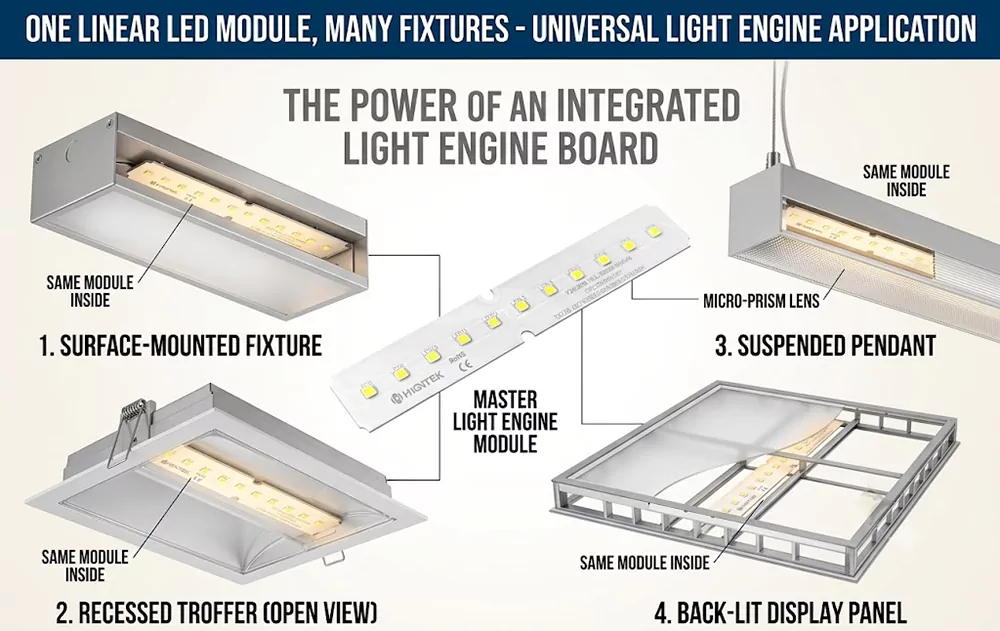
Linear LED modules can be used for various types of lamps
  • Surface-mounted fixtures.
    These attach directly to a finished ceiling or wall with no cut-out or grid access needed, which makes them the most common and most forgiving format. A linear led module runs the length of the channel behind a diffuser, and because nothing has to be recessed, the fixture drops onto drywall or concrete in minutes. That practicality is why surface-mounted runs dominate retrofits, office corridors, retail floors, and back-of-house areas — anywhere cutting the ceiling is not an option and a clean line of neutral white light is enough.
  • Recessed fixtures.
    Here the fixture sits flush into the ceiling, wall, or floor so it does not protrude, either trimless for a seamless plaster-in look or flanged with visible trim. The module throws light down through a lens or diffuser while the hardware disappears into the structure. This is the minimalist choice for architectural interiors, conference rooms, and high-end retail, where lighting designers want the line of light but none of the visible fixture.
  • Suspended fixtures.
    Hung from the ceiling on cables, suspended linear lights suit rooms with high headroom. Their advantage is bi-directional output: a module can light downward onto the work plane and upward to wash the ceiling, which cuts glare and adds depth to the space. Offices, hotels, bars, and restaurants use them to both illuminate and define a room, and because the format is modular, designers chain multiple modules into continuous lines of almost any length — the core idea behind modular linear led lighting.
  • Backlit fixtures.
    In a backlit fixture the module hides behind a diffusing surface instead of facing the room. Backlit panels, illuminated signage, light boxes, and edge-lit displays all depend on even brightness across the whole face, so the module’s only job is uniform output with no visible hotspots. This is where optical design and tight LED spacing matter most — an advertising sign or a luminous ceiling looks premium or cheap based entirely on how evenly the light spreads.

Across all four formats the module does the same work. The lighting fixtures themselves determine how light is projected and how much hardware the human eye can see. This is where Higntek works less like a single supplier and more like an engineering-driven manufacturer: starting from the fixture type and application you are developing, it analyzes the core components from a lighting-module engineering view and, through material selection, design, prototyping, and testing, delivers a reliable module matched to the fixture you need.
What Factors Affect the Luminous Efficiency of Linear LED Modules?

The luminous efficiency of a linear LED module is set by five interacting factors: the LED chip, the PCB material, the layout, the drive current, and the driver. There is no single “correct” efficacy figure to aim for — the right balance is decided per project, because pushing for the highest lm/W trades against the color quality, output, and cost a given application actually needs.

LED Chip.

The LED chip determines luminous efficiency and lifespan stability. Two characteristics determine the upper limit: rated luminous efficiency and white light generation method. Most white LEDs use phosphor conversion technology—that is, coating a blue LED chip with phosphor. This method achieves the highest luminous efficiency currently available. However, to produce a warmer color temperature or a higher color rendering index (CRI), more phosphor conversion is needed, which reduces luminous flux. This is why, for the same luminaire, a 3000K color temperature, CRI 90 luminaire will have a lower lm/W value than a 5000K color temperature, CRI 80 luminaire. Therefore, we must set high-efficiency targets based on the light quality required by the space.

Hignetek selects LED chips based on the lighting requirements of each project (brightness, luminous efficiency, color temperature, CRI), rather than simply relying on parameters in a datasheet. Furthermore, our self-developed LED chips use a more stable alloy material instead of a silver layer, and their sulfidation tests show almost zero light decay. The product’s reliability and airtightness are ensured by employing a double-layer vacuum coating method with Aryl Phenyl Imidazole (APB), and the thermal resistance is reduced to approximately 1°C/W using Jet Vapor Deposition (JVD) technology. The innovative packaging process patented based on NCSP technology achieves high luminous efficiency from low current to high current.

PCB.

The long-term stability of the luminous efficiency of an LED lighting module depends on thermal management. Junction temperature is the most critical physical factor affecting efficiency. If the circuit board cannot effectively dissipate heat, the junction temperature will rise, and the output power will decrease. Aluminum or copper substrates dissipate heat from the LEDs faster than FR-4 substrates, thereby reducing junction temperature, protecting module efficiency, and reducing light decay. Thermal management is not about improving comfort, but about improving performance. Therefore, Higintek selects the appropriate substrate, thermal conductivity specifications, and additional auxiliary processes based on the thermal load of each project, rather than simply choosing the cheapest circuit board.

Layout Design.

How the LEDs are spaced and routed decides where heat concentrates and how evenly the light spreads. Packing chips too tightly creates hotspots that raise local junction temperature and drag efficacy down, while spacing them well lets the board share the thermal load and lets the optics produce an even line. Layout is the quiet factor most buyers overlook, yet it links thermal management and optical uniformity in one decision — which is precisely where Higntek’s proprietary PCB design excels: before shipping the first batch of samples, we adjust the LED spacing and copper foil routing according to the specific requirements of the luminaire.

Current and Voltage.

Current and voltage decide how much light a chip delivers and at what efficiency, and the right operating point is specific to the chip, not one fixed value. LEDs do not hold efficacy steady as current rises — a behavior called efficiency droop: more current means more total light, but each extra milliamp returns less light per watt and adds heat, so running at maximum rated current trades efficiency for brightness. The operating point also varies by chip — a package size such as 5050 covers many different variants, each with its own forward voltage and its own current-and-power window for peak performance, so the drive has to be matched to the actual chip rather than the package name. Designing the current to sit at that efficient point is how a module earns high lm/W, and setting that operating point to a project’s output target is part of Higntek’s electrical design rather than an afterthought — which is why output and efficiency end up a deliberate trade rather than a fixed number.

Driver.

The efficiency of the driver itself is also included in the overall system efficiency. Switching constant current drivers typically achieve conversion efficiencies of 90-95%, but improper linear or DOB-level driving leads to reduced efficiency and greater energy loss as heat. Add to this optical losses in lenses or diffusers, and the actual efficiency of the module in the luminaire will be significantly lower than the bare LED chip efficiency stated in the datasheet—this is why module-level energy efficiency verified through LM-80/TM-21 testing is crucial. This is also the metric used by Higntek—our engineering team pairs each module with a high-efficiency driver before mass production and performs performance ratings at the module level, not the bare chip level.

In summary, these five factors explain why “LED luminous efficacy” and “module efficiency” are not the same concept, and why a universal value cannot be used when manufacturing finished luminaires and LED lighting modules. The truly important efficiency is measured within the finished luminaire, based on the project’s specific color and output targets. When developing LED lighting modules, a certain amount of headroom must be allocated for light loss to meet final requirements.

What factors are used to evaluate linear LED modules?

Buyers judge a linear LED module on a short list of measurable specs: luminous efficacy in lm/W, CRI, CCT, color consistency (SDCM), rated lifespan, color and dimming capability, electrical ratings, dimensions, and mounting compatibility. No single figure tells the whole story — the right module is the one whose full spec set matches the job, not the one with the highest number on any one line.

Linear LED modules have become one of the most versatile building blocks in modern lighting design. From office panels and batten lights to architectural linear fixtures and retail lighting systems, their flexibility, efficiency, and ease of integration make them a preferred solution across many applications.
As we’ve discussed throughout this guide, the performance of a linear LED module is never determined by a single specification. Luminous efficacy, color quality, thermal management, PCB design, driver selection, optical components, and installation compatibility all work together to influence the final lighting result. Focusing on only one parameter—such as lm/W or LED chip brand—often overlooks the engineering trade-offs that ultimately determine long-term performance and reliability.

From our experience working with OEM and lighting brands, successful projects usually begin with a clear understanding of application requirements rather than product specifications alone. Factors such as fixture structure, optical distribution, dimming requirements, installation method, and target efficiency should all be considered early in the design stage.
At Higntek, we develop and manufacture custom Linear LED Modules with a system-level engineering approach. By combining LED selection, PCB design, thermal optimization, driver integration, and optical customization, we help customers create lighting products that balance performance, reliability, efficiency, and manufacturing practicality.
Whether you’re developing a new luminaire or improving an existing design, understanding the fundamentals behind Linear LED Modules is the first step toward building a better lighting solution.

FAQ

What are the requirements for outdoor linear LED modules?

Outdoor linear LED modules need a sealed build: a weather-rated IP enclosure, a conformal-coated PCB and driver, surge protection, and a corrosion-resistant housing. Beyond the IP rating, look for surge immunity to IEC 61000-4-5 — 4kV is a practical baseline, higher for exposed sites — plus UV-stable covers and a finish that survives salt air on coastal projects. The thermal design must also cope with sealed, sun-loaded conditions.

Hotspots and uneven light usually come from LED spacing set too wide, a diffuser placed too close, or voltage drop and heat building up over a long run. A tight, even LED layout with a matched diffuser removes visible dots, while constant-current drive and good thermal management hold brightness and color steady end to end. Loose color binning — a high SDCM — also shows up as uneven tint.

Match the IP rating to the environment: IP44 for covered areas, IP65 for general outdoor rain and dust, IP66 for high-pressure washdowns, IP67 for temporary submersion, and IP68 for permanent submersion. The first digit (6) means dust-tight; the second covers water ingress. For coastal or corrosive sites, a corrosion-resistant housing often matters more than a higher water digit.

Looking for a Custom Linear LED Module Solution?

From PCB design and LED layout to optics, drivers, and assembly, we provide end-to-end development and manufacturing support tailored to your lighting product.

On-Time Delivery 99.38%

Consistent production & reliable global delivery

End-to-End Engineering Support

From design optimization to production guidance

3-Day Rapid Prototyping

Fast sampling to accelerate product validation

100% Quality Inspection

Full testing ensures stable and reliable performance

Discuss LED module project specifications with professional engineers.

Pre-Engineering Inquiry