

LED color is the color the eye perceives when an LED emits light, and it is decided by two things at once. The first is the wavelength content of the emitted light. The second is the way human vision samples that wavelength content. An LED carries no color label inside it, it emits a spectrum, and the eye assigns a name to that spectrum.
The consequence for a specification is direct. A color name such as warm white, and even a color temperature such as 3000 K, is a summary of a spectral power distribution rather than a description of it. Two LED sources can carry the same color temperature and the same color rendering index and still look different side by side, because the numbers compress a spectrum into one or two values and lose the wavelength detail that the eye actually reads. Therefore, in order to help our partners who require a high degree of color consistency to have a clearer understanding, I and my engineers have specially compiled this detailed description, hoping that everyone will no longer be able to obtain the target light-sensing LED lighting module simply by specifying a color temperature parameter.
What Is LED Color?
LED color refers to the specific wavelength of visible light emitted by a light-emitting diode. The visible working band is usually quoted as approximately 380 to 780 nm, with some references extending the red end toward 790 nm and with the practical limit depending on the viewer and the light level. The eye samples the electromagnetic spectrum through three cone types whose peak responses sit in the short, middle and long wavelength regions, close to the blue, green and yellow-red parts of the visible band. Because those responses overlap and are compared rather than measured, different spectra can produce an identical perceived color.
Color is therefore a perception with a physical cause, and the physical cause is what a purchase order can control. The measurable side of LED color is the spectrum: how much radiant power the device emits at each wavelength, how wide each emission band is, and how much of the emitted power falls inside the visible band at all.
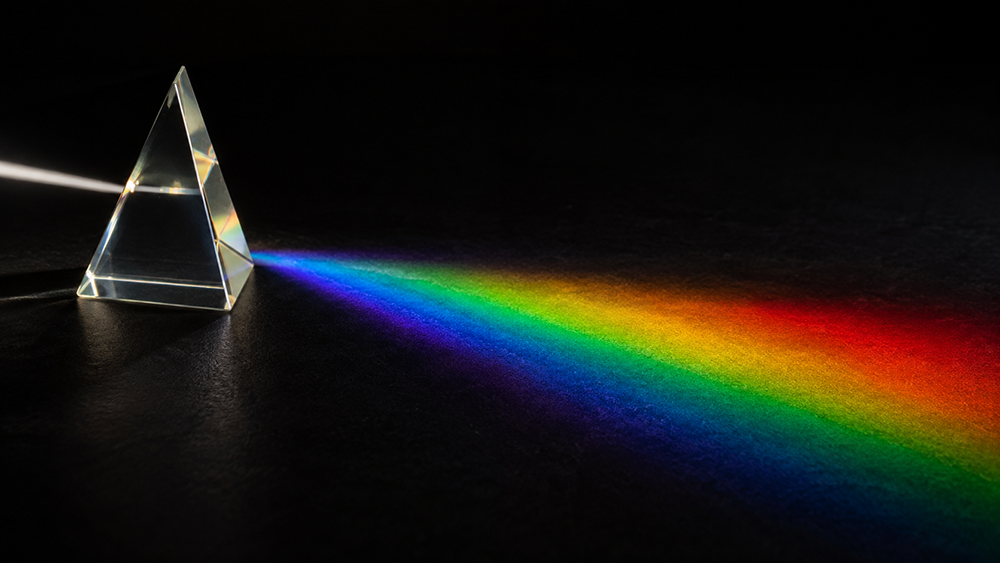
White light is the clearest illustration of why the spectrum and the summary numbers are different things. Our review found that white LED light reaches the same warm or cool appearance through two different routes, and that the two routes do not behave the same way in production.
- The first route runs a blue-emitting die and converts part of that blue light with a phosphor coating. Phosphor composition and coating thickness then set the resulting color temperature, and a phosphor-converted white that carries little red content renders saturated reds poorly even when its headline number looks healthy.
- The second route mixes separate color channels, typically red, green and blue, with additional dedicated channels for white or amber where the application needs them. Additive mixing of primaries gives the widest control and the clearest path to a tunable product, and it brings its own cost: the build needs an emitter array, a diffuser and enough optical mixing distance for the channels to stop reading as separate sources.
The real buying question is which route the application can tolerate, because the two routes differ in color tolerance, control complexity and how much rework they create when the target color changes late. Send us the target color temperature, the application and the observed color problem. We will map the module build, the emitter selection and the tolerance the finished product can accept.

How Do LEDs Produce Different Colors of Light?
The key to LED lights emitting different colors lies in the fact that when an electric current flows through a semiconductor material, it releases photons of a specific wavelength. The color we perceive is determined by the bandgap energy of the semiconductor within the LED chip, as well as the specific methods used to blend these wavelengths. LEDs emit light by electroluminescence: electrons and holes recombine in the active region of a semiconductor junction and release energy as photons. The band gap of the material sets the photon energy, and photon energy sets the wavelength, so the band gap decides the color. The chain in a working device runs from carrier injection through the junction, to recombination in the active region, to photon emission out of the die.
It is also the reason a silicon junction is unsuitable as a visible light source: in silicon the released energy is converted largely to heat, and the small fraction that escapes as light falls in the infrared rather than in the visible band. Visible emission comes from compound semiconductor materials whose band structure can be tuned.
Photon energy and wavelength move in opposite directions. The working relation is that wavelength in nanometres is approximately 1240 divided by the band gap in electronvolts, so a wider band gap produces shorter-wavelength light. Nitride materials used for blue and green emission sit in the region of 3.4 eV, and the narrower-gap arsenide materials used for deep red and infrared emission sit near 1.4 eV. A multi-color product such as an RGB LED strip follows the same rule: its blue and green channels sit on nitride dies and its red channel on a narrower-gap phosphide die, so each channel carries its own efficiency limit. Treat those figures as approximate reference points rather than fixed thresholds for every device, because alloy composition shifts the gap continuously.
Wavelength availability is not uniform, and that is a commercial fact rather than a scientific footnote. The efficiency of green emission in the nitride system has historically lagged blue and red, a limit usually called the green gap. Deep ultraviolet emission below about 5 percent efficiency has been reported for commercial devices, amber and deep-red emitters carry a cost penalty of their own, and phosphor-converted red is inefficient compared with direct emission. A buyer who asks for a specific wavelength is therefore asking for a material family, and for that family’s efficiency and cost profile.
Our research identified that each color band is served by a specific III-V material system, so a wavelength request is really a material request with its own efficiency and cost profile. This is why two LED packages that appear identical in appearance may emit light of completely different colors.
What semiconductor materials are used for LEDs of different colors?
As we mentioned earlier, the bandgap energy of a semiconductor determines the wavelength of an LED. A larger bandgap results in a shorter wavelength (such as blue light), while a smaller bandgap produces a longer wavelength (such as red or infrared light). Each color band maps to a material family. Alloy composition does the tuning: adding indium to a gallium nitride lattice narrows the gap and pushes emission from violet toward green, while the ratio of aluminium, gallium and indium in a phosphide lattice sets emission anywhere from green-yellow to red. Substrate choice and epitaxial quality then decide how efficiently the device converts current into light in that band.
- For ultraviolet LEDs, aluminium gallium nitride (AlGaN) provides the wide band gap needed to reach wavelengths below visible violet. These devices need a separate efficiency and cost review; a UV requirement cannot be met by substituting a blue LED from the visible range.
- Indium gallium nitride (InGaN) covers blue, cyan and much of green. Blue InGaN dies also pump the phosphor in common white LEDs. Raising the indium fraction shifts emission toward green, where lower conversion efficiency makes the target wavelength and output level especially important to specify together.
- Aluminium indium gallium phosphide (AlInGaP) is the usual high-brightness family for amber and red. Its alloy composition sets the color within that range, so an amber or red order should name the wavelength descriptor and operating conditions rather than assume that every die sold under one color name matches.
- Aluminium gallium arsenide (AlGaAs) and related gallium arsenide alloys serve deep red and infrared wavelengths. Gallium phosphide (GaP) and gallium arsenide phosphide (GaAsP) are older green and yellow families used where their output and cost fit the design; they are not interchangeable with a current InGaN green emitter on brightness alone.
Color band | Typical material family | What the family contributes |
|---|---|---|
Ultraviolet, below the visible band | AlGaN cladding with InGaN wells | Wide gaps reach the shortest wavelengths, at low efficiency and high cost |
Blue and cyan | InGaN | The mature high-efficiency band, and the pump for most white LEDs |
Green | InGaN | Same family as blue, with lower efficiency across the green gap |
Yellow and amber | AlInGaP | Gap tuned for roughly 570 to 600 nm emission |
Red | AlInGaP | The standard high-brightness red used in displays, signals and horticulture |
Deep red and infrared | AlGaAs and related GaAs alloys | Narrow gaps below roughly 1.9 eV for emission beyond 660 nm |
Legacy green and yellow | GaP and GaAsP | Early low-brightness materials, still used where cost dominates |
The table lists the families that are in commercial use rather than every material ever reported, and several families overlap the same color band. Efficiency depends on the alloy fraction, the current level and the junction temperature, so two components built on the same family can differ substantially at the same nominal color.
What Is the Relationship Between LED Color and Wavelength?
The color of light emitted by an LED is determined directly by its wavelength, which serves to distinguish between colored LEDs, ultraviolet (UV) LEDs, and infrared (IR) LEDs. Photon energy rises as wavelength falls, so violet photons carry more energy than red photons. White LED light combines wavelengths: neither one peak nor one wavelength number identifies its perceived white color. Wavelength is the physical measurement in nanometres; color is the eye’s response to the emitted spectrum.
The visible band is commonly described as running from about 380 to about 780 nm. Shorter wavelengths inside that band read as violet and blue, middle wavelengths as green, and longer wavelengths as amber through red. I have summarized common wavelength ranges in the table below; boundaries differ by a few to a dozen nanometres between references because cone sensitivity and the definition of a color name are not sharp edges.
Approximate band | Usual color name |
|---|---|
380 to 420 nm | Violet |
420 to 450 nm | Deep blue |
450 to 490 nm | Blue |
490 to 510 nm | Cyan |
510 to 550 nm | Green |
550 to 585 nm | Yellow-green to yellow |
585 to 595 nm | Amber |
595 to 620 nm | Orange |
620 to 645 nm | Red |
645 nm and above | Deep red toward infrared |
Based on our industry experience over the past decade, there are two points we would like to emphasize:
- There is no unique wavelength-to-color mapping, so any conversion of a wavelength into a display color value is an approximation rather than a measurement.
- White LEDs also have no single emission wavelength at all: a phosphor-converted white emits a blue pump peak, often around 450 to 460 nm, plus a broad converted band, and the color a viewer sees comes from the combination rather than from one peak.
For a single-color product, the practical question is which wavelength descriptor the specification names. Peak wavelength identifies the wavelength of maximum radiated power. Dominant wavelength identifies the monochromatic wavelength that would match the perceived hue, which is why it can differ from the peak by several nanometres. Centroid wavelength describes the centre of gravity of the emission band and is closer to an average than to either of the other two. Spectral bandwidth, quoted as full width at half maximum, describes how narrow or broad the emission band is, and it changes how saturated the color looks: a narrow emitter reads as a purer color than a broad one at the same peak.
The descriptor matters because the three values can differ for the same device, and an order that names only a number leaves the supplier free to choose the descriptor. A workable single-color requirement names the descriptor, its tolerance and a maximum bandwidth. White-light products use a different system altogether: they are specified and sorted by nominal color temperature with a tolerance step, not by emission wavelength, so wavelength binning and color temperature binning are two separate order languages.
How do I choose the right color temperature for an LED lighting product?
Choose from the application and the materials being lit, then hold it with a tolerance. Warm white around 2700 to 3000 K suits residential and hospitality interiors, neutral white around 3500 to 4100 K suits offices and general commercial work, and 5000 K and above suits outdoor and industrial installations. State the ambient light level too, because one color temperature reads differently against daylight and against a dark interior.
Are colored LEDs full spectrum?
No. A single-color LED emits a narrow band, so it contains almost no energy outside that band and cannot render other colors faithfully. Full spectrum describes broad white emission, and even there the claim needs a spectrum rather than a label, because a phosphor-converted white can carry very little red content and a bulb that looks red to the eye can still emit blue and green.
Not Sure Which LED Color Specifications You Need?
Description: Share your application, target CCT, CRI requirements, or lighting goals with our team. We can help you identify the key specifications to consider before choosing an LED module.