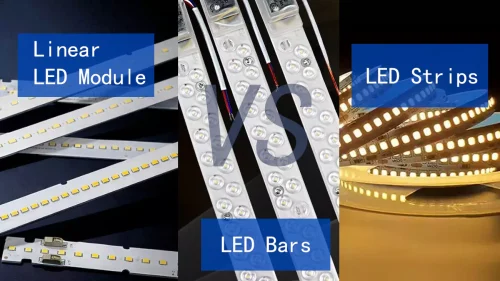
LED Module Components, Types, and Specifications Guide

LED Module structure Components, Types, and Technical Specifications Guide

An LED module is a ready-to-integrate lighting unit that combines LED chips with a PCB, electrical components, optical structure and thermal design to produce controlled light in a specific fixture or application.
That simple definition matters because most lighting problems do not start with “the LED is not bright enough.” They usually start deeper in the module. A linear office light may show uneven edges because the LED spacing and diffuser do not match. An outdoor module may lose output faster because heat cannot move away from the LED junction efficiently. A commercial shelf light may look slightly off-brand because the CCT, CRI and optical angle were chosen as separate parts instead of one engineered system.

The U.S. Department of Energy describes LED lighting as one of the most efficient lighting technologies available, while ENERGY STAR points out that thermal management is often the single most important factor in long-term LED performance. That is exactly why LED modules should be understood as engineered assemblies, not just small boards with LEDs soldered on them.
For lighting brands, OEM buyers and product engineers, the real value of LED modules sits in the balance between luminous efficacy, color quality, heat dissipation, driver compatibility, optical control and manufacturability. This is also where a custom LED module manufacturer such as Higntek becomes relevant. The work is not only about producing LED PCB assemblies, but about turning application requirements into stable, scalable lighting modules for office, commercial, outdoor and industrial use.

What Are LED Modules?

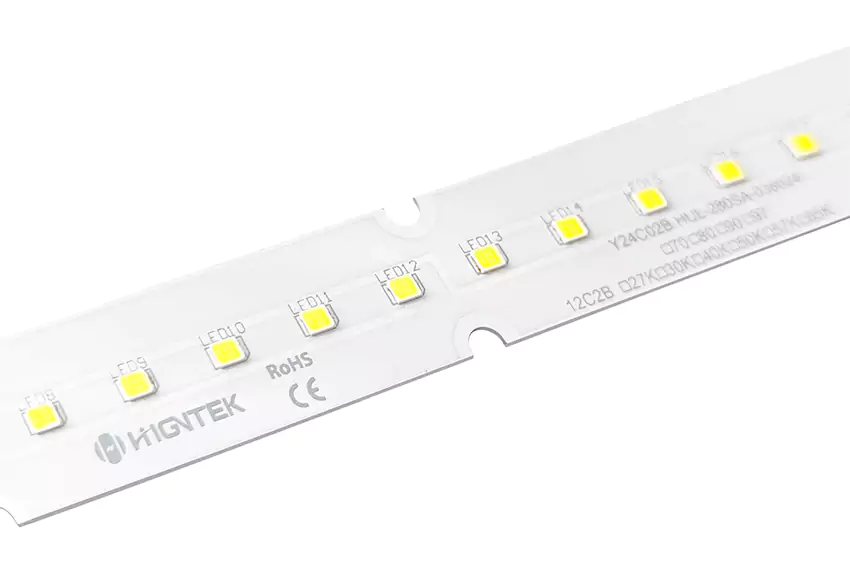
LED modules are integrated lighting units that combine multiple LED chips, a PCB, electrical components, optical parts and thermal design into a ready-to-use light source for finished lighting products.
I usually avoid describing an LED module as “a board with LEDs” because that sounds simple but not accurate enough. A single LED only emits light. A module gives those LEDs a controlled electrical route, a stable mounting base, a designed light pattern and a way to move heat away from the light source. In real product development, that difference decides whether a lighting fixture looks consistent after installation or becomes difficult to control in mass production.

The value of LED modules sits in three areas. They make lighting design easier to integrate, they help brands repeat the same light output across batches, and they give engineers more control over luminous flux, CCT, CRI, beam angle, current level, connector position and thermal path. That is why LED modules are common in office panels, commercial shelf lights, outdoor lighting, industrial task lights and architectural linear lighting.

Energy efficiency is one reason LED technology became mainstream. The U.S. Department of Energy states that ENERGY STAR rated residential LEDs use at least 75% less energy and last up to 25 times longer than incandescent lighting. At module level, however, that result is not created by the LED chip alone. Electrical design, optical layout, PCB material and heat dissipation all affect how much of that potential performance becomes reliable product performance.
A common mistake is to judge an LED module only by brightness. In a commercial shelf-lighting project, for example, a module with higher initial output may still perform poorly when the diffuser creates visible dots, the CRI makes product colors look flat, or the PCB cannot keep temperature balanced across the strip. A professional LED module should solve the full lighting problem, not just push more lumens.
What Are LED Modules


How Does an LED Module Work?

An LED module works by sending controlled electrical current through LED chips mounted on a PCB, then using optical and thermal design to shape the light and protect long-term performance.
The LED chip converts electrical energy into light through a semiconductor process. The PCB carries current and holds the components in position. The driver or driving circuit controls how power reaches the LEDs. The lens, diffuser or reflector manages light distribution. The PCB substrate, soldering quality, housing contact and heat path decide how effectively heat moves away from the LED junction.

  • The driving method deserves early attention because LEDs are current-sensitive devices. Unstable current can cause flicker, visible output variation, color shift or faster degradation. Constant current LED modules are usually preferred when stable light output and LED protection matter most. Constant voltage modules are often used in strip-style or parallel-connected systems where layout flexibility and easier power distribution are more important. Neither option is “better” in every case. The correct choice depends on module structure, power supply design, installation length and application environment.
  • Thermal design is the part many basic explanations underplay. ENERGY STAR states that LEDs use heat sinks to absorb and dissipate heat, and that thermal management is generally the single most important factor in successful LED performance over lifetime. Higher operating temperature makes light degrade faster and shortens useful life.

That is why a good LED module is never designed around brightness alone. High-output linear modules may appear more powerful on datasheets, but without proper electrical engineering design, higher current can lead to increased junction temperature and reduced luminous flux maintenance. A more balanced module may deliver better real-world value because it keeps output, efficiency, color stability and heat under control at the same time.
In one office lighting module project we reviewed, the target was a 600 × 600 mm panel with soft output, stable 4000K color and a clean diffuser surface. The early sample looked bright enough, but small light spots were still visible when viewed from a normal office distance. The problem was not the LED output itself. The LED spacing was too close for the diffuser distance, and the PCB layout also needed better heat balance. After adjusting the spacing, diffuser match and driver setup, the module delivered a smoother surface and became easier to repeat in production. That is the hidden engineering behind a panel light that looks simple from the outside.

What Are LED Modules Used For?

LED modules are used in lighting products that need a controlled, repeatable and manufacturable light source instead of loose LED components. Their applications cover office lighting, commercial lighting, outdoor lighting, industrial lighting, architectural lighting, smart lighting and specialty lighting.
The value changes with the environment. Office lighting focuses on visual comfort and consistency. Commercial lighting needs color quality and clean product presentation. Outdoor lighting needs protection, heat resistance and stable operation. Industrial lighting often cares more about reliability under long working hours than decorative appearance.

Application AreaCommon LED Module FormPractical Value
Office lightingLinear modules, backlight modules, edge-lit modulesSupports uniform light, controlled CCT and repeatable ceiling layouts
Commercial lightingShelf lighting modules, signage lighting modules, linear modulesKeeps product visibility, brand color and brightness consistent across stores
Outdoor lightingProtected modules, high-power modules, sealed module designsImproves reliability under heat, humidity, dust and long operating cycles
Industrial lightingHigh-output modules, robust LED PCB assembliesProvides stable illumination for work zones, equipment areas and inspection tasks
Architectural lightingFlexible modules, linear modules, custom-shape modulesFits coves, curves, edges and non-standard structures more easily
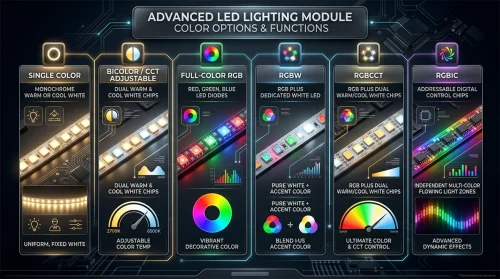
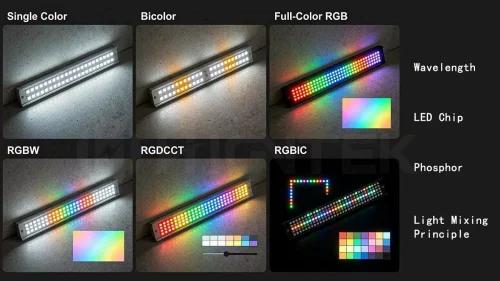
Smart lighting systemsDimmable modules, CCT-tunable modules, RGB or RGBW modulesSupports brightness control, color tuning and system-level lighting control
Specialty lightingUV modules, IR modules, application-specific modulesSupports UV curing, IR sensing, inspection systems, machine vision and other focused technical uses

For lighting brands, LED modules also reduce development complexity. A company can build several fixture types from a controlled module platform, then adjust PCB shape, LED package, current level, optical structure and connector position for each product line. That approach is useful when a brand needs panel lights, linear lights and shelf lights with consistent color quality across different SKUs.
A realistic case we met would be a mid-sized commercial lighting company developing shelf lights for cosmetics stores. The design team may need a slim linear LED module, high CRI, consistent 3000K or 4000K output and no visible light dots on glossy packaging. In that project, the module affects how the merchandise looks, not only how the fixture performs. Poor module design can make premium retail displays look uneven. A well-engineered module makes the lighting feel controlled before anyone notices the technical work behind it.

For OEM and custom lighting projects, this is why module development should start with application requirements instead of component selection alone. The stronger path is to define light output, color quality, beam behavior, thermal limits, electrical architecture, mechanical space and production volume together. That is also the area where our Higntek’s official capabilities are relevant, since we provide custom LED module development, LED PCBA and SMT assembly, component sourcing, optical and thermal engineering support, prototype verification and scalable production for professional lighting applications.

What are the Main Components of an LED Module?

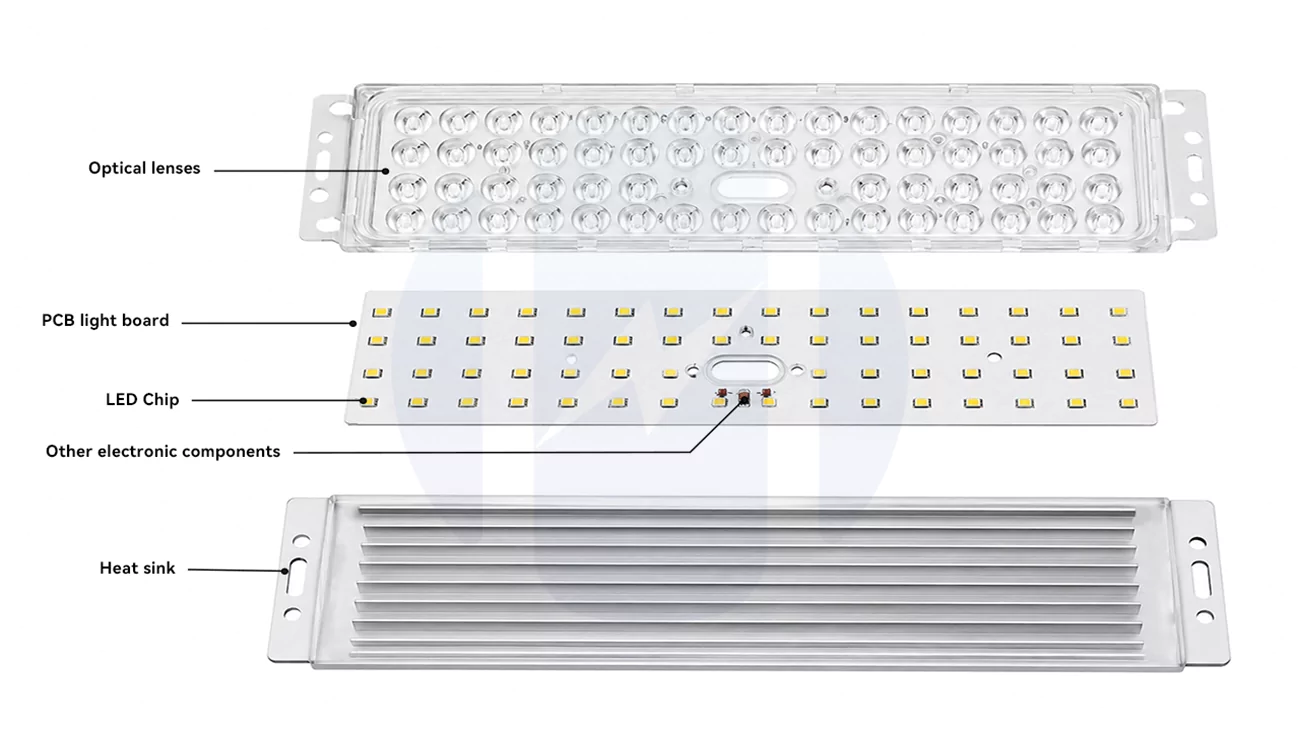
An LED module is built from several working parts, and each part affects light output, color quality, heat behavior, electrical stability and final product reliability.
I usually start this topic with one correction. The LED chip is not the whole module. Buyers may first inquire about the chip brand, power, or lumen output, but the final lighting effect depends on the coordinated work of the LED package, PCB, driver, connector, optics, and other electronic components. A strong LED module should not only emit light. It should deliver the same light quality repeatedly in a real fixture, under real operating temperature, with stable electrical behavior.
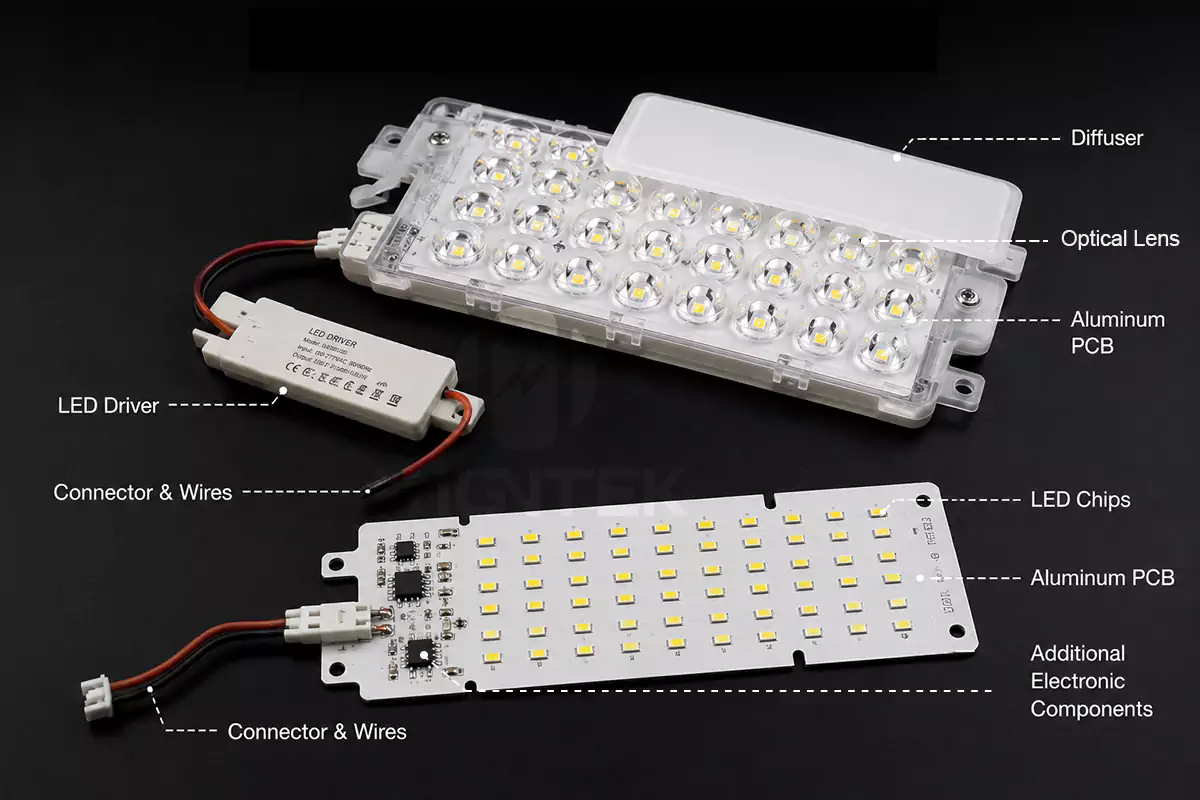
 

ComponentMain RoleWhat It Decides in Real Use
LED chips or LED packagesProduce light from electrical energyLuminous efficacy, output level, CCT range, color quality and performance ceiling
PCBCarries the circuit and supports componentsHeat transfer, electrical routing, mechanical fit and production consistency
Driver or driving circuitRegulates power supplied to LEDsCurrent stability, flicker risk, dimming behavior and LED protection
Connectors and wiresConnect the module to power or control systemsInstallation speed, serviceability, polarity safety and connection reliability
Optical lenses and diffusersShape, spread or soften the lightBeam angle, glare control, hot spots, uniformity and visual comfort
Other electronic componentsSupport protection, control and circuit stabilitySurge protection, filtering, temperature response and long-term reliability
  • LED Chips & Packaging.
    The LED chip or LED package is the light-producing core. In many professional LED modules, the more accurate term is LED package, because the chip is already packaged into a usable light source by various LED chip brands before being mounted onto the PCB.
    For lighting, this selection affects more than brightness. It also influences CCT, CRI, color consistency and luminous efficacy. However, achieving a specific light effect depends on the specific LED technology design, not just the semiconductor chip itself.
  • PCB.
    The PCB is the module’s electrical route and thermal base. FR4 can work in lower-power or cost-sensitive designs. Aluminum PCB is common when heat needs to move away from the LEDs more efficiently. Flexible PCB helps when the module must follow a curve, fit a narrow channel or adapt to a special structure. In actual production projects, we need to pay attention not only to PCB materials, but also to details such as PCB thickness, copper thickness, surface treatment processes, and thermal conductivity. These factors collectively affect junction temperature, soldering reliability, mechanical fit, and the consistency of LED module production.
  • Driving Method.
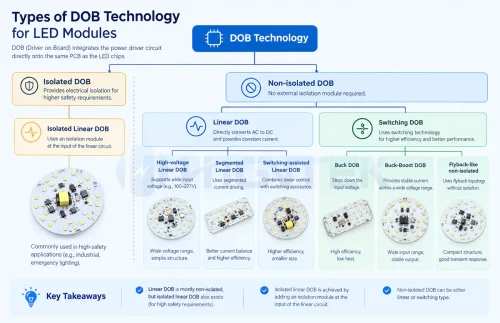
    The driver or driving circuit controls how power reaches the LEDs. Some LED modules depend on an external LED driver, while others integrate driver ICs or control components on the board. The key point is stable current or stable voltage according to the module design. Poor driver matching can lead to flicker, uneven brightness, overstress or faster lumen depreciation. This is why constant current and constant voltage modules should not be chosen by habit. They should be selected according to circuit architecture, installation length, power supply design and application requirements.
  • Connectors.
    Connectors, wires and terminals look less important on the datasheet, but they often decide whether a module is easy to assemble at scale. In a slim retail linear light, a connector placed in the wrong position may create shadow, force awkward wiring or slow down assembly. In outdoor lighting, connection design also affects sealing, maintenance and long-term reliability. Small mechanical details become expensive when they repeat across thousands of units.

  • Optical Components.
    Optical lenses and diffusers decide how the light appears after it leaves the LED package. A lens can narrow, widen or redirect the beam. A diffuser can soften the light and reduce visible LED dots. Reflective structures can guide light across a surface and improve visual uniformity. This is especially important in office panels, shelf lighting and architectural lines, where poor optical design is visible immediately. A module can have strong luminous flux and still look low-grade when it creates hot spots or harsh contrast.

And other electronic components support circuit stability and protection. Depending on the module design, this may include resistors, capacitors, inductors, diodes, bridge rectifiers, driver ICs, transistors, TVS devices or NTC thermistors.
Thermal structure links several of these components together. Heat affects the LED package, solder joints, phosphor behavior, driver components and lumen maintenance. ENERGY STAR states that LEDs use heat sinks to absorb and dissipate heat, and that thermal management is generally the single most important factor in successful LED performance over lifetime. That is why serious LED module design considers LED placement, PCB substrate, copper thickness, housing contact and heat path together.
What Is the Difference Between Constant Current LED Modules and Constant Voltage LED Modules?

Constant current LED modules are driven by a regulated current, usually specified in mA or A, while the constant voltage LED modules receive a fixed DC voltage such as 12 V, 24 V or 48 V and manage LED current through the module circuit. This difference affects more than the driver label. It changes wiring style, driver selection, brightness stability, voltage-drop risk and thermal behavior.

I would not treat this as a which one is better question. Constant current modules usually fit the LED strings, high-power modules and light engines where LED protection and stable output matter most. Constant voltage modules are more practical for strip-style modules, cuttable sections, parallel wiring and long linear runs. The wrong decision may still light up during a quick test, but it would create uneven brightness, color shift, connector heating or reliability problems once the module is installed.

What Is a Constant Current LED Module?

Constant current LED modules are designed to operate at a constant current, such as 350mA, 700mA, or other specified current values, while the voltage is automatically adjusted under the control of the driver according to the number and arrangement of LEDs. This structure is common in LED modules where stable brightness and LED protection matter most. The driver supplies a fixed current to the LED load. The voltage is not the main target. It rises or falls within the driver’s rated range so the selected current stays stable.
Constant current modules often appear in high-power LED modules, downlight engines, outdoor light engines, industrial lighting and professional linear modules. They also fit series LED string layouts because the same current flows through every LED in the string. That makes the electrical condition easier to control, especially when the design needs predictable light output and thermal behavior.

The main advantage is stability that engineers can actually control. In a constant current LED module, the current stays at the required level, while the driver adjusts voltage to match the LED load. That load changes with the number of LEDs, the way they are connected, the LED package type and even the operating temperature. So before the production, the LED string voltage, driver current rating, output voltage range, dimming method and heat path all need to line up.
When this part is done well, the module is less likely to suffer from current drift, flicker, uneven brightness or LED overstress. It also becomes easier to keep color and light output stable over time, because the LEDs are not being pushed outside their intended working range. For professional lighting projects, it is the kind of early check that prevents electrical and thermal problems from showing up after installation.

Constant voltage LED modules provide a stable voltage to all LEDs, typically 12V, 24V, or 48V. Current control is achieved through the module’s electrical design or by adjusting built-in circuitry. This structure is common in LED strips, flexible modules, signage lighting, cabinet lighting, shelf lighting and long linear runs. The power supply provides a fixed voltage. The module then uses resistors, driver ICs or other current-control components to keep the LEDs operating within the intended range.

The advantage is layout flexibility. Constant voltage modules are easier to connect in parallel, easier to divide into sections in many strip-style designs, and easier to plan across different fixture lengths. That is why 24 V LED modules are widely used in retail linear lighting, cabinet lighting, signage backlighting and architectural cove lighting.
The risk is that fixed voltage does not automatically mean stable LED current. Long wire runs, undersized conductors, weak current-control circuits or poor thermal design can create uneven brightness and reliability problems. In a long shelf-lighting run, the section near the power supply may look slightly brighter than the far end because of voltage drop. That is not a small visual detail in retail lighting. It can make product displays look inconsistent across one shelf line.

How to Choose Between Constant Current and Constant Voltage LED Modules?

The safer choice depends on the module structure, installation layout, output target and thermal condition.

  • For compact high-power modules, outdoor light engines and industrial lighting modules, constant current usually makes more sense. These applications need tighter control over LED current, heat and lumen stability. A sealed outdoor wall washer, for example, has limited room for heat escape, so current control and thermal design become part of the same reliability decision.
  • For flexible strips, retail shelf lights, signage backlighting and longer linear runs, constant voltage often fits better. These projects usually need parallel wiring, cuttable sections, segmented installation or different module lengths. The engineering focus then shifts to voltage drop, wire gauge, total wattage, power supply headroom, connector temperature and current-control design inside the module.

For example, in a shelf lighting project for a cosmetics brand chain store that our engineers reviewed last month with the client, the system used 24V modules because each shelf unit had a different length and the installation team needed simple parallel wiring. Constant voltage was the practical choice, but it did not remove the need for careful testing. The far end of each run still had to be checked for brightness drop, and the connectors needed temperature checks after continuous operation. We also reviewed diffuser performance and CCT consistency across different shelf lengths before the design moved toward mass production.
My practical rule is very simple. Use constant current when LED protection, output stability and heat control are the main risks. Use constant voltage when modular layout, installation flexibility and segmented wiring are the main risks. Then check the full system instead of trusting the label. A well-designed constant voltage module can be reliable, and a poorly matched constant current system can still fail.

For custom LED module projects, our Higntek’s role fits this decision at the engineering stage rather than as a generic supplier statement. Its stated capabilities in custom LED module development, LED PCBA and SMT assembly, optical and thermal engineering support, component sourcing and prototype verification are relevant because current mode affects PCB layout, driver matching, connector planning, heat behavior and production repeatability.

FAQ

Where to buy Zhaga LED modules?

Zhaga LED modules can be sourced from LED module manufacturers that design products around Zhaga-compatible interfaces. For outdoor lighting projects, Higntek offers Zhaga-standard outdoor LED modules, including the HUO Series, which is designed for modular compatibility in street lighting, industrial lighting and public area illumination.

No. LED modules differ in LED package, PCB material, driving method, voltage or current rating, optics, CCT, CRI, beam angle, thermal design and protection level. The same wattage does not mean the same performance.

On-Time Delivery 99.38%

Consistent production & reliable global delivery

End-to-End Engineering Support

From design optimization to production guidance

3-Day Rapid Prototyping

Fast sampling to accelerate product validation

100% Quality Inspection

Full testing ensures stable and reliable performance

Discuss LED module project specifications with professional engineers.

Pre-Engineering Inquiry