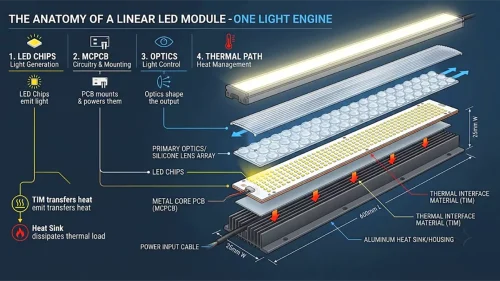
Calculate LED lumens, efficiency, and lighting guidelines.

Calculate LED lumens, efficiency, and lighting guidelines

Two LED panels sit on the same procurement spec. Both rated 40W. Both labelled as 4x36W fluorescent equivalents. One delivers 2,900 lumens to the room. The other delivers 3,800. Same wattage on the carton, almost a third more light from one to the other.
Across 300 panels in a commercial fit-out, that gap decides whether the building hits its task illuminance, qualifies for utility rebates, and clears Title 24 plan check, or comes in noticeably under spec by year three. The spec that matters is lumens, not watts. Watts only describe what it costs to run.
Most procurement teams still treat the two as interchangeable, a habit inherited from the incandescent era when wattage and brightness moved together. With LED, they do not. What follows is built around the questions buyers ask when specifying LED for commercial projects: how lumens are calculated, why source efficacy and system efficacy are not the same number, how to size fixture count for a working plane, and how CRI and CCT change the answer without changing the lumen budget.

What are LED lumens?

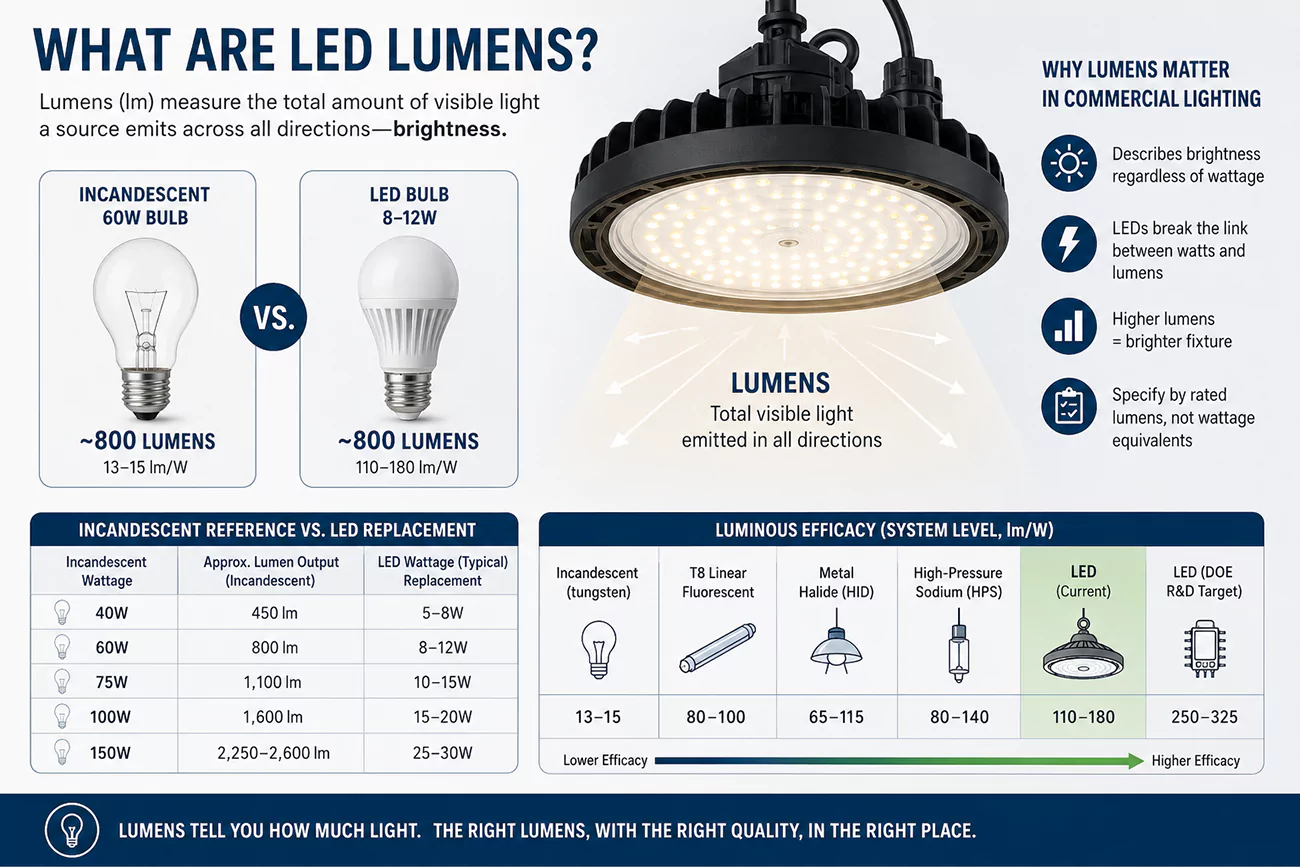
A lumen (lm) is the unit of luminous flux. In plain terms, lumens measure the brightness of a source: the total amount of visible light it emits across all directions, weighted against the human eye’s spectral response. In commercial procurement, lumens describe the light a fixture delivers, while watts describe the electricity it consumes.

Under incandescent technology the two tracked each other because the physics was locked. A tungsten filament at roughly 2800K produced 13 to 15 lm/W, with the rest lost as infrared heat, which is why incandescent light bulbs were sold by wattage and a “60W bulb” became shorthand for “around 800 lumens” in legacy specifications. LED technology breaks that link. The lumens per watt LED fixtures deliver now depends on chip binning, driver topology, optical assembly, and housing thermal performance, and varies substantially between products that look identical on a procurement form. Two 40W LED panels from different manufacturers, tested in the same integrating sphere, can read close to 3,800 lm and under 2,900 lm respectively. The lumens of an LED light are now independent of its input power. The higher the lumen value, the brighter the light, and the higher the luminous efficacy, the higher the lumen value at the same wattage. LED lamp lumens should therefore be specified by rated output, not by wattage equivalence.

The LED lumens chart below maps the legacy incandescent reference most buyers still carry mentally against the LED wattage that actually replaces it. An LED light lumens chart like this is a planning anchor, not a substitute for the photometric file.

Incandescent WattageApproximate Lumen OutputLED Wattage (2024 typical)
40W450 lm5–8W
60W800 lm8–12W
75W1,100 lm10–15W
100W1,600 lm15–20W
150W2,250–2,600 lm25–30W

For commercial specification, the more useful comparison is luminous efficacy: the lumens per watt an LED source actually delivers across source families, since most retrofits replace an entire technology category rather than a single fixture.
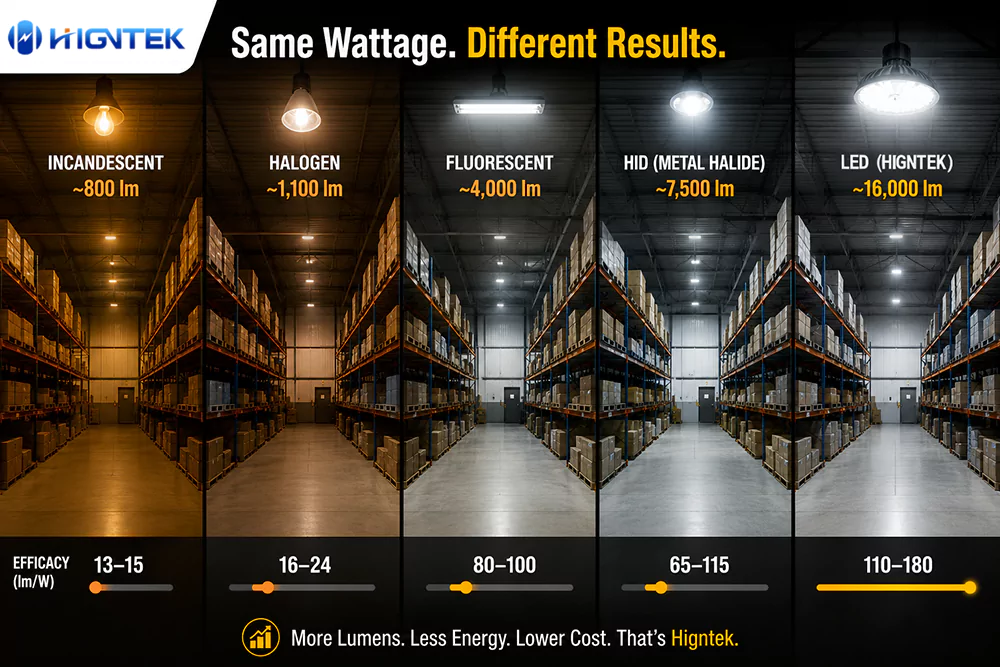
Typical lumens and luminous efficacy for different luminaires


SourceTypical Efficacy (lm/W)Notes
Incandescent (tungsten)13–15Phased out under most commercial codes
Halogen16–24Roughly 90% heat
T8 linear fluorescent80–100System efficacy after ballast losses
T5HO fluorescent90–105Common in high-bay pre-LED
Compact fluorescent (CFL)50–75Mercury content, ballast failures
Metal halide (HID)65–115Severe lumen depreciation, long restrike
High-pressure sodium80–140Monochromatic, useless for color tasks
LED (2026 current commercial fixtures)130–200System efficacy, not chip

The theoretical maximum at 555 nm, the peak of human photopic sensitivity, is 683 lm/W. No white-light fixture approaches it, because a usable spectrum must include red wavelengths the eye perceives less efficiently. Higntek’s current top-of-the-line modern LED lighting modules boast luminous efficacy ranging from 180 to 265 lm/W. The same physical principle explains why a luminaire with a nominal luminous efficacy of 180 lm/W and a color rendering index (CRI) of 70 cannot be directly compared to one with a nominal luminous efficacy of 130 lm/W and a CRI of 90: there is a natural trade-off between luminous efficacy and CRI; deliberately increasing luminous efficacy → lowering the CRI.
Distribution warehouses can use luminaires with a luminous efficacy of 180 lm/W; while showrooms and food processing plants require luminaires with a luminous efficacy of 130 lm/W and a CRI (CRI > 90).
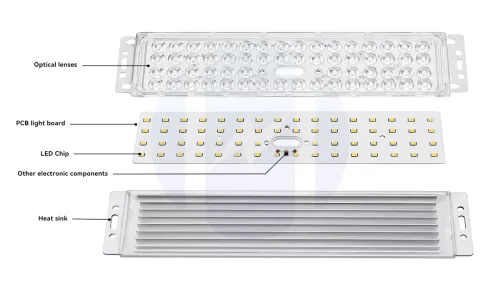
One further spec-sheet trap is total lumens versus useful lumens. Total lumens is the integrated output across all directions under LM-79 photometry. Useful lumens, defined under the EU Ecodesign Directive, counts only light within a 90-degree forward cone. For downlights, trough lights, high bay lights, and panel lights, illuminance calculations should use the actual lumen count provided by the LED in the photometric file, rather than the lumen count of the bare LED package. This is because the difference between the two is 20% to 40% due to thermal management and optical and electrical design considerations.

Importance of Luminous Efficiency.

Luminous efficacy connects optical performance to the utility bill, and it gets gamed harder than almost any other spec. Two numbers float around. Light source efficiency is measured on an LED package on a 25°C thermal test bench, typically using rated voltage and current measurements. This is also the source of high luminous efficacy data such as 270+ lm/W for LED chips. That number describes the chip in a lab, not in a fixture. System efficacy, also called luminaire efficacy, is what leaves the housing after the full chain of losses.
In our bench measurements, driver losses pull off 5 to 15% depending on topology and load point, thermal droop comes in at 2 to 8% at a real 65 to 85°C junction, and optical losses through lens and diffuser run 5 to 15% depending on beam angle and haze level. Reflector geometry and trapped light inside the housing eat more. By the time photons leave the aperture, a 200 lm/W chip ships 160 to 175 lm/W from a well-designed fixture, and 115 to 130 lm/W from a poor one. That 30 to 40% spread between two fixtures carrying the same headline number is the entire reason efficacy belongs in the spec rather than the marketing copy, and it is why the high efficiency LED modules we specify are quoted at delivered LED lighting modules efficacy, not chip-level figures.
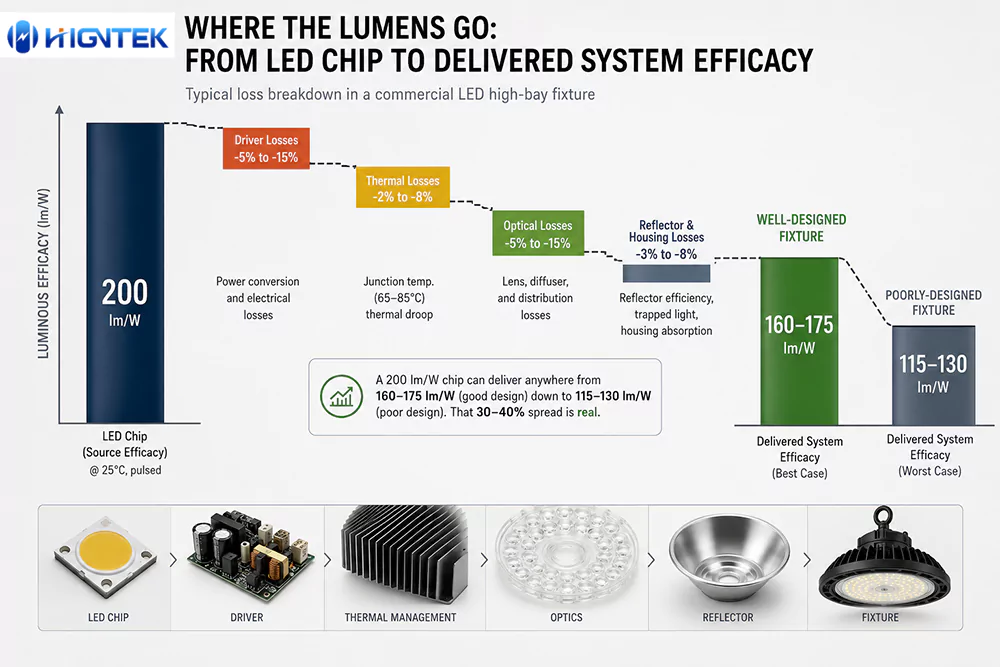
Luminous flux from LED chips to complete lighting fixtures

A representative case: a 280,000 sq ft cold-storage and dry warehouse, 312 fixtures of 400W metal halide, connected load over 130 kW. Retrofit to 150W LED high-bays at roughly 155 lm/W brought load down to about 47 kW, with annual savings north of $140,000. The utility rebate, keyed to DLC Premium listing, came to about $62 per fixture, roughly $19,000 off the project. Payback landed under 18 months before the cold-storage HVAC offset, which the facilities team put at another $11,000 to $14,000 a year.

The DesignLights Consortium (DLC), whose Qualified Products List most US utility rebate programs are keyed to, maintains two tiers. Per its technical requirements, DLC Premium products must meet higher efficacy and lumen maintenance requirements than DLC Standard products, currently around 150 lm/W minimum plus L70 of at least 50,000 hours for high-bay categories. Miss the tier and the rebate disappears, leaving a $200,000 retrofit to absorb $60,000 to $80,000 of incentive money baked into the proposal. California’s Title 24 Section 140.6 adds lighting power density caps on top: office 0.65, retail 0.84, warehouse 0.48 W/sq ft. Anything under about 130 lm/W system efficacy fails the load calculation before the plans go out for stamp.

Formula for Calculating Luminaire Lumens.

Every commercial design hinges on one number: the number of lumens delivered to the working plane. The formula is the lumen method, introduced by the Illuminating Engineering Society (IES) nearly a century ago. As the IES notes, the concepts it is based on still persist as the basis for prescribing lighting levels today, and every photometric package still runs on it.

Total lumens required = (Target illuminance × Area) ÷ (CU × LLF)

Target illuminance has the most published guidance, since the IES Lighting Handbook gives a range per task:

Space typeTarget illuminance
General office (reading, writing)300–400 lux (30–40 FC)
Technical office (drafting, fine assembly)400–500 lux
Retail general sales500–750 lux
Retail feature display1,000–2,000 lux
Warehouse general storage100–200 lux
Warehouse picking aisles200–300 lux
Industrial assembly (medium work)500 lux
Industrial inspection (fine work)1,000+ lux

One foot-candle equals about 10.76 lux, or one lumen per square foot. US sheets quote FC and most software uses lux, so conversion errors are common in spec reviews.

  • CU is the fraction of rated lumens reaching the working plane: about 0.95 for accent/spot, 0.85 for downlight/direct, 0.75 for ambient/wall-wash, 0.50 for indirect. It is looked up by room cavity ratio:RCR = 5 × H × (L + W) ÷ (L × W).
    Where H is the cavity height to the ceiling or fixture. Tall narrow rooms run a high RCR and lose more light to the walls. Manufacturers publish CU tables indexed by RCR and surface reflectance.
  • LLF, the maintenance factor, captures everything between commissioning and end of life. The 0.85 default is the product of lamp lumen depreciation, driver factor, luminaire dirt, and room-surface dirt. A clean office holds 0.85, but a metal-stamping plant with oil mist runs closer to 0.65, and post-occupancy lux readings come in 25 to 30% below design where the default was used without adjustment.

Worked example: a 12,000 sq ft manufacturing floor, 500 lux target, fixtures at 18 ft, reflectances 50/30/20. Area is about 1,115 m², RCR about 1.4 giving CU about 0.78, LLF 0.80.
Total lumens required = (500 × 1,115) ÷ (0.78 × 0.80) ≈ 893,000 lm
At 22,500 lm per fixture (a 150W high-bay at ~150 lm/W) that is about 40 fixtures, on a grid roughly 23 to 27 ft apart, usually adjusted to column lines with a few added for edge uniformity.

Two variables break the basic formula.
Beam angle is the first: a 75W LED at constant output gives about 12,030 lux at 2m through a 12-degree optic but only 2,530 lux through a 17-degree optic, so above 15 to 18 ft mounting you run photometric simulation (AGi32, DIALux, Visual) instead.
Surface reflectance is the second: CU tables assume around 80/50/20, an older building near 50/20/10 needs roughly double the lumens, and coating booths or black stages push that to 4×.

The watts to lumens LED conversion runs in both directions:
Required power (W) = Luminous Flux(lm) ÷ System efficacy (lm/W)
Fixture lumen output (lm) = Fixture power (W) × System efficacy (lm/W)
When purchasing lighting fixtures, it’s important to note that wattage does not equal lumen output (luminous flux). At the same power, a higher luminous efficacy means a greater luminous flux and thus higher brightness.

Required LumensAt 100 lm/WAt 130 lm/WAt 150 lm/WAt 170 lm/W
5,000 lm50W38W33W29W
10,000 lm100W77W67W59W
15,000 lm150W115W100W88W
20,000 lm200W154W133W118W
25,000 lm250W192W167W147W
30,000 lm300W231W200W176W

100 lm/W is typical for older or low-grade fixtures, 130 is the DLC Standard floor, 150 is the DLC Premium threshold, and 170+ is where top-tier commercial fixtures land.

How many lumens do I need for different applications?

Two things decide the number: the illuminance the task needs, and the area being lit. Multiply the two and that is the lumen budget, before any corrections for the building itself. Everything below works through those two factors in order, then the corrections that real buildings always require.
The illuminance target is where most procurement specs go off the rails, because the figure that matters is the task being performed, not the room label. A “warehouse” might host bulk storage at 5 to 10 fc or fine inspection at 100+ fc, and the lumen budget between the two differs by a factor of ten. The IES task-based ranges that actually drive commercial design:

ApplicationTarget (foot-candles)Target (lux)
Warehouse bulk storage5–10 fc50–100 lux
Warehouse picking and packing20–30 fc200–300 lux
General office and open plan40–50 fc400–500 lux
Conference and training rooms30–40 fc300–400 lux
Retail general sales floor50–75 fc500–750 lux
Retail feature and display100–200 fc1,000–2,000 lux
Fine manufacturing and assembly75–100 fc750–1,000 lux
Precision inspection and QC100+ fc1,000+ lux
Hospitality guest rooms and apartments10–20 fc100–200 lux
Parking structure interior5 fc50 lux
Loading dock20–30 fc200–300 lux

Area is the multiplier. One foot-candle is one lumen falling on one square foot, so a 4,000 square foot space targeting 50 fc needs 200,000 lumens before correction factors. That is the back-of-envelope figure that goes into a feasibility budget before the photometric layout is run.
That base figure assumes a flat empty floor, which no real building is. Two corrections are non-negotiable.

  • The first is the ceiling height multiplier. The base calculation assumes an 8 ft mounting reference, which almost no commercial or industrial building uses. The accepted scaling runs roughly 1.0 at 8 ft, 1.10 at 9 ft, 1.20 at 10 ft, 1.35 at 11 ft, and 1.50 at 12 ft and above. A 20,000 square foot distribution floor with 28 ft clear height does not take a 1.5 multiplier in a straight line, because high-bay optics are designed to project, but the inverse-square reality still means the number of lumens needed at the source climbs steeply with mounting height. This is exactly where beam distribution selection stops being optional, and where a flat lumen-per-square-foot rule of thumb quietly underlights a building by 30 percent.
  • The second is surface reflectance. The lumen budget assumes typical commercial reflectances. A warehouse with bare structural deck, dark racking, and concrete floor absorbs far more light than a painted office, and the required lumens climb 20 to 40 percent to hold the same task plane illuminance. Dark-walled environments such as machine shops or coating areas push that correction higher.

Besides the physical space, two other details determine the final required lumen output.

  • Application Scenarios: Ambient lighting sets the general work illuminance at 10 to 50 fc, while task lighting raises the illuminance of specific work areas to 70 to 80 fc (this is why warehouse picking aisles require dedicated aisle lighting fixtures instead of relying on high bay lights), and the illuminance of accent lighting in retail and showroom environments is approximately three times that of ambient lighting.
  • Luminous Efficacy: The luminous efficacy of a luminaire determines its operating costs. For example, a system with a luminous efficacy of 150 lm/W consumes approximately 0.33 watts per square foot on a 4,000 square foot floor. This fully complies with California Building Code Section 24, Section 140.6 (as described above). Lower luminaires (90 lm/W) require approximately 40% more energy.

To close, an LED light lumens chart that collapses the formula above into a single look-up by application. Numbers assume 8 to 10 ft mounting and typical commercial reflectances; apply the ceiling and reflectance corrections above for taller or darker spaces.

ApplicationLumens per sq ft1,000 sq ft5,000 sq ft10,000 sq ft
Warehouse bulk storage5–105,000–10,00025,000–50,00050,000–100,000
Warehouse picking aisles20–3020,000–30,000100,000–150,000200,000–300,000
General office40–5040,000–50,000200,000–250,000400,000–500,000
Retail general sales50–7550,000–75,000250,000–375,000500,000–750,000
Retail feature display100–200100,000–200,000500,000–1,000,0001,000,000–2,000,000
Manufacturing assembly75–10075,000–100,000375,000–500,000750,000–1,000,000
Precision inspection100+100,000+500,000+1,000,000+
Loading dock20–3020,000–30,000100,000–150,000200,000–300,000

The difference between lumens, CRI, CCT, and brightness.

These four terms get used interchangeably on purchase orders, and the confusion costs real money on commercial retrofits. Brightness is the subjective visual perception of light, whereas lumens are the objective, scientific measurement of the total amount of visible light emitted by a source. The other two metrics describe entirely different properties: CCT is the tone of the light, and CRI is the accuracy of the colors it reveals. A spec that pins down lumens but leaves CCT and CRI to the supplier’s default is a spec that will be argued about after installation.

Luminous efficacy.

Luminous efficacy is the number of lumens emitted by an LED per watt of energy consumed. It is also a measure of electricity bill consumption. It says nothing about what the light looks like or how things look under it.

Color temperature.

CCT, correlated color temperature, is measured in Kelvin and describes whether the light reads warm or cool. The industry bands are stable across manufacturers, and for commercial application the mapping is functional rather than aesthetic:

CCT rangeAppearanceTypical commercial application
2700–3000KWarm whiteHospitality, premium residential, fine dining
3000–3500KWarm-neutralRetail, apparel, food display
3500–4000KNeutral whiteOffices, conference rooms, classrooms
4000–4500KCool-neutralHealthcare, specialty retail
5000–6500KCool white / daylightWarehouses, parking, industrial floors

The warm end is the residential and hospitality default, which is worth knowing because it is the reference point most clients arrive with before a commercial project pulls them cooler. A frequent and expensive myth is that a higher CCT means a brighter light. It does not. Brightness is the number of lumens emitted, and it is fully independent of CCT and CRI. A 5000K fixture with low lumen output is dim, and a 3000K fixture with high output is intense.

Color Rendering Index.

CRI, the color rendering index, is a 0 to 100 score for how accurately a source reveals true colors against a reference. The practical bands: 70+ is the minimum acceptable base, 80+ is good and is the floor for most general commercial work, 90+ is excellent and required where color decisions are made, and 95+ closely tracks natural daylight.
The number that gets missed is R9, a CRI sub-score for deep red rendering. Standard CRI (Ra) can post a respectable number while R9 is poor, which is why food looks grey under a fixture that claims CRI 85, and why printed proofs, paint chips, and apparel colors get rejected under nominally compliant lighting. For any space where color is a decision and not a backdrop, R9 has to be called out separately on the spec, because the headline Ra figure hides it.
There is a trade-off between Color Rendering Index (CRI) and luminous efficacy. Higher luminous efficacy usually comes at the cost of a lower CRI/Ra; conversely, a higher CRI requires a reduction in luminous efficacy. To increase lumens per watt, high-efficiency LED lighting module designs utilize wavelengths most sensitive to the human eye (green-yellow band), which narrows the spectral range and naturally results in a lower CRI. Achieving a CRI of 95 or higher requires a more complex phosphor system to convert blue light into a broader spectrum including deep red, but this conversion reduces efficiency. A luminaire with a nominal luminous efficacy of 170 lm/W and a color rendering index (CRI) of 70 is not a superior or inferior version of the same product, while a luminaire with a nominal luminous efficacy of 130 lm/W and a CRI of 95 is not. They are two different engineering solutions for different lighting needs, and the specifications must clearly state the problem being solved.

The impact of CRI on color reproduction

The recommended commercial CRI and CCT pairings are tighter than most procurement teams realize:

Space type

CRI

CCT

General offices

80–90

3500–4000K

Fashion and apparel retail

90+

3000–3500K

Galleries and high-value display

95+

3000–3500K

Premium hospitality and high-end residential

90+

2700–3000K

Warehouses and industrial floors

80

5000–6500K

Specifying 95+ CRI on a bulk storage warehouse wastes efficacy and money; accepting 80 CRI on a paint-matching line generates returns and rework.
LED specification at commercial scale either delivers a building that hits its illuminance targets, qualifies for rebates, and passes plan check, or one that comes in 30 percent under spec at year three. The gap is rarely the headline number on the data sheet. It is the system efficacy, the binned CRI and R9, and the delivered luminaire lumens that the module supplier stands behind.
For project teams scoping a retrofit or a new commercial build, the practical checklist runs through four items: ask the supplier for system efficacy at the rated drive current with the optic installed, request binned CRI and R9 figures rather than typical values, verify DLC tier listing against the utility rebate’s eligibility requirement, and run the connected load against the applicable Title 24 lighting power density cap before locking fixture count.
Our high efficiency LED modules are quoted at delivered Module performance rather than chip-level marketing figures, so the LED lamp lumens on the cut sheet match what arrives at the working plane. Our application engineers can review your photometric requirements and recommend the module configuration that holds the lumen budget against real delivered output. Get in touch for a project review or a sample request.

FAQ

How many lumens is a 60 watt LED bulb?

A 60W incandescent bulb produces about 800 lumens, and the LED that replaces it delivers the same ~800 lumens while drawing only 8–12W. The LED lumens chart above shows the full set of equivalents. A genuine 60W LED fixture is a different product and would put out roughly 8,000–9,000 lumens at commercial efficacy.

Modern commercial LED fixtures deliver roughly 80–150 lm/W at the system (luminaire) level, with top-tier products in the 160–225 range. The lumens LED lights produce at the chip level can exceed 265 lm/W, but those are laboratory numbers, not what actually leaves the fixture.

No. Lumens measures quantity only, not color quality (CRI), tone (CCT), or how the light is distributed. Over-lighting wastes energy and can breach lighting power density caps like Title 24. Match lumens to the task, not to the highest number available.

Multiply fixture wattage by system efficacy: a 100W fixture at 150 lm/W delivers about 15,000 lumens. Use system (luminaire) efficacy, not the chip’s source efficacy, or the figure overstates real delivered output by 20–30%.

Spec sheets often quote chip-level source efficacy or total package lumens. After driver, thermal, and optical losses, system output is typically 20–40% lower, and for directional fixtures the useful lumens within the forward cone is lower still.

Planning a New LED Lighting Project?

Share your application requirements with our engineering team and receive tailored recommendations on lumens, efficacy, CCT, CRI, and LED module design.

On-Time Delivery 99.38%

Consistent production & reliable global delivery

End-to-End Engineering Support

From design optimization to production guidance

3-Day Rapid Prototyping

Fast sampling to accelerate product validation

100% Quality Inspection

Full testing ensures stable and reliable performance

Discuss LED module project specifications with professional engineers.

Pre-Engineering Inquiry