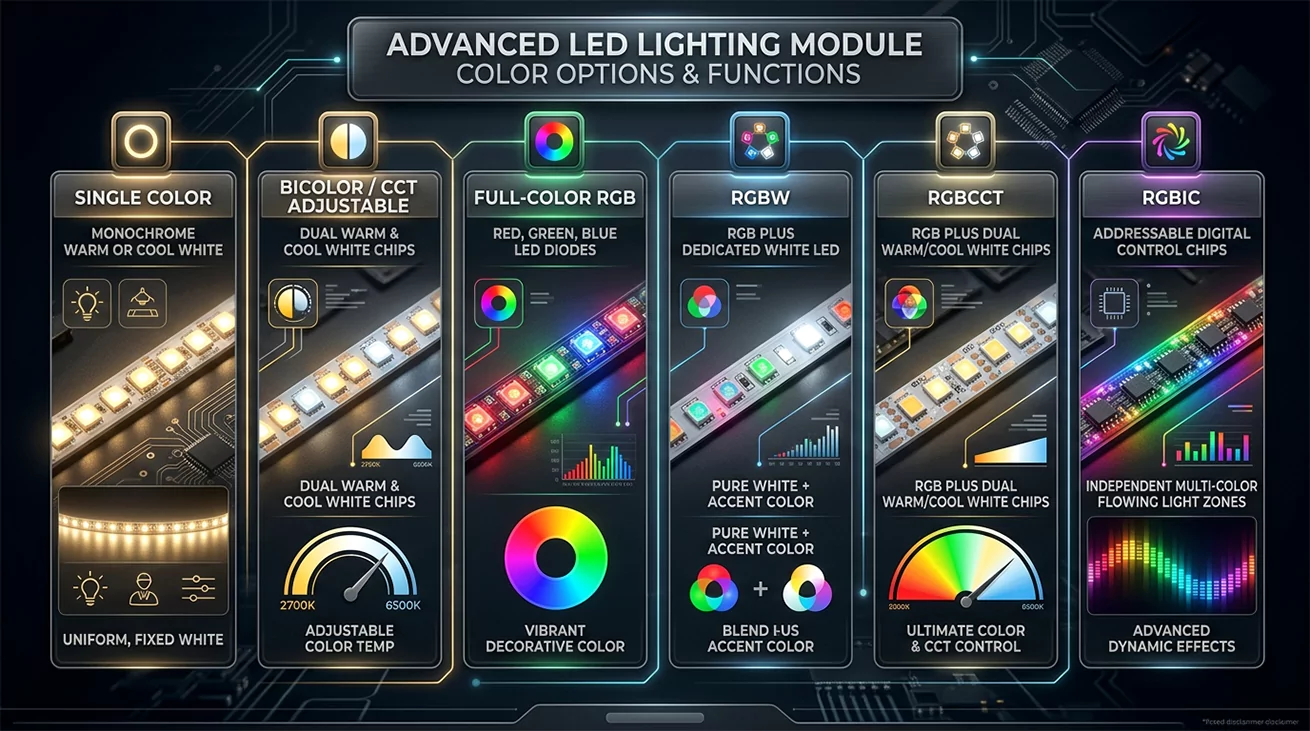
A single color LED module produces one fixed light color, such as white, red, green, blue, amber, pink, or another specified color. It is the simplest LED module colour option, and it is often the most practical one when the lighting task does not change.
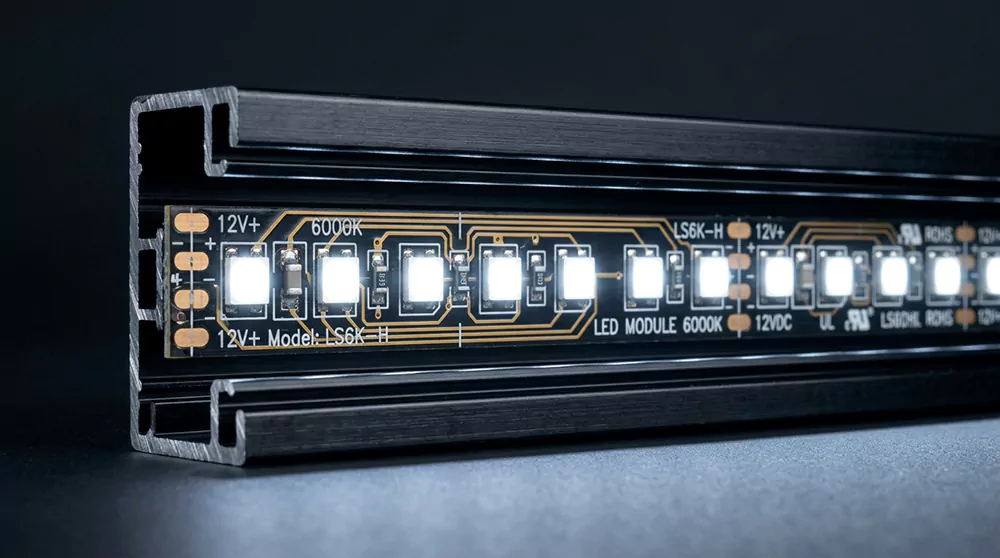
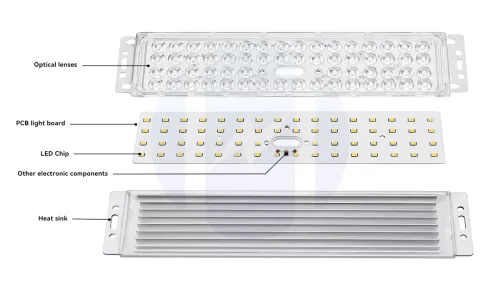
Single color modules usually use one LED color type across the PCB. A white module is normally specified by CCT, such as the 2700K warm white, 3000K warm white, 4000K neutral white, or 5000K to 6500K cool white. ENERGY STAR explains CCT on the Kelvin scale, where lower values such as 2700K to 3000K look warmer, while 4000K and higher look cooler. A colored module uses LED chips or LED packages selected for the target color, such as red for signage, green for status indication, blue for decorative lines, or amber for warning and wayfinding.
The useful part is not only lower cost. Single color keeps the control system clean. The module turns on, turns off, and dims through a matched driver or dimming method. The PCB layout is usually simpler, the connector can have fewer pins, and production testing is more direct because there are fewer color channels to balance.
This is why single color still appears in signage lighting, channel letters, cabinet lighting, shelf lighting, backlight panels, machine indicators, stair lighting, and architectural lines. In these applications, changing color may sound attractive during product discussion, but the installed product often spends its entire life showing one fixed color. Paying for unused RGB control does not make the project more professional.
One correction matters here. Single color white is not one generic white. For the retail, cosmetics, food, textile, and printed graphics, CRI or more detailed color rendition metrics also matter because the module affects how objects appear under the light. ENERGY STAR describes CRI as a measure of how much color shift objects undergo under a light source compared with a reference source, while IES TM-30 gives a broader set of metrics for evaluating color rendition.
For fixed shelf or cabinet lighting, a defined white CCT, CRI target, LED binning control, suitable PCB width, and proper thermal path may be more useful than unused RGB control. After checking the actual store use, the requirement is often stable neutral white across many shelves, not color effects. In that case, a single-color white module with a defined CCT, CRI target, LED binning control, suitable PCB width, and proper thermal path is more useful than RGB. It keeps wiring simpler and makes batch consistency easier to inspect.
A full-color RGB LED module uses red, green, and blue LED channels to create many colors through additive mixing. It is the basic full-color choice among LED module colour options. RGB works by changing the brightness ratio of the three channels. Red plus green can create yellow. Green plus blue can create cyan. Red plus blue can create magenta. When all three channels are turned on, RGB can simulate white, but that white is not the same as a dedicated white LED channel. DOE explains that white LED light can be produced through color-mixed systems, where light from multiple monochromatic LEDs, such as red, green, and blue, is mixed to produce white light.

An RGB module normally needs three control channels. Red, green, and blue are controlled separately, often through PWM dimming. In a non-addressable RGB module, the whole module or whole section changes color together. That is enough for mood lighting, simple color scenes, brand accents, exhibition furniture, and decorative lines.
From a module design angle, RGB is not just “three colors on a board.” Red, green, and blue LEDs have different electrical and optical behavior. The PCB routing, current setting, LED binning, and thermal design affect whether colors mix evenly and whether one channel becomes visually stronger than the others after long use.
RGB is useful when the project wants affordable full-color effects without complex pixel animation or high-quality white output. I would use it for decorative ambience, gaming accents, signage borders, bar lighting, exhibition booths, and simple architectural color lines.
This is one of the mistakes worth correcting. RGB can create many colors, but it is not a strong white-light solution by default. RGB mixed white may show a color cast, and the result depends on LED binning, current control, diffuser distance, optical mixing, and controller calibration. For signage accents or decorative effects, that may be acceptable. For cosmetics, food, hospitality task lighting, or product display, it may not be enough.
An RGBW LED module combines red, green, blue, and one dedicated white LED channel. It is usually chosen when a project needs color effects plus a cleaner white mode than RGB alone can provide.
The white channel is the reason RGBW exists. Instead of using red, green, and blue to simulate white all the time, the module can use the W channel for a more direct white output. This often gives a cleaner and more practical white scene, especially in decorative commercial lighting where the product alternates between ambience and usable white. The quality of white in RGBW still depends on the selected white LED package, color temperature (CCT), color rendering index (CRI), banding, current setting, optics, diffuser, and heat dissipation design.
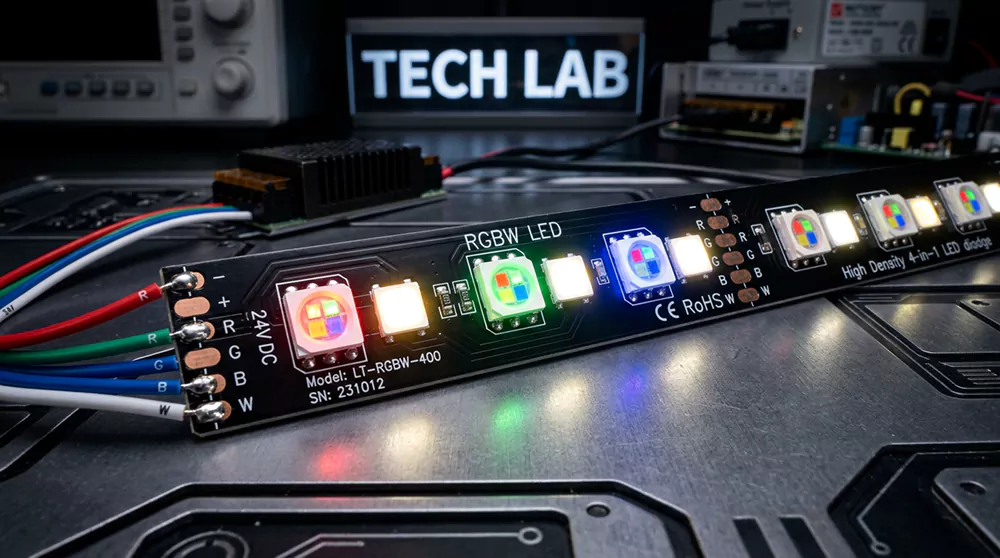
The control system normally needs four channels. That means the controller, connector, wiring, PCB layout, and test process must all support red, green, blue, and white separately. In compact modules, four-channel routing can become a real layout issue, especially when the module also has strict width, brightness, and heat requirements.
RGBW modules are common in retail displays, hotel interiors, decorative linear lights, signage, exhibition systems, furniture lighting, and architectural accents. A hotel feature wall is a typical case. Most of the time it may need soft white light that does not look tinted. During events, it may shift into brand colors or ambient color scenes. RGBW handles that better than RGB while staying simpler than RGBCCT.
The limitation is fixed white. RGBW normally has one white CCT, such as warm white, neutral white, or cool white. Once selected, that white point does not shift across a warm-to-cool range unless the module design changes. For projects that need both color effects and tunable white, RGBCCT is usually the stronger fit.
An RGBCCT LED module combines RGB color channels with tunable white channels, usually warm white and cool white. It can create colorful scenes and also adjust white light from warm to cool, which makes it one of the most flexible LED module Color functionality options. A typical RGBCCT structure has five channels. Red, green, and blue create color effects. Warm white and cool white create CCT adjustment. Some designs use a five-in-one LED package, while others arrange RGB LEDs and CCT white LEDs separately on the PCB. The right structure depends on LED density, module width, optical mixing distance, diffuser design, power budget, and cost target.
Some suppliers also use RGBCW, RGBWW, RGB+CCT, or RGBWWCW for similar RGB plus dual-white designs. In most project discussions, RGBCW means red, green, blue, cool white, and warm white, so it is often another name for RGBCCT. Still, we would confirm the actual channel map before sampling, because naming can vary between catalogs.

The practical value is that the project does not have to choose between color scenes and adjustable white. A retail display can use neutral or high-CRI white during normal store hours, warmer white for premium ambience, and RGB color for campaign scenes. A smart lighting product can move from functional white to decorative color without changing the module platform.
Still, RGBCCT should not be treated as automatically “the best.” It is more complex. Five-channel control needs a compatible controller or driver, more PCB routing space, more connector capacity, more current planning, and more testing. In small modules, optical mixing can also be harder because RGB and white channels must look visually uniform through the diffuser.
Another correction is important. RGBCCT does not automatically guarantee higher CRI. It gives the design more white-light flexibility because warm white and cool white channels can be selected with suitable CCT and CRI targets. The actual color rendering depends on the white LED packages and specification. That distinction matters in professional communication.
We only recommend RGBCCT to clients when the product requires truly adjustable white light and color effects. A cosmetics counter, smart furniture light, hotel ambient wall, or premium retail display may need exactly that mix. If the product only needs warm-to-cool white, bicolor is cleaner. If it only needs one fixed white plus color effects, RGBW may be enough. The advantage of RGBCCT lies in its technological superiority when both color temperatures are used simultaneously in the final application. For Higntek, this is a natural but careful soft-integration point. RGBCCT module development needs LED chip arrangement, LED PCB design review, component selection, control circuit planning, optical mixing, thermal balance, and functional testing.
An RGBIC LED module is an addressable full-color LED module with integrated control ICs for pixel-level or segment-level color control. It is also called an addressable LED module, and its main value is independent control, not simply just more colors. The IC may be built into the LED package or mounted as a separate control chip on the PCB. The controller sends data signals to the ICs, and the ICs control the brightness and color of the addressable point. This makes RGBIC different from ordinary RGB. It needs data control and power planning at the same time.
In ordinary RGB modules, a whole module or section often changes color together. In RGBIC modules, each LED or LED group can receive separate control data. That is how RGBIC creates chasing effects, flowing gradients, rainbow movement, scanning lines, animated patterns, and point-by-point color changes.
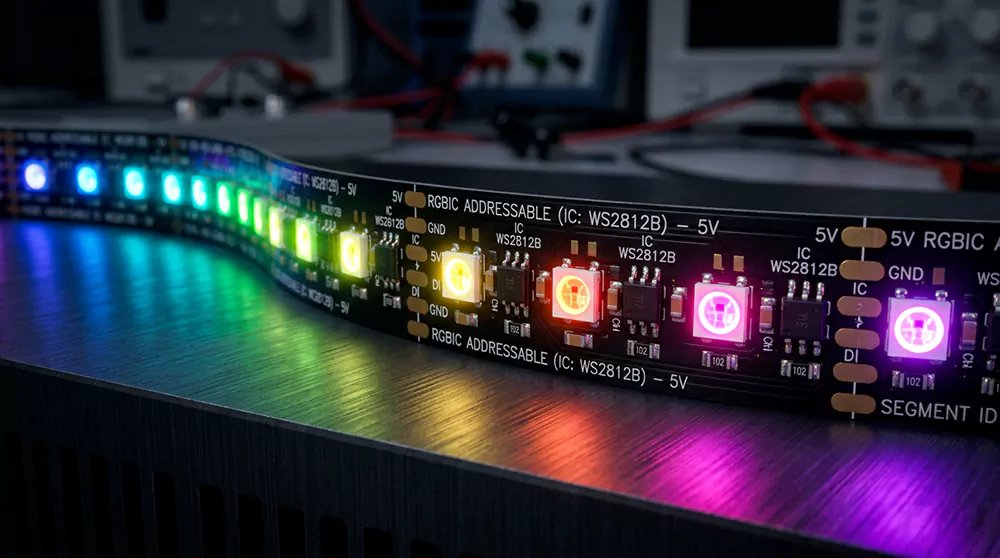
There are also practical details that buyers often miss. Pixel grouping changes the effect. One RGBIC module may control each LED individually, while another may control several LEDs as one segment. Both can be addressable, but the visual resolution is different. This is why RGBIC should be specified by pixel resolution, IC type, controller protocol, voltage, and power structure, not only by the effect name.
Among all LED module colour options, RGBIC is the most effect-driven. I would choose it when the project needs addressable motion, pixel-level behavior, and dynamic visual control. RGBIC modules are common in gaming lighting, stage decoration, dynamic signage, façade lines, exhibition installations, interactive displays, smart decorative strips, and visual-effect linear lights. They are not the first choice for projects that mainly need accurate white light or simple long-term operation.
The engineering requirements are higher than RGB. RGBIC design needs attention to IC type, data signal integrity, voltage drop, current capacity, controller compatibility, pixel density, power injection, connector design, and protection requirements. For long runs or high-density modules, poor power planning can cause brightness drop, color shift, or unstable data behavior.
Full-color RGB LED modules use red, green, and blue channels for color mixing, while RGBW LED modules add one dedicated white channel for cleaner and more usable white light. The real difference is not just one extra LED. It changes the control channels, PCB layout, connector design, driver matching, power distribution, white-light quality, and final application fit.
We would not compare RGB and RGBW by asking which one has more colors. Both belong to common LED module colour options, and both can create color-changing effects. The better question is whether the module needs white light that people will actually use, not just a short decorative white scene. If white is only a temporary effect, RGB may be enough. If the product often works in white mode, RGBW usually deserves a closer look.
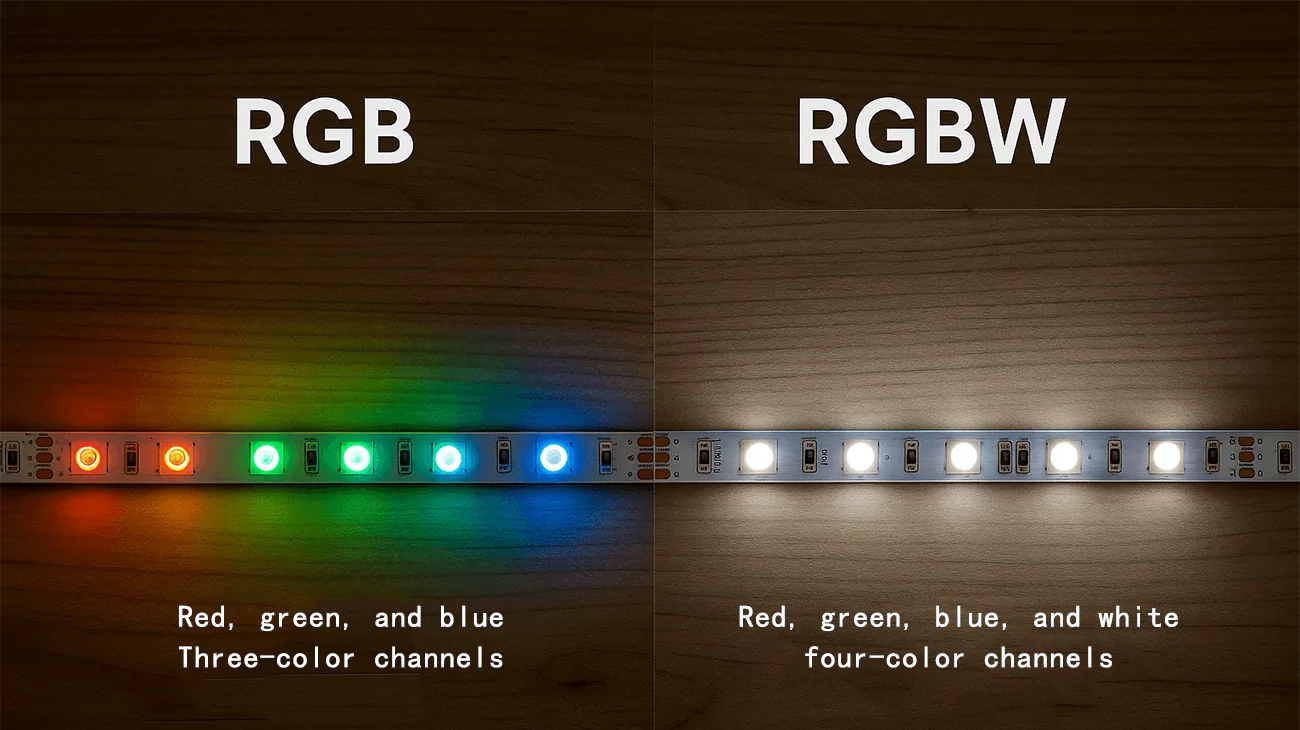
RGB creates white by turning on red, green, and blue together. The U.S. Department of Energy explains that white LED light can be produced through phosphor conversion, color-mixed systems using multiple monochromatic LEDs such as red, green, and blue, or hybrid methods. In a practical RGB module, mixed white depends heavily on channel balance, LED binning, current setting, diffuser distance, optical mixing, and controller calibration. It may look slightly pink, blue, green, or uneven when the optical design is weak.
RGBW avoids part of that problem by adding a white LED channel. That channel may be warm white, neutral white, or cool white, depending on the selected LED package. In retail, hospitality, signage, furniture lighting, and architectural accents, this often gives a more practical white mode than RGB mixed white.
We still would not call RGBW “automatically better.” The white quality depends on the white LED’s CCT, CRI, binning, . ENERGY STAR describes CCT as the Kelvin-based appearance of white light, with 2700K to 3000K looking warmer and 4000K and higher looking cooler; it also defines CRI as the degree of color shift objects show under a light source compared with a reference source. That is why a serious RGBW specification should not stop at the RGB + W. It should also define what kind of white is needed.
The control structure is another place where buyers often make mistakes. RGB normally needs three control channels. RGBW normally needs four. That one extra channel affects the controller, wiring, connector pins, PCB routing, current distribution, and test process. On a narrow flexible PCB, mini linear module, or high-density custom module, four-channel routing can become a real design constraint, not just a small BOM change.
RGB is still useful when color effect is the main purpose and white light is not expected to carry the daily visual task. Bar lighting, gaming accents, simple signage borders, exhibition lines and low-cost ambience lighting can all work well with RGB because the project mainly needs color change, not a dependable white mode. Once the same module has to move between color ambience and regular white operation, the RGBW becomes more useful. A retail display may use white during daily store hours and brand colors during campaign scenes. A hotel wall feature may need soft white most evenings and color effects during events. A furniture lighting system may need warm white for daily use and RGB color for decorative modes. In those cases, RGBW is not just a vague upgrade. It is closer to how the lighting will actually be used.
A boutique display manufacturer we met working on a 24V under-shelf lighting module once asked for RGB because the brand wanted seasonal color effects. After checking the use pattern, the lighting was mainly expected to stay white during normal retail operation, with color used only for campaign moments. RGB alone could create color, but the white scene looked slightly cold through the diffuser. RGBW with a neutral white channel became the better specification because the product needed functional white first and color effects second.
| Comparison | Full-color RGB LED module | RGBW LED module |
|---|---|---|
| Light channels | Red, green, blue | Red, green, blue, white |
| White output | Mixed from RGB channels | Produced by a dedicated white channel |
| White quality | Suitable for effect lighting, but may show color tint | Usually cleaner and more practical, depending on CCT, CRI, binning, optics, and thermal design |
| Control channels | Usually 3 channels | Usually 4 channels |
| PCB and wiring | Simpler | More routing and connector requirements |
| Best fit | Decorative color effects, signage accents, gaming lights, simple ambience | Retail display, hospitality lighting, furniture lighting, signage, architectural accents needing both white and color |
| Cost and complexity | Lower | Higher because of the extra channel and related control requirements |
| Common mistake | Treating RGB mixed white as equal to real white light | Assuming RGBW automatically means tunable white or high CRI |
| Selection logic | Choose it when color effects matter more than white quality | Choose it when white scenes are used often and color effects are still needed |
For quick selection, I would keep it simple. RGB is enough when the module mainly creates color effects and white is not a working light. RGBW is the better fit when white light will be seen, used, or judged in the real space. For quick selection, RGB fits color-first effects. RGBW fits projects where white scenes will be used and judged in the real space.
RGBW and RGBCCT LED modules are not the same. RGBW uses red, green, blue, and one fixed white channel, while RGBCCT uses red, green, blue, warm white, and cool white channels, so it can create RGB color scenes and also tune white light from warm to cool.
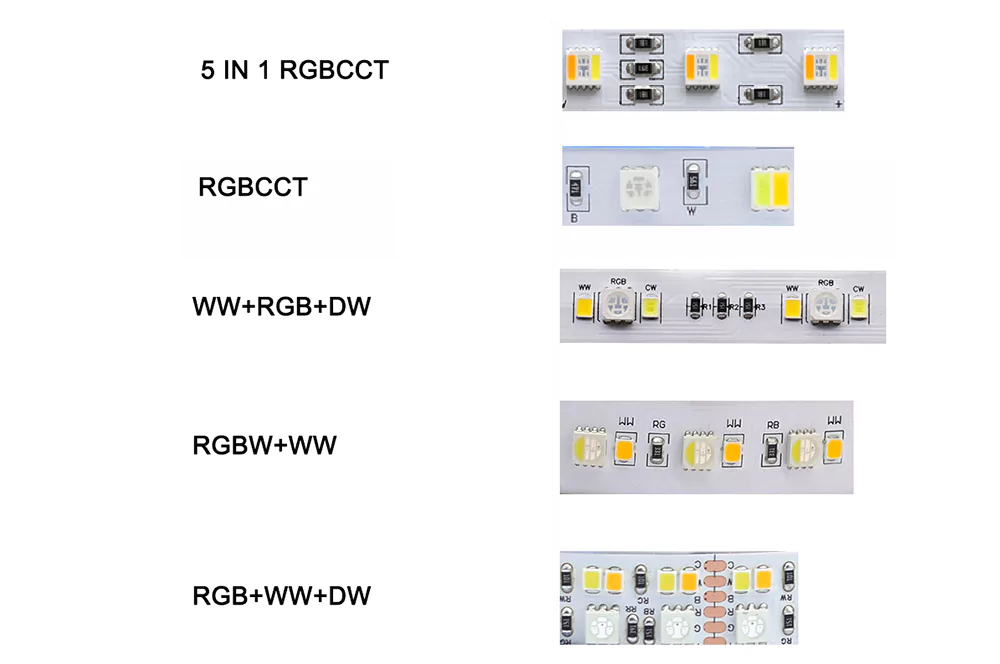
Both RGBW and RGBCCT can create colorful ambience. Both can provide a white-light mode. The difference is what kind of white the module can produce, how much control the final product needs, and how much complexity the PCB and driver system can accept.
- An RGBW LED module has four channels. Red, green, and blue handle color mixing, and the W channel provides one dedicated white output. That white channel may be warm white, neutral white, or cool white, depending on the LED package selected during design. Once the white LED is chosen, the white point is usually fixed. A 3000K RGBW module does not become a proper 6500K white module just because the RGB channels are added. It can slightly tint the appearance, but that is not the same as real tunable white.
- An RGBCCT LED module normally has five channels. Red, green, and blue handle color scenes, while warm white and cool white create adjustable white light. RGBCCT provides full-color and various white light color temperature controls to meet the intelligent spatial needs of lighting that change over time.
The trade-off is complexity. RGBW usually needs four-channel control. RGBCCT usually needs five-channel control. More channels mean more PCB routing, more solder pads, more connector capacity, more driver outputs, more current planning, and more optical testing. DOE also notes that color-tunable products bring control options and possible complications beyond ordinary dimming. In LED module work, that complexity quickly becomes physical. PCB width, copper thickness, LED spacing, diffuser distance, heat path, and controller compatibility all start to matter.
| Comparison | RGBW LED module | RGBCCT LED module |
|---|---|---|
| Channel structure | Red, green, blue, one white channel | Red, green, blue, warm white, cool white |
| Color capability | RGB color scenes, often described as millions of colors when controller resolution supports it | RGB color scenes plus warm-to-cool white control |
| White-light type | Fixed white CCT, depending on selected W LED | Tunable white through warm and cool white mixing |
| White flexibility | Better than RGB, but limited to one white channel | Stronger because white can shift from warm to cool |
| CRI logic | Depends on selected white LED package | Also depends on selected white LED packages; easier to specify for different white scenes |
| Control channels | Usually 4 channels | Usually 5 channels |
| PCB and wiring | Less complex than RGBCCT | More routing, more pins, more driver/control requirements |
| Best fit | Color effects plus one reliable white mode | Color effects plus adjustable white-light scenes |
| Typical applications | Signage, hotel accents, retail display, furniture lighting, decorative commercial lighting | Smart lighting, premium retail, mirror lighting, hospitality ambience, multifunctional architectural modules |
| Common mistake | Treating RGBW as tunable white | Assuming RGBCCT is always necessary or automatically higher CRI |
| Cost logic | Better when one white CCT is enough | Worthwhile when warm-to-cool white is actually used |
We would be careful with one common claim. RGBCCT does not automatically mean higher CRI than RGBW. CRI depends on the selected white LED packages and specification, not only on the channel name. ENERGY STAR’s downlight criteria use Ra ≥80 and R9 >0 as color-quality requirements, which is a useful reminder that color rendering is measured, not assumed from a product label. RGBCCT is usually easier to specify for stronger white-light flexibility because the warm white and cool white channels can be selected with suitable CCT and CRI targets. The actual white quality still depends on LED binning, optics, diffuser distance, current setting, and thermal design.
A small project case makes the difference less abstract. A lighting brand developing a 24V smart mirror module first considered RGBW because the product needed color ambience and a real white mode. During sample review, the white light worked for basic illumination, but the customer also wanted a warm morning mode, a neutral makeup mode, and a cooler task mode. That changed the specification. RGBW was enough for one white mode. RGBCCT was better for the product line because adjustable white was part of the selling function, not just a decorative extra.