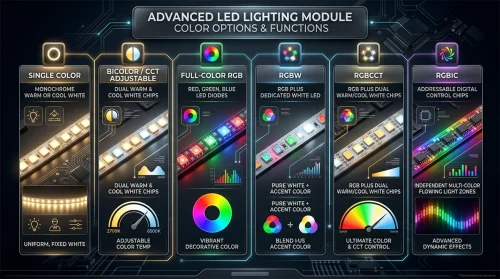
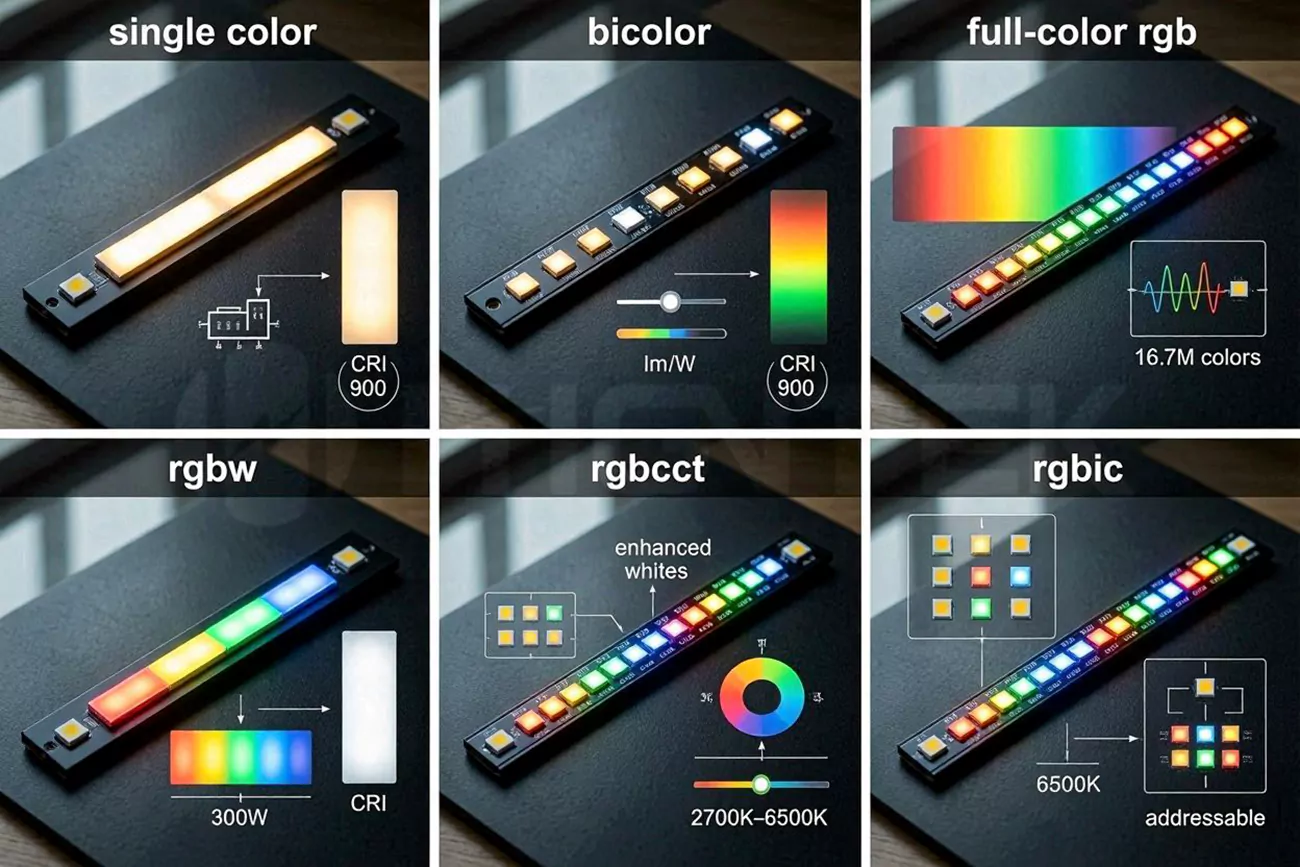
The right LED module color function depends on the project’s visual task, white-light requirement, control method, installation environment, and target cost. In our engineering review, we first identify whether the module needs stable single-color output, bi-color CCT adjustment, full-color RGB effects, RGBW scenes with a dedicated white channel, addressable RGB or RGBIC-type pixel control, or RGBCCT control for both color effects and tunable white performance.
LED module colour options are not only visual choices. They affect LED channel design, PCB layout, driver matching, controller selection, wiring, power distribution, optical mixing distance, heat behavior, color consistency, and final assembly cost, so we usually confirm the final choice by developing and reviewing LED PCBA samples before moving toward production. A backlit logo may only need clean and consistent single white. A retail display may need warm-to-cool adjustment to match product materials and store atmosphere. A signage or advertising module may justify RGBW when brand color and white highlights must appear in the same structure. A programmable façade usually needs addressable control only when independent zones or animated patterns bring real project value.
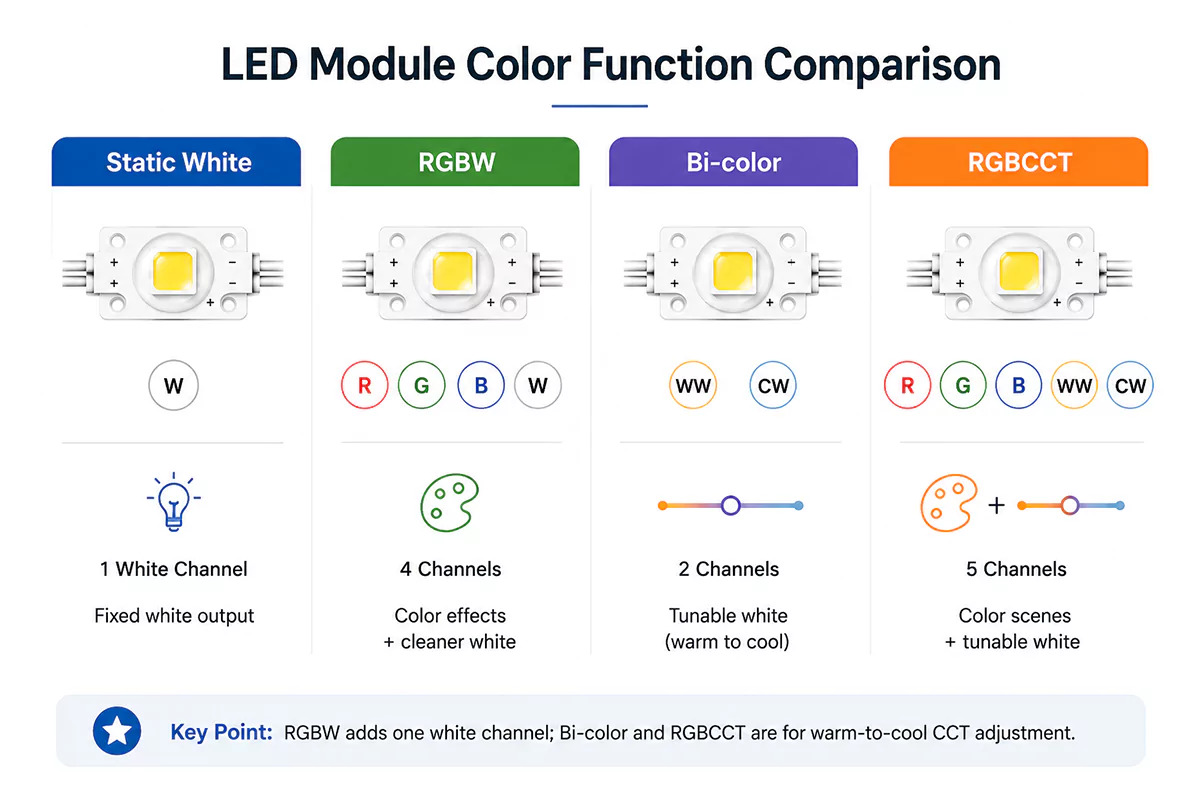
White-light applications need a separate judgment. RGBW can improve white output compared with RGB mixed white because it adds a dedicated white channel, but it is not the same as professional tunable white. Bi-color and RGBCCT modules usually make more sense when the project needs controlled CCT adjustment, such as warm white for hospitality, neutral white for retail, or cool white for task-oriented spaces.
At Higntek, color-function selection starts as an engineering decision, not a feature label. Once the visual task is clear, our team turns it into a practical LED PCBA direction – channel structure, PCB routing, driver matching, optical spacing, control method, and production consistency. This keeps the discussion focused on what the module must deliver after installation, instead of choosing the option with the longest color-function name.
Which LED Module Color Type Is Best for My Application?
The best LED module color type depends on what the application must show every day, not on how many colors the specification sheet can list. In our engineering review, we usually separate projects into six practical needs first – stable single-color output, bi-color CCT adjustment, full-color RGB effects, RGBW color scenes with a cleaner white channel, addressable RGB or RGBIC-type animation, and RGBCCT control for both color and tunable white.
This is where many projects make the wrong turn. A buyer may ask for the “full color” because it sounds safer, but a backlit logo, a menu board, a hotel wall washer, and a programmable façade do not pay for the same kind of LED module Color functionality. More channels can mean more PCB routing, more driver matching, more controller requirements, more wiring, more heat to review, and more points to inspect during production.
| Application | Recommended LED module color type | Why this option usually works better | What our engineering team would check first |
|---|---|---|---|
| Channel letters and fixed brand logos | Single color | It keeps the structure simple, stable, and cost-controlled when the brand color does not change | LED bin consistency, diffuser distance, brightness uniformity, and long-hour heat behavior |
| Light boxes, menu boards, and cabinet backlighting | Single white or bi-color | Single white works for fixed clean output; bi-color adds warm-to-cool adjustment when the same fixture needs different moods | CCT target, hotspot control, lens or diffuser spacing, and batch-to-batch color consistency |
| Retail shelves and product display | Bi-color or RGBCCT | Adjustable white helps match cosmetics, jewelry, apparel, food packaging, and store atmosphere | CRI, CCT range, Duv shift, dimming smoothness, and whether RGB effects are really needed |
| Bars, restaurants, and hospitality accents | RGBW or RGBCCT | RGBW supports decorative color plus a dedicated white channel; RGBCCT gives more useful white-light flexibility | Whether the project mainly needs mood color, practical warm white, or both |
| Signage and advertising modules | RGB or RGBW | RGB supports color-changing brand effects; RGBW improves white text and pale background performance compared with RGB mixed white | White-channel brightness, color mixing distance, controller compatibility, and outdoor protection when needed |
| Architectural lines and façade accents | RGBW, bi-color, or RGBCCT | The right option depends on whether the building needs color scenes, tunable white, or both | IP protection, coating, connector reliability, thermal path, and installation maintenance |
| Themed retail, event props, and motion effects | Addressable RGB or RGBIC-type modules | Independent control enables chasing, flowing, segmented, or pixel-level animation | IC/data layout, voltage drop, controller protocol, repair access, and whether animation justifies the added cost |
| Smart ambient lighting products | RGBCCT | It combines RGB effects with warm and cool white channels, making it suitable for multi-scene lighting products | Channel balance, CCT transition, white-light quality, and firmware/control requirements |
| Machine status and simple indicator modules | Single color or bi-color | Clear signal recognition matters more than decorative color range | Viewing angle, color recognition, current setting, and operating-hour stability |
After this first application match, our engineering team turns the likely color type into a sample-development direction. The next decision is how many LED channels the module actually needs, how the PCB should be routed, how the diffuser or lens will affect output, and how the chosen structure will behave in production. This is often where an initial request becomes a more precise and cost-controlled custom LED module plan.
In a cosmetics retail display project for a regional retail chain, the first request was RGBW for all shelf-backlighting modules because the marketing team wanted more scene options. The program covered three counter formats across standard stores and flagship stores, and most fixtures were expected to run stable product lighting for 10 to 12 hours per day. After we reviewed the actual store scenes, the requirement became more specific. Standard counters needed consistent neutral white for daily product display, while flagship counters needed color scenes for seasonal launches and promotional windows.
The original plan placed RGBW into every counter. The revised plan split the project into two module versions. About 1,450 single white modules were used for standard counters, while around 320 RGBW modules were kept for flagship counters. That meant roughly four out of five repeated modules stayed in a simpler white-light structure, while the higher-visibility counters still kept the color flexibility the brand team wanted.
The useful lesson was not that RGBW was wrong. It was that RGBW did not need to be everywhere. For the single white version, our review focused on CCT consistency, diffuser spacing, hotspot control, expected power load, and long-hour thermal behavior. For the RGBW version, we compared white text and pale graphics under the same diffuser condition, then checked whether the added RGB channels justified extra control wiring, controller points, and scene setup. This kept the everyday fixtures practical while reserving RGBW control for the counters where shoppers would actually notice the color scenes. With the revised split, only about 18% of the modules needed RGBW control, while the rest stayed in a simpler single-white structure.
What This Means for Color-Function Selection?
This type of project shows why color-function selection should be mapped by area, not only by product name. In early planning, we usually separate stable daily output, visible color scenes, and repeated production quantity before defining the LED PCBA sample direction. A practical selection process usually starts with 4 actions:
- Keep stable white or fixed-color output for modules used mainly for daily illumination, repeated shelf lighting, logo backlighting, or standard display areas.
- Reserve RGBW, RGB, or animated color control for areas where color scenes will be visible and commercially useful, such as campaign counters, entrance displays, or promotional windows.
- Review white output under the real diffuser, lens, or pale graphic surface before choosing between single white, RGBW, bi-color, or RGBCCT.
- Confirm whether the added color function also brings extra wiring, controller points, scene setup, inspection work, or after-sales troubleshooting.
This keeps the selection process practical. The goal is not to reduce color options, but to place each color function where it creates visible value.
How to Choose the Appropriate LED Module Color Function?
The appropriate LED module color function should match the real lighting task, white-light requirement, control method, installation environment, and target cost. In our engineering review, we first ask what the module must do after installation, because a fixed logo, a shelf light, a hotel accent wall, and a programmable façade need different levels of LED module Color functionality.
Every color option changes the module structure. Single color, bi-color, RGB, RGBW, addressable RGB, and RGBCCT affect LED chip arrangement, channel count, PCB routing, driver matching, wiring, heat behavior, and inspection focus. The most suitable choice should therefore be decided together with the actual module design, not separated from optical structure, power design, control method, and production requirements.
In practice, we narrow the decision through six linked factors. Cost control tells us whether extra LED channels and controllers are really necessary. White-light quality decides whether the project needs fixed white, RGBW, bi-color, or RGBCCT. Visual effect separates static output, simple color change, and real animation. Control complexity shows whether the installation can support extra wiring, controller points, programming, and troubleshooting. Production consistency matters when repeated modules must match in the brightness, CCT, and color point across batches. Installation environment decides whether coating, connector reliability, heat path, and protection design should influence the color-function choice.
Is RGBW better than RGBCCT for white light applications?
RGBW is better when the project needs RGB color effects plus one cleaner white channel, but RGBCCT is better when the project needs controlled warm-to-cool white adjustment. RGBW can improve white text, pale graphics, and highlights compared with RGB mixed white. For tunable white applications, RGBCCT is usually the stronger structure because it combines RGB channels with warm white and cool white channels.
What is the best LED module for signage and advertising?
Single color is usually best for fixed brand signs, while RGBW is often better for advertising modules that need both color effects and cleaner white elements. RGB can handle basic color-changing effects, but RGB mixed white is usually weaker than a dedicated white channel. For animated signage, addressable RGB or RGBIC-type control is worth considering only when motion effects are part of the final display concept.
Develop a Custom LED Module Colour Solution
Need a specific color range, CCT adjustment, RGB control, or customized lighting performance? Higntek provides complete LED module development from concept design to production.