LED Module Colour Function Selection Guide for Custom Lighting Projects

How to Choose the Right LED Module Color Function

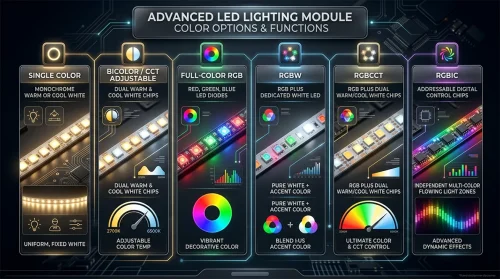
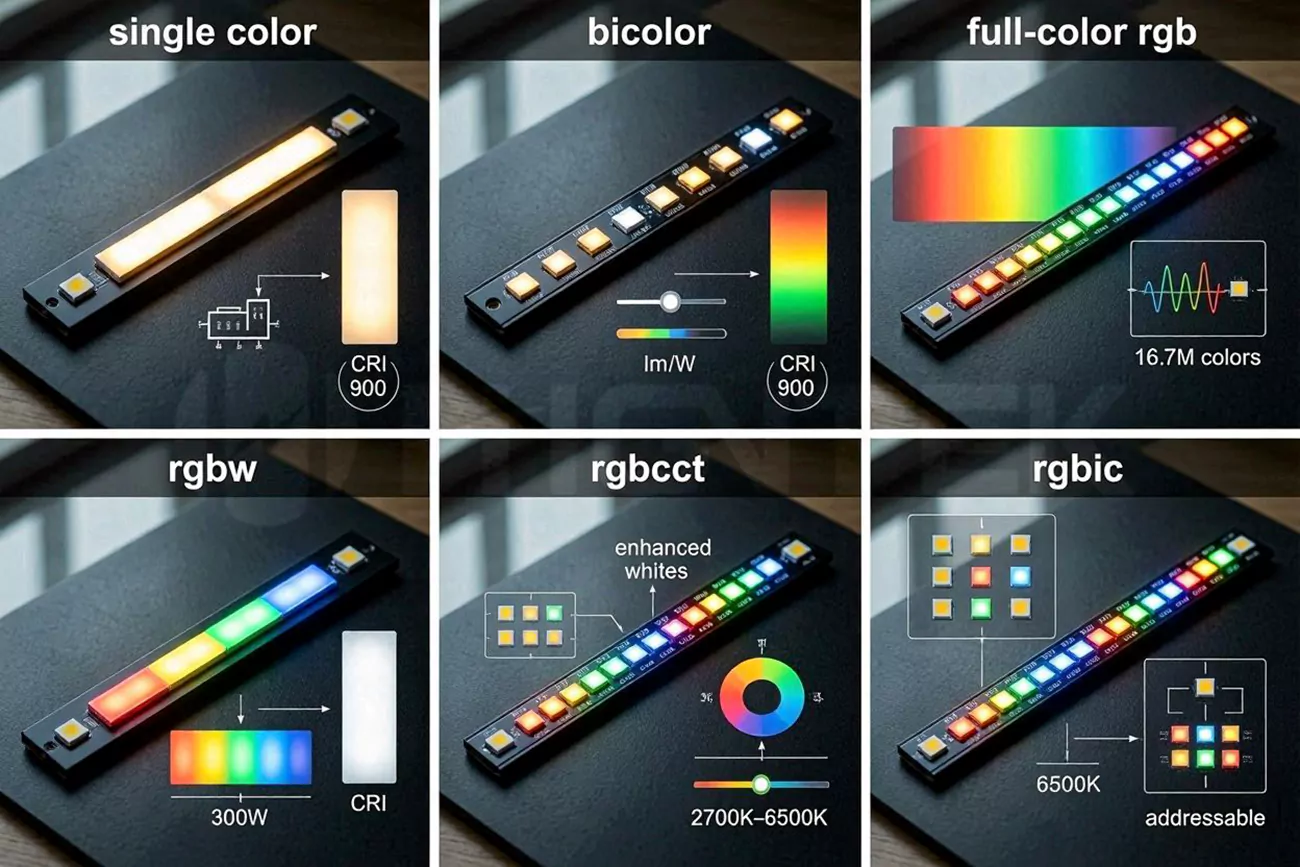
The right LED module color function depends on the project’s visual task, white-light requirement, control method, installation environment, and target cost. In our engineering review, we first identify whether the module needs stable single-color output, bi-color CCT adjustment, full-color RGB effects, RGBW scenes with a dedicated white channel, addressable RGB or RGBIC-type pixel control, or RGBCCT control for both color effects and tunable white performance.

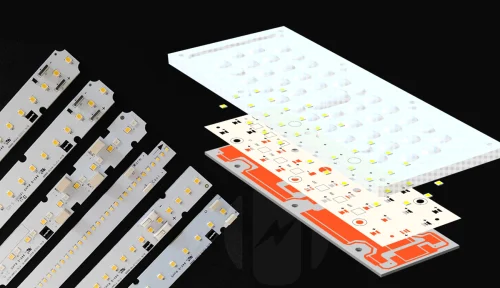
LED module colour options are not only visual choices. They affect LED channel design, PCB layout, driver matching, controller selection, wiring, power distribution, optical mixing distance, heat behavior, color consistency, and final assembly cost, so we usually confirm the final choice by developing and reviewing LED PCBA samples before moving toward production. A backlit logo may only need clean and consistent single white. A retail display may need warm-to-cool adjustment to match product materials and store atmosphere. A signage or advertising module may justify RGBW when brand color and white highlights must appear in the same structure. A programmable façade usually needs addressable control only when independent zones or animated patterns bring real project value.
White-light applications need a separate judgment. RGBW can improve white output compared with RGB mixed white because it adds a dedicated white channel, but it is not the same as professional tunable white. Bi-color and RGBCCT modules usually make more sense when the project needs controlled CCT adjustment, such as warm white for hospitality, neutral white for retail, or cool white for task-oriented spaces.

At Higntek, color-function selection starts as an engineering decision, not a feature label. Once the visual task is clear, our team turns it into a practical LED PCBA direction – channel structure, PCB routing, driver matching, optical spacing, control method, and production consistency. This keeps the discussion focused on what the module must deliver after installation, instead of choosing the option with the longest color-function name.

Which LED Module Color Type Is Best for My Application?

The best LED module color type depends on what the application must show every day, not on how many colors the specification sheet can list. In our engineering review, we usually separate projects into six practical needs first – stable single-color output, bi-color CCT adjustment, full-color RGB effects, RGBW color scenes with a cleaner white channel, addressable RGB or RGBIC-type animation, and RGBCCT control for both color and tunable white.
This is where many projects make the wrong turn. A buyer may ask for the “full color” because it sounds safer, but a backlit logo, a menu board, a hotel wall washer, and a programmable façade do not pay for the same kind of LED module Color functionality. More channels can mean more PCB routing, more driver matching, more controller requirements, more wiring, more heat to review, and more points to inspect during production.

ApplicationRecommended LED module color typeWhy this option usually works betterWhat our engineering team would check first
Channel letters and fixed brand logosSingle colorIt keeps the structure simple, stable, and cost-controlled when the brand color does not changeLED bin consistency, diffuser distance, brightness uniformity, and long-hour heat behavior
Light boxes, menu boards, and cabinet backlightingSingle white or bi-colorSingle white works for fixed clean output; bi-color adds warm-to-cool adjustment when the same fixture needs different moodsCCT target, hotspot control, lens or diffuser spacing, and batch-to-batch color consistency
Retail shelves and product displayBi-color or RGBCCTAdjustable white helps match cosmetics, jewelry, apparel, food packaging, and store atmosphereCRI, CCT range, Duv shift, dimming smoothness, and whether RGB effects are really needed
Bars, restaurants, and hospitality accentsRGBW or RGBCCTRGBW supports decorative color plus a dedicated white channel; RGBCCT gives more useful white-light flexibilityWhether the project mainly needs mood color, practical warm white, or both
Signage and advertising modulesRGB or RGBWRGB supports color-changing brand effects; RGBW improves white text and pale background performance compared with RGB mixed whiteWhite-channel brightness, color mixing distance, controller compatibility, and outdoor protection when needed
Architectural lines and façade accentsRGBW, bi-color, or RGBCCTThe right option depends on whether the building needs color scenes, tunable white, or bothIP protection, coating, connector reliability, thermal path, and installation maintenance
Themed retail, event props, and motion effectsAddressable RGB or RGBIC-type modulesIndependent control enables chasing, flowing, segmented, or pixel-level animationIC/data layout, voltage drop, controller protocol, repair access, and whether animation justifies the added cost
Smart ambient lighting productsRGBCCTIt combines RGB effects with warm and cool white channels, making it suitable for multi-scene lighting productsChannel balance, CCT transition, white-light quality, and firmware/control requirements
Machine status and simple indicator modulesSingle color or bi-colorClear signal recognition matters more than decorative color rangeViewing angle, color recognition, current setting, and operating-hour stability

After this first application match, our engineering team turns the likely color type into a sample-development direction. The next decision is how many LED channels the module actually needs, how the PCB should be routed, how the diffuser or lens will affect output, and how the chosen structure will behave in production. This is often where an initial request becomes a more precise and cost-controlled custom LED module plan.

In a cosmetics retail display project for a regional retail chain, the first request was RGBW for all shelf-backlighting modules because the marketing team wanted more scene options. The program covered three counter formats across standard stores and flagship stores, and most fixtures were expected to run stable product lighting for 10 to 12 hours per day. After we reviewed the actual store scenes, the requirement became more specific. Standard counters needed consistent neutral white for daily product display, while flagship counters needed color scenes for seasonal launches and promotional windows.
The original plan placed RGBW into every counter. The revised plan split the project into two module versions. About 1,450 single white modules were used for standard counters, while around 320 RGBW modules were kept for flagship counters. That meant roughly four out of five repeated modules stayed in a simpler white-light structure, while the higher-visibility counters still kept the color flexibility the brand team wanted.

The useful lesson was not that RGBW was wrong. It was that RGBW did not need to be everywhere. For the single white version, our review focused on CCT consistency, diffuser spacing, hotspot control, expected power load, and long-hour thermal behavior. For the RGBW version, we compared white text and pale graphics under the same diffuser condition, then checked whether the added RGB channels justified extra control wiring, controller points, and scene setup. This kept the everyday fixtures practical while reserving RGBW control for the counters where shoppers would actually notice the color scenes. With the revised split, only about 18% of the modules needed RGBW control, while the rest stayed in a simpler single-white structure.

What This Means for Color-Function Selection?

This type of project shows why color-function selection should be mapped by area, not only by product name. In early planning, we usually separate stable daily output, visible color scenes, and repeated production quantity before defining the LED PCBA sample direction. A practical selection process usually starts with 4 actions:

  • Keep stable white or fixed-color output for modules used mainly for daily illumination, repeated shelf lighting, logo backlighting, or standard display areas.
  • Reserve RGBW, RGB, or animated color control for areas where color scenes will be visible and commercially useful, such as campaign counters, entrance displays, or promotional windows.
  • Review white output under the real diffuser, lens, or pale graphic surface before choosing between single white, RGBW, bi-color, or RGBCCT.
  • Confirm whether the added color function also brings extra wiring, controller points, scene setup, inspection work, or after-sales troubleshooting.

This keeps the selection process practical. The goal is not to reduce color options, but to place each color function where it creates visible value.

How to Choose the Appropriate LED Module Color Function?

The appropriate LED module color function should match the real lighting task, white-light requirement, control method, installation environment, and target cost. In our engineering review, we first ask what the module must do after installation, because a fixed logo, a shelf light, a hotel accent wall, and a programmable façade need different levels of LED module Color functionality.
Every color option changes the module structure. Single color, bi-color, RGB, RGBW, addressable RGB, and RGBCCT affect LED chip arrangement, channel count, PCB routing, driver matching, wiring, heat behavior, and inspection focus. The most suitable choice should therefore be decided together with the actual module design, not separated from optical structure, power design, control method, and production requirements.
In practice, we narrow the decision through six linked factors. Cost control tells us whether extra LED channels and controllers are really necessary. White-light quality decides whether the project needs fixed white, RGBW, bi-color, or RGBCCT. Visual effect separates static output, simple color change, and real animation. Control complexity shows whether the installation can support extra wiring, controller points, programming, and troubleshooting. Production consistency matters when repeated modules must match in the brightness, CCT, and color point across batches. Installation environment decides whether coating, connector reliability, heat path, and protection design should influence the color-function choice.
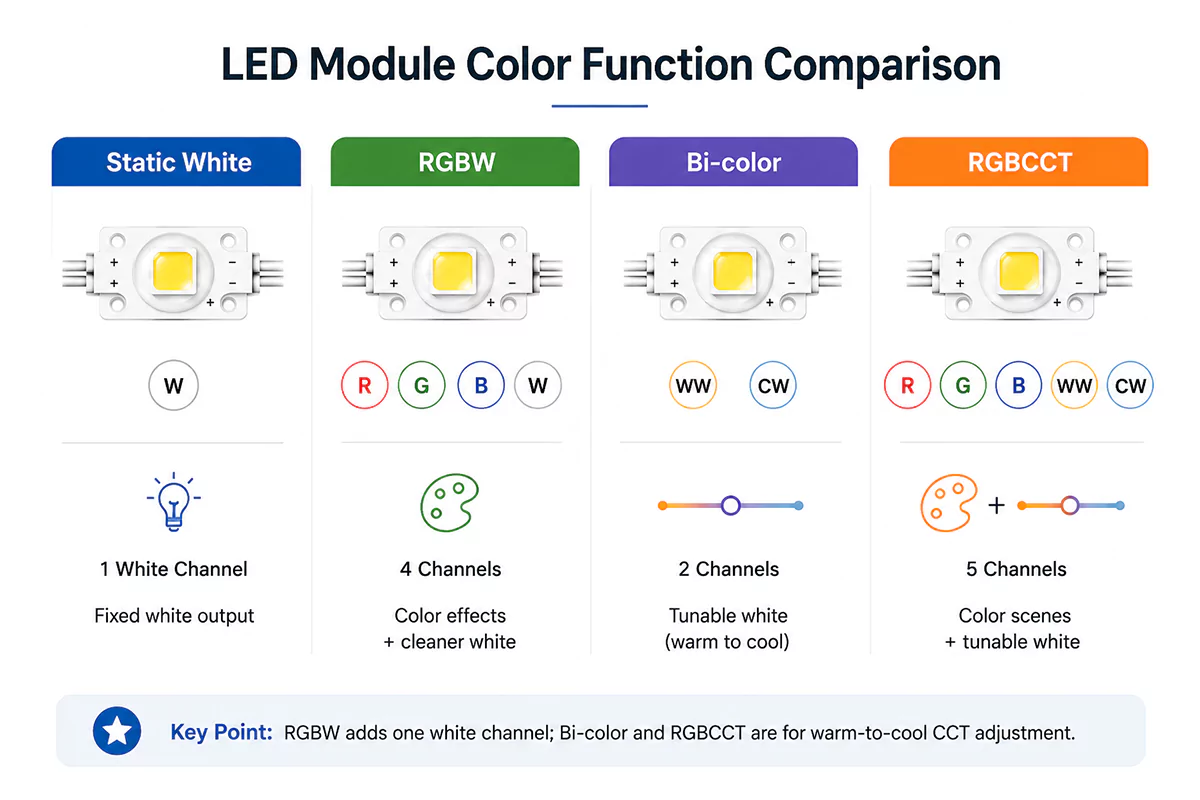
LED Module Color Function Comparison
  • The first consideration is whether the extra color capability will create visible value. If the project only needs one fixed color or one fixed CCT, a simpler single-color or single-white structure usually keeps cost, control, and production more manageable. If the project needs clean white text, pale graphics, product display lighting, or interior illumination, white-light quality becomes more important than the number of color effects. This is where the white-light requirement starts to shape the module structure.
  • The second consideration is how the color effect will be controlled and repeated. Static output, simple RGB color change, warm-to-cool CCT adjustment, and pixel-level animation place very different demands on controllers, wiring, programming, and future troubleshooting. A function that looks attractive in a sample may become difficult to manage if the installation needs too many controller points or if repeated modules cannot stay consistent in brightness, CCT, and color point across batches.
  • The third consideration is the installation environment. A module used inside a dry retail fixture does not face the same pressure as a module used in a humid cabinet, outdoor sign box, façade line, or long operating-hour application. Coating, connector reliability, thermal path, power load, and protection design can all influence which LED module colour option is practical for the final product. And the table below breaks these three considerations into six practical selection factors.
Selection factorWhat we check firstBetter-fit LED module colour options
Cost controlDoes the project only need one fixed color or one fixed CCT?Single color is usually the simplest and most cost-controlled choice.
White-light qualityDoes the white output need to look clean, stable, and suitable for products or interiors?Single white, bi-color, RGBW, or RGBCCT, depending on whether fixed white or tunable white is required.
Visual effectDoes the project need static light, color-changing effects, or animated motion?RGB for simple color change, RGBW for cleaner white plus color, addressable RGB for segmented animation.
Control complexityCan the installation support controllers, extra wiring, programming, and future troubleshooting?Single color and bi-color are simpler; RGBW, RGBCCT, and addressable RGB need more control planning.
Production consistencyDo repeated modules need to match in brightness, CCT, and color point across batches?Single white or bi-color can be easier to stabilize; RGBW and RGBCCT need tighter channel balancing.
Installation environmentWill the module work inside a dry sign box, a retail fixture, a humid cabinet, or an outdoor structure?Outdoor or humid applications need protection review, connector reliability, coating, and thermal design.

What Should We Validate Before Finalizing LED Module Color Functionality?

Before finalizing the color function, we develop the LED PCBA sample around the real channel structure, optical spacing, wiring path, and control method. The goal is not only to show that the color can be displayed, but to confirm that the module can be powered, controlled, inspected, and repeated in production.
At this stage, the review moves from selection logic to measurable module behavior. We look at whether the white output stays clean, whether the color point remains stable, whether heat and voltage stay manageable, whether the optical structure creates uniform output, and whether the control method can support reliable production and future servicing. Based on past experience, we have translated key evaluation criteria into specific validation items for your reference.

Validation itemWhat our engineering team checksWhy it matters
RGB vs RGBW white comparisonCompare RGB mixed white with RGBW dedicated white output under the same diffuser or lens conditionHelps confirm whether the project really needs a dedicated white channel for white text, pale graphics, or highlight areas
CCT and Duv checkReview whether white output shifts too warm, too cool, green, pink, or purple across key dimming and CCT pointsImportant for bi-color and RGBCCT modules used in retail, hospitality, and architectural lighting
Thermal reviewCheck whether multi-channel operation concentrates heat around LED chips, resistors, driver ICs, or dense circuit areasHelps avoid choosing a flexible color structure that creates avoidable thermal pressure
Voltage drop checkReview brightness or color shift across the longest wiring path or module chainUseful for cabinet signs, façade lines, long display fixtures, and addressable RGB layouts
Optical mixing checkReview hotspots, color separation, and uneven white under the actual cover, lens, diffuser, or installation distanceCritical for backlighting, light boxes, RGBW modules, and close-view display fixtures
Controller and dimming checkTest dimming smoothness, scene switching, CCT transition, and controller compatibilityImportant for bi-color, RGBW, RGBCCT, and addressable RGB projects
Color quality report when neededReview CRI or TM-30 data when the module will light products, surfaces, or interiorsUseful for cosmetics, jewelry, hospitality, retail display, and architectural lighting
BOM and assembly reviewCompare LED channels, ICs, resistors, connectors, controller requirements, coating, and assembly stepsHelps judge whether the visual benefit justifies the added cost and production complexity

These checks turn the color request into a manufacturable module plan. A multi-channel design is only valuable when it improves the installed result and still keeps heat, wiring, control, inspection, and maintenance within the project’s practical limits.

  • Fixed-output projects should stay simple when flexibility does not improve the installed result. Single color is still the most practical choice for many logo, cabinet, indicator, and backlighting modules because it lets the engineering review focus on CCT target, diffuser spacing, brightness uniformity, heat path, and batch consistency. 
  • Bi-color adds value when the same product needs warm-to-cool white adjustment, but it should still be checked for Duv shift, channel balance, and dimming transition before production.
  • Color-changing projects need a different review. RGB is suitable when the project mainly needs saturated color effects, while RGBW makes sense when the same module must show color scenes and cleaner white elements. 
  • RGBCCT adds the most flexibility because it combines RGB effects with warm and cool white channels, but the added channels also increase current balancing, controller planning, and prototype validation work. For fixed signage, that extra structure is often more than the project needs.
  • Addressable RGB should stay reserved for projects where independent zones or pixel-level motion will be visible in daily use. In the review, our engineering team would check the data path, voltage drop, controller response, repair access, and whether the animation is visible enough to justify the added ICs and programming work. That is usually a better discussion than simply asking whether addressable RGB looks more advanced.

How Do We Choose Between Static White and Tunable White LED Modules?

A fixed white requirement can be solved in more than one way. A dedicated single-white module is usually the simplest structure when the project only needs one stable CCT, while RGBW can also provide a fixed white point through its dedicated white channel when the same module also needs RGB color scenes. For real warm-to-cool CCT adjustment, bi-color and RGBCCT are more direct choices. The selection should therefore be compared by cost, flexibility, control load, and production repeatability, not only by whether the module can display white.

OptionCost levelFlexibilityBest engineering reason to choose itMain trade-off
Dedicated single-white moduleLowestOne fixed CCTBest when stable white output, simple control, and repeatable production matter mostNo RGB effect or CCT adjustment
RGBWMediumRGB scenes plus one fixed white pointBest when the same module needs color effects and cleaner white text, pale graphics, or highlight areasExtra RGB channels, wiring, controller points, and optical mixing work
Bi-colorMediumWarm-to-cool CCT adjustmentBest when the project needs tunable white without RGB effectsNeeds two-channel control, CCT transition review, and Duv control
RGBCCTHighestRGB effects plus tunable whiteBest when both color scenes and adjustable white modes will be used oftenHighest channel count, controller load, current balancing, and validation work

The main cost difference is not only the LED package. It comes from the full module structure, channel count, PCB routing, driver matching, wiring work, controller points, inspection focus, and future troubleshooting. When one stable white point is enough, a dedicated single-white module keeps the sample plan and production version cleaner. When RGB scenes are also part of the real visual plan, RGBW can justify the extra structure because the RGB channels have a clear purpose.
The flexibility comparison is different for tunable white. Bi-color is usually the more controlled and cost-balanced route when the project only needs warm-to-cool CCT adjustment. RGBCCT offers the widest function range, but it should be selected when both RGB effects and tunable white modes will be used regularly enough to justify the added control setup, channel balancing, thermal review, and production validation.

In a hotel minibar and shelf-lighting project for a Southeast Asian fixture maker, the first request was RGBCCT for the whole fixture family. The reason was understandable. The product team wanted one module platform that could support warm hospitality scenes, cooler functional lighting, and occasional color accents. After we reviewed the room types and daily lighting scenes, the requirement became narrower. Standard room fixtures only needed one stable warm white point for a consistent hospitality feel, while premium suite fixtures needed warm-to-cool adjustment for day and evening scenes.
The original plan used five-channel RGBCCT across the full product line. The revised plan used static warm white modules for standard room fixtures and bi-color modules for the premium suite version. In our sample review, the static warm-white version focused on CCT consistency, diffuser uniformity, expected power load, and thermal behavior during long-hour operation. The bi-color version added CCT transition, Duv shift, dimming smoothness, and warm-white/cool-white channel balance.

The useful lesson was similar to the retail display project. A more flexible color structure is valuable only when the installed scene can use that flexibility. In this case, moving the standard fixtures away from RGBCCT kept the main production run simpler, while the premium suite version still gained the tunable white function guests would actually experience.
Once the required white-light behavior is clear, the sample plan becomes much more focused – define the channel structure, confirm optical spacing, review the thermal path, and prepare a production version that can be repeated across the fixture family.

What Are the Pros and Cons of Different LED Color Modules?

Different LED color modules should be compared by what they add to the module and what they cost the project in return. In our engineering discussions, this is often where the real decision becomes clear. A customer may ask for “full color,” but after we look at the daily use, white-light demand, controller plan, and production quantity, the better answer may be single white, bi-color, RGBW, or RGBCCT.
In this comparison, the pros means the practical value the color structure brings to the installed product, while the cons means the extra structure the project must carry in PCB routing, control design, wiring, inspection, and maintenance. This is why the best-fit option is not always the most flexible option. It is the option whose added channels are actually used in the final product.

LED color module typeProsConsBest-fit projects
Single colorSimple circuit structure, stable output, easier color consistency, lower controller requirement, good for long operating hoursNo color change or CCT adjustmentChannel letters, fixed logo backlighting, cabinet signs, machine indicators, menu boards
Bi-colorAdjustable warm-to-cool white, better for practical lighting than RGB mixed white, simpler than RGBCCTNo saturated RGB effects, still needs two-channel control and CCT balancingRetail shelves, hospitality panels, office lighting modules, display fixtures
Full color RGBCreates color-changing effects with red, green, and blue channels, useful for visual attraction and brand-color scenesRGB mixed white is usually not clean enough for serious white-light applicationsDecorative signs, simple advertising effects, atmosphere lighting, basic color-changing modules
RGBWAdds a dedicated white channel, so white text and pale graphics look cleaner than RGB mixed whiteNot the same as tunable white unless the design includes separate warm and cool white channelsSignage, advertising modules, hospitality accents, brand display units
Addressable RGB or RGBIC-typeSupports independent zones, chasing effects, segmented motion, and pixel-level animationHigher control complexity, IC/data layout, programming, troubleshooting, and repair difficultyThemed retail, event props, interactive lighting, façade motion, branded animation
RGBCCTCombines RGB effects with warm and cool white channels, strong for multi-scene lighting productsMore channels, more current balancing, more controller planning, more prototype testingSmart ambient lighting, premium retail, hospitality fixtures, architectural lighting modules

The table shows why more color does not always mean a better LED module. Single color and bi-color often win when the project needs stable white output, simpler control, and repeatable production. RGB, RGBW, and RGBCCT become more useful when color scenes or white-light flexibility are part of the real visual plan.

The most common white-light mistake is treating every white-capable option as equal. RGB mixed white may be acceptable for decorative effects, but it is not the same as a dedicated white channel or a tunable white structure. For projects where white text, product appearance, or interior surfaces matter, our review separates RGB, RGBW, bi-color, and RGBCCT early before the PCB and control design move forward.
Addressable RGB belongs in its own decision path. It is valuable when independent zones, chasing effects, or pixel-level animation change the viewer experience. It is less convincing when the final installation will mostly stay static, because the added ICs, data routing, controller setup, and repair checks remain even when the motion effect is rarely used. When our engineering team selects LED color specifications for a client, the evaluation process transitions directly into developing the LED module prototype—covering PCB layout, component selection, control scheme planning, defining testing priorities, and considering production consistency.

The safest way to choose LED module colour options is to start from the real application and then verify the decision through the module structure. A good color function should match the visual task, white-light requirement, controller plan, thermal condition, and production target without adding channels the project will not use.

From our experience developing customized LED modules, one of the most common mistakes is choosing advanced color functions before defining the actual lighting purpose. More functions do not always mean a better solution. The right design should consider installation environment, required light quality, control compatibility, maintenance needs, and project budget together.
For Higntek, this is where custom LED module development has practical value. We assist lighting brands, luminaire manufacturers, and project developers in translating application requirements into optimized LED module solutions. Our engineering team supports complete customization, including LED color function selection, optical design, PCB development, electrical requirements, control integration, prototyping, and mass production.
Whether you need a reliable single-color module, adjustable white lighting, or a fully programmable RGB-based system, we focus on creating the right balance between lighting performance, system reliability, and commercial value.

FAQ

Is RGBW better than RGBCCT for white light applications?

RGBW is better when the project needs RGB color effects plus one cleaner white channel, but RGBCCT is better when the project needs controlled warm-to-cool white adjustment. RGBW can improve white text, pale graphics, and highlights compared with RGB mixed white. For tunable white applications, RGBCCT is usually the stronger structure because it combines RGB channels with warm white and cool white channels.

Single color is usually best for fixed brand signs, while RGBW is often better for advertising modules that need both color effects and cleaner white elements. RGB can handle basic color-changing effects, but RGB mixed white is usually weaker than a dedicated white channel. For animated signage, addressable RGB or RGBIC-type control is worth considering only when motion effects are part of the final display concept.

Architectural lighting can use single color, bi-color, RGBW, addressable RGB, or RGBCCT, depending on the visual task. Single color fits fixed façade lines or accent lighting. Bi-color works for warm-to-cool white transitions. RGBW supports color scenes with cleaner white highlights, while RGBCCT fits projects that need both color effects and tunable white. Addressable RGB is better for façades or installations that need segmented motion rather than static illumination.

Single white or single color is usually the best LED module for backlighting. Backlit logos, light boxes, cabinet signs, and display panels normally need uniform brightness, stable CCT, controlled hotspots, and consistent module output more than dynamic color effects. Bi-color can be useful when the same backlit surface needs warm and cool white modes. RGBW or RGBCCT should only be selected when the backlighting also needs color scenes.

Addressable RGB LED modules are worth the cost only when independent zones, chasing effects, pixel-level animation, or interactive scenes create real value. They are useful for themed retail, event props, façade motion, and branded installations where movement attracts attention. For static signs, standard backlighting, or simple shelf lighting, addressable control usually adds ICs, data routing, controller setup, programming, and repair work without improving the daily result.

Develop a Custom LED Module Colour Solution

Need a specific color range, CCT adjustment, RGB control, or customized lighting performance? Higntek provides complete LED module development from concept design to production.

On-Time Delivery 99.38%

Consistent production & reliable global delivery

End-to-End Engineering Support

From design optimization to production guidance

3-Day Rapid Prototyping

Fast sampling to accelerate product validation

100% Quality Inspection

Full testing ensures stable and reliable performance

Higntek-icon logo

Discuss LED module project specifications with professional engineers.

Pre-Engineering Inquiry