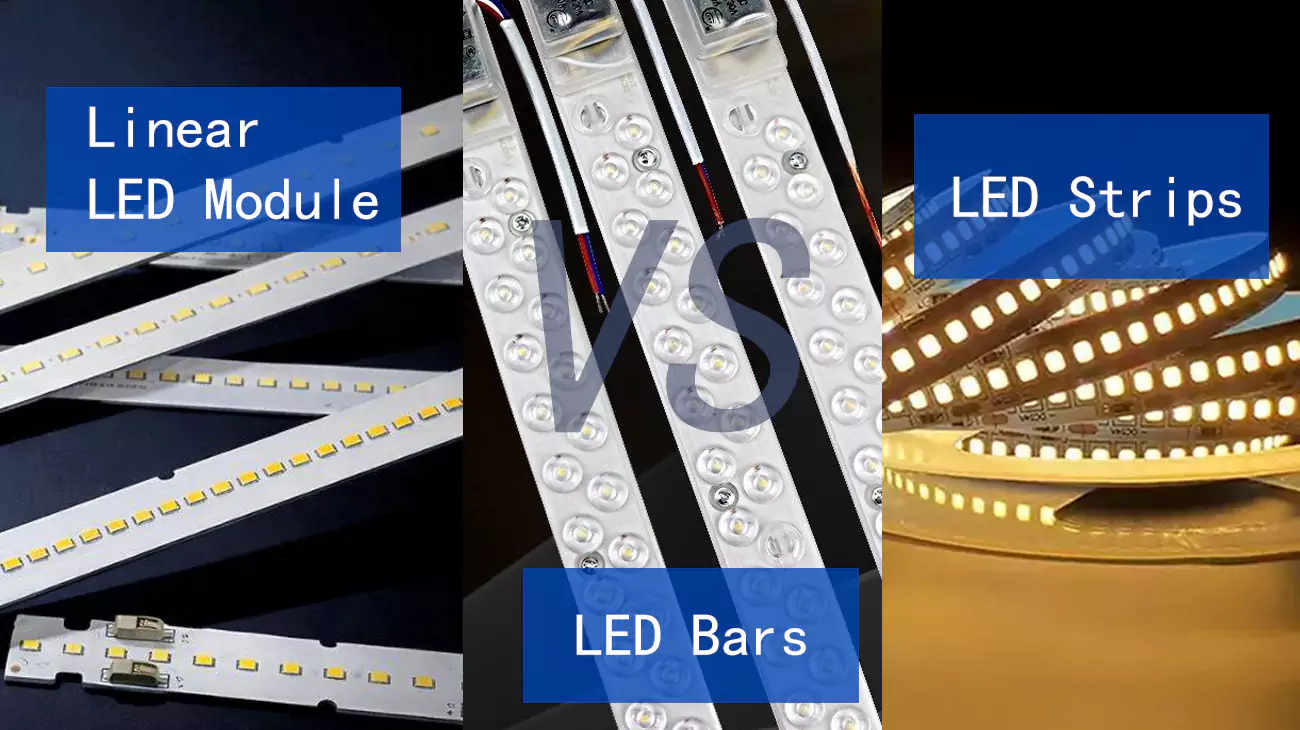
When selecting lighting sources for commercial, industrial, or residential projects, the choice between Linear LED Modules, LED Strips, and LED Light Bars directly impacts long-term operating costs, running stability and overall lighting effect. Most purchasers only focus on low initial price while ignoring core performance and service life, resulting in frequent maintenance, severe lumen depreciation and higher total cost of ownership in the long run. We compared their test data and provided practical selection tips to help you make accurate project decisions.
What Is a Linear LED Module?
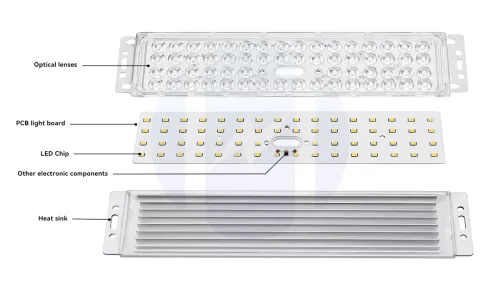
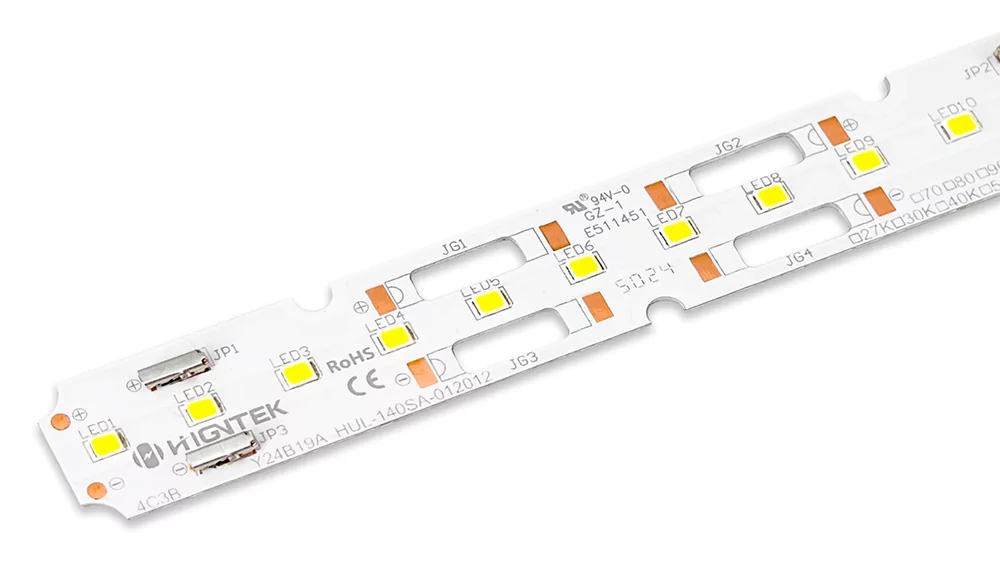
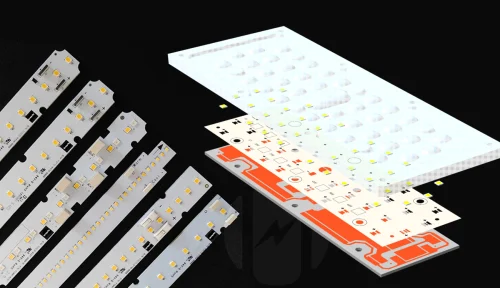
Linear LED modules are lighting components specifically designed for linear luminaires and the retrofitting of existing lighting systems. They consist of an LED light source, a PCB circuit board, an optional optical lens, and necessary electrical interfaces. They typically use LED diodes connected in series on a rigid aluminum-based circuit board to produce continuous, smooth, and uniform light.
Unlike flexible LED strips and fully enclosed LED light bars, linear modules have standardized dimensions and interfaces, making them easier to integrate into various lighting fixtures. Linear LED modules can also be customized in size and optical requirements to meet specific project needs. Professionally manufactured, they achieve high luminous efficiency, stable and uniform brightness, and an ultra-long lifespan, making them a mainstream lighting solution for offices, retail stores, warehouses, and large-scale indoor lighting projects.
Advantages and disadvantages of Linear LED Module.
In terms of core advantages, linear LED modules deliver excellent luminous efficiency from 150 to 190 lumens per watt, and high-end models can reach over 200 lumens per watt. They feature standard L70 lifespan of 50000 to 100000 hours, which can steadily work for 11 to 23 years under 12-hour daily working mode. Optimized lamp bead layout and matched optical lenses ensure light uniformity above 90%. Linear LED modules utilize a tool-free, quick-connect structure according to CIE standards and maintain color consistency within a strict 3 SDCM range. A single damaged module can be replaced individually without disassembling the entire luminaire, significantly reducing maintenance difficulty.
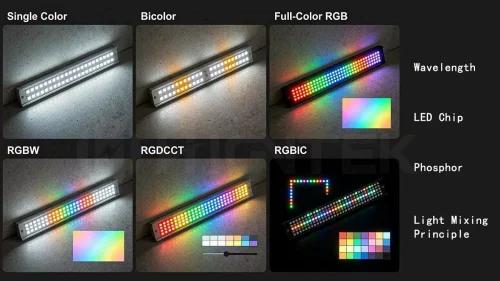
Besides efficient lighting, another reason for the popularity of linear LED modules is their extensive color tuning options, including different color temperatures, RGB or RGBW versions, and even the ability to adjust brightness, color, or the activation status of individual LEDs via a single LED controller. This versatility allows a single product category to meet a wide range of application needs, from decorative accent lighting to complex smart lighting systems.
The upfront procurement cost is 3 to 5 times higher than ordinary LED strips. Installation requires close contact with heat-conductive mounting base; working environments over 45℃ without effective heat dissipation will shorten product service life by 30% to 50%. Besides, on-site cutting is limited, only 12V and 24V constant voltage versions support fixed-point cutting every 50 to 100 millimeters.
A full range of linear LED modules types can meet diverse engineering demands, including 350-1050mA constant current modules for ultra-long distance layout, ultra-thin edge-lit modules within 5mm thickness, cuttable constant voltage modules for old lamp renovation, multi-protocol dimmable modules, UGR≤19 anti-glare backlight modules for classroom and medical lighting, high-power industrial modules and 100-277V direct AC modules for traditional fluorescent lamp replacement.
What Is an LED Strip?
If you’ve ever seen soft lighting under kitchen cabinets, behind a TV wall, on a hotel ceiling, or around retail shelves, you’ve likely seen LED light strips. LED light strips are thin and flexible. Their core is a **flexible printed circuit board (FPC)**, on which multiple **light-emitting diodes (LEDs)** and other components are directly arranged and embedded to form a continuous linear light source. The brightness and energy consumption of the light strip vary depending on the LED model specifications, width, length, LED density, and output power of the LEDs.
Modern LED light strips have evolved into lighting products with a rich variety of specifications and functions, offering countless configurations. From monochrome lighting to RGB dynamic color changing, from 12V and 24V low-voltage power supplies to 220V high-voltage solutions, from optical lens designs that improve light uniformity to waterproof structures that meet outdoor environment requirements, different color types, voltage schemes, optical designs, and protection levels collectively determine their performance and applicable scenarios in practical applications. Often, users think that choosing a light strip is simply a matter of “brightness,” but they only realize after implementation that these details are the key to a good user experience.
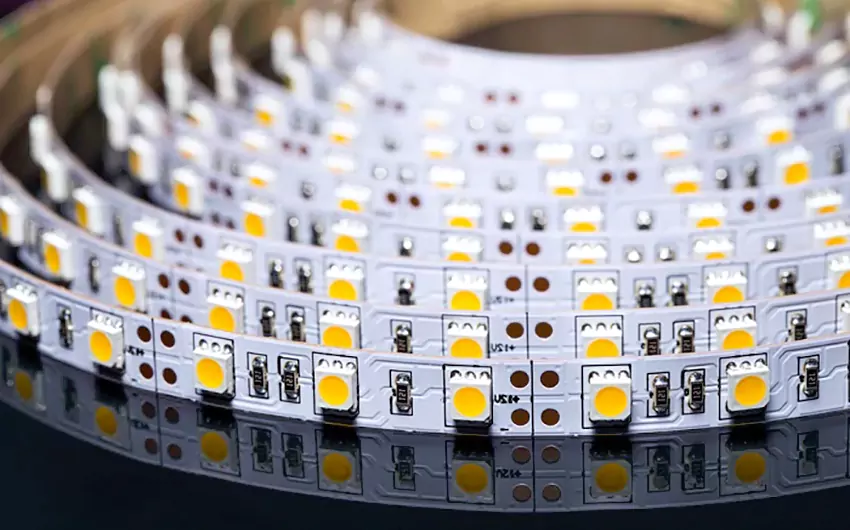
Advantages and disadvantages of LED Strips.
The true uniqueness of LED light strips lies in their flexibility. Unlike traditional lighting fixtures, because the flexible PCB substrate itself can be bent, cut, and extended, light strips can conform to curved walls, wrap around corners, be installed in narrow gaps, and even integrate into architectural details—features impossible with traditional lighting. Most LED light strips are typically supplied in 5-meter or 10-meter rolls, usually with self-adhesive tape on the back for easy and quick installation. This is why LED light strips are now ubiquitous—in hotels, game rooms, shopping malls, restaurants, residences, exhibitions, and even car interiors.
Another reason people choose LED light strips is their energy efficiency. The main reason for the energy savings of LED light strips is their low power consumption and high lumen output. For example, in a retail shelf project we worked on that relied on fluorescent lighting, we upgraded it by using high-efficiency LED strip lights with an efficiency of over 130 lm/W. This resulted in nearly 40% energy savings compared to the old lighting solution, while maintaining the same level of illumination. High-quality LED light strips have a longer continuous lifespan (up to 50,000 hours), making their energy-saving effect particularly significant for projects requiring long-term operation, such as retail displays, hotel environments, commercial buildings, or residential lighting. This high energy efficiency also leads to cost savings.
However, LED light strips are not without their flaws, one of the biggest issues being heat dissipation. Although LED technology is more efficient than traditional lighting, LEDs still generate heat during operation, and overheating is one of the main causes of luminous flux decay, color shift, and premature failure. Because flexible PCB LED strips are based on flexible PCBs, the substrate’s thermal conductivity is not as good as rigid metal plates, and they lack independent heat dissipation structures, thus their heat dissipation capacity is usually limited. Overly dense and high-power strips, or those placed in enclosed troughs or poorly ventilated channels, can cause heat to accumulate rapidly, leading to overheating. Many strips may continue to operate for several years, but noticeable brightness decline may occur much sooner than expected.
Voltage drop in LED strips is another very common problem. As current flows along the conductive lines of the strip, the voltage gradually decreases, especially in long-distance installations. 12V LED strips typically experience a significant brightness drop after about 5 meters, while 24V strips often exhibit uneven brightness after 10 meters. To maintain stable lighting, additional power injection points are usually required, increasing installation costs by 30% to 50%.
LED light strips, with their slim FPC structure and high-density LED chips, are a top choice for ambient art lighting. Their value lies in integrating light naturally into the building and interior space, but most LED light strips cannot be used to replace the main interior lighting. While LED light strips typically provide approximately 500 to 1500 lumens of luminous flux per meter, their heat dissipation limitations make it difficult to maintain stable illumination under prolonged high brightness.
What Is an LED Light Bar?
LED light bar is a fully sealed rigid finished lighting fixture, consisting of thickened aluminum alloy shell, built-in LED light board and PC or glass light-transmitting cover. The built-in light panel contains multiple linearly arranged LEDs that produce a focused, powerful beam of light. It is completely assembled in a factory and only needs simple fixing and wiring on construction sites, mainly developed for harsh outdoor environments and mobile equipment lighting scenes. Higntek can customize internal LED modules to meet customers’ LED light bar lighting needs, achieving high-efficiency, high-brightness lighting effects through high-efficiency LED selection, appropriate driver configuration, and electrical design. Furthermore, we can tailor optical designs (lens control beam angle) to meet customers’ floodlighting and focusing requirements.
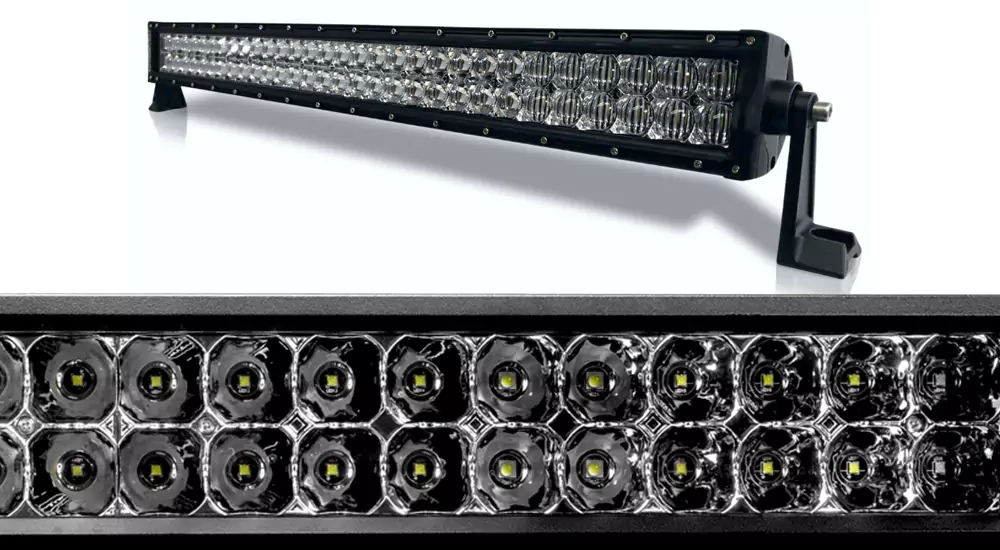
Core strengths include high IP rating up to IP67-IP69K, capable of resisting high-pressure water flushing and temporary shallow water immersion, as well as stable operation under long-term vibration conditions. It can reach full brightness instantly without preheating, perfectly fitting emergency lighting needs. Multiple optional beam angles cover long-distance concentrated lighting and large-area flood lighting demands, and standardized bracket installation unifies construction processes suitable for mass outdoor projects.
LED light bars are typically available in fixed sizes, such as 0.3 meters, 0.5 meters, and 1 meter, and cannot be adjusted on-site, thus offering limited adaptability to irregularly shaped installation spaces. Their unit price is also relatively high, with basic models typically starting at $40 and high-power models exceeding $300.
Differences between Linear LED Module, LED Strip, and LED Light Bar.
To help customers clearly distinguish three mainstream linear lighting products and make data-supported purchasing decisions, we conduct in-depth comparative analysis from eight core dimensions including structure design, constant current & constant voltage driving mode, thermal management performance, overall use cost, brightness and luminous efficiency, field installation mode, actual service life and applicable scenarios. All reference data comes from our past project site measurements and authoritative industry standards, including LM-80, TM-21, and IESNA, providing direct and effective decision-making references for engineering projects.
- Structure Design.
Linear LED modules adopt 1.2-2.0mm thick rigid aluminum-core PCB plus integrated extrusion heat dissipation fins, with 15-25 square centimeters effective heat dissipation area per meter, built-in quick wiring terminals and complete optical matching accessories. LED strips apply 0.3-0.5mm ultra-thin flexible circuit board without any heat dissipation structure, and the back adhesive only plays a fixing role. LED light bars take a sealed aluminum shell as the main structure with internal LED light board, realizing heat dissipation only through the external shell, resulting in poor internal heat circulation efficiency. - Constant Current & Constant Voltage Driving Mode.
Linear LED modules support three main driving schemes: constant current, constant voltage, and DOB. 350-1050mA constant current driving is applicable for laying length over 10 meters, controlling overall brightness deviation within ±5% within 50 meters. 12V/24V constant voltage driving suits short-distance arrangement and fixed-point cutting. Direct AC 100-277V models can be connected to commercial power directly without external driving power supply. LED strips only support single 12V/24V constant voltage power supply matched with PWM dimming function, lacking constant current stabilization design, which easily causes brightness attenuation due to voltage drop in long-distance wiring. Most LED light bars adopt built-in constant voltage stabilizers, and only partial high-power versions are equipped with simple constant current chips with a single applicable scene. Temperature Resistance.
Any lighting module or luminaire requires good thermal management; otherwise, hot spots will directly affect light stability and lifespan. Higintek has a dedicated page for detailed explanations of thermal management in the LED module development process. Here, we share the ideal operating temperature ranges for Linear LED Modules, LED Strips, and LED Light Bars under the same good thermal management conditions.
A well-designed linear LED module can achieve stable continuous operation for 12 hours in a temperature range of -40°C to 85°C, with an L90 lifespan exceeding 60,000 hours. LED Light Bars, due to their use of a rigid metal-based PCB, have an operating temperature range basically the same as linear LED modules. LED strips are more prone to heat buildup and accelerated aging; they can withstand outdoor temperatures up to 60°C, but a fully sealed structure would further limit their heat dissipation efficiency.Cost-effectiveness.
In terms of initial purchase cost, LED strips are the lowest, with a unit price per meter only 1/3 to 1/2 that of linear LED modules. However, long-term use may cause LEDs to detach or their lifespan to be shortened by high temperatures. Regular maintenance is required after 2 years of use. While linear LED modules have a slightly higher initial purchase cost than LED strips, their robust aluminum-based PCB and ability to integrate various drivers, electronic components, and optical components allow for more specific lighting needs and greater stability. LED light bars, being closer to finished luminaires, have the highest initial purchase cost. Their long-term stability depends on the internal LED modules and the weather resistance of the housing. It is recommended that LED light bar brands choose professional LED module manufacturers as suppliers to reduce future maintenance costs.Brightness.
Due to heat dissipation limitations, LED light strips typically achieve 300-1500 lm/m per meter. Ordinary LED light strips have a luminous efficacy of 70-100 lm/W, with high-end products reaching up to 140 lm/W, sufficient only for auxiliary ambient lighting and general lighting needs. Linear LED modules, with proper LED chip selection, driver adaptation, and density layout, can achieve a luminous efficacy of 150-190 lm/W, with high-end products exceeding 220 lm/W. The luminous flux per meter can reach 2000-5000 lumens, fully meeting indoor main lighting illuminance requirements of over 300 lux. LED strips typically use high-efficiency LED modules as their internal light-emitting panels, resulting in the highest brightness.Field Installation Method & Efficiency.
Linear LED modules need to be installed in the lamp body or trough using screws, rivets, or industrial adhesives, depending on the luminaire design. Constant current models use series wiring, with an installation efficiency of 5-8 meters per person per hour. LED strips are first fixed with adhesive backing and then used with the trough and lampshade. Long-distance installations require a multi-point power supply layout, with an installation efficiency typically of 15 to 20 meters per hour. LED strips are fixed with bolts and use simple relay wiring, making them easy to install on fixed brackets, but not suitable for decorative recessed installations.Actual Service Lifespan.
The L70 effective lifespan of linear LED modules is 50000 to 100000 hours, realizing stable indoor use for 11 to 23 years without overall replacement within ten years. LED strips only have 20000 to 30000 hours L70 lifespan, needing regular replacement every 3 to 5 years with obvious light decay in the early using period. LED light bars can be used steadily for 9 to 13 years indoors, while affected by outdoor harsh climate, the stable service life is shortened to only 3 to 5 years with fast aging speed.- Core Applicable Scenarios.
Linear LED modules are widely used in indoor main functional lighting including office spaces, retail stores, teaching classrooms, medical institutions, warehouses, parking lots and traditional linear lamp renovation projects. LED strips are applied to auxiliary decorative lighting such as lamp trough hidden lighting, cabinet bottom supplementary lighting, display cabinet lighting and building outline lighting, as well as short-term temporary installation scenes. LED light bars are dedicated to outdoor construction site lighting, vehicle lighting, marine equipment, agricultural machinery, emergency lighting and other industrial special operation lighting fields.
| Comparison Factor | Linear LED Module | LED Strip | LED Light Bar |
|---|---|---|---|
| Overall Structure | Rigid linear PCB module with integrated LEDs and engineered thermal layout | Flexible PCB with surface-mounted LEDs and adhesive backing | Complete lighting assembly with housing, optics, heat sink, and mounting structure |
| Typical PCB Material | Aluminum PCB or FR4 with thermal management design | Flexible copper PCB | Aluminum housing with internal PCB assembly |
| Mechanical Rigidity | Rigid structure for stable installation | Flexible and bendable | Fully enclosed rigid fixture |
| Driver Method | External driver, integrated driver, or DOB solution | Usually low-voltage constant voltage driver | External or built-in constant current driver |
| Common Input Voltage | 12V / 24V / AC DOB / customized solutions | 5V / 12V / 24V DC | AC100-277V or low-voltage DC |
| Operating Temperature Range | Typically -40°C to 85°C depending on thermal design | Typically -20°C to 60°C | Typically -40°C to 85°C |
| Thermal Management | Strong thermal dissipation through aluminum PCB or heat sink integration | Limited thermal dissipation due to flexible substrate | Excellent thermal management with dedicated heat sink housing |
| Luminous Efficacy Range | Typically 120–210 lm/W depending on LED package and drive current | Typically 70–140 lm/W | Typically 90–180 lm/W |
| Brightness Stability | High long-term lumen stability | Moderate, affected by heat buildup | High stability for long-hour operation |
| Beam Distribution | Customizable optical layout and beam angle | Wide diffuse lighting | Directional or focused lighting with optics |
| Waterproof Capability | IP20 to IP68 depending on encapsulation structure | IP20 to IP67 with silicone coating | Commonly IP65/IP67/IP68 |
| Typical Lifespan | 50,000–100,000 hours with proper thermal control | 20,000–50,000 hours | 50,000–80,000 hours |
| Maintenance Difficulty | Moderate, modular replacement possible | Easy replacement but adhesive aging can occur | Higher due to integrated fixture structure |
| Energy Efficiency | High efficiency optimized for commercial and industrial projects | Moderate efficiency for decorative lighting | High efficiency for outdoor and architectural lighting |
| Customization Flexibility | Very high customization for PCB layout, optics, voltage, connectors, and drivers | Limited mainly to length, density, and color options | Moderate customization depending on housing structure |
| Installation Method | Screws, clips, channels, magnetic fixing, or integrated assembly | Adhesive mounting or aluminum profile | Brackets, mounting rails, or fixed structural installation |
| Main Design Priority | Performance, thermal reliability, and scalable integration | Flexibility and low-cost decorative lighting | High-output durable illumination |
| Common Application Scenarios | Commercial lighting, linear fixtures, signage, office lighting, industrial systems, OEM projects | Accent lighting, retail decoration, cabinet lighting, ambient lighting | Outdoor lighting, architectural lighting, vehicle lighting, industrial lighting |
| Core Engineering Advantage | Strong balance between efficiency, thermal control, lifespan, and customization | Fast installation and flexible shaping | High brightness and environmental durability |
| Main Limitation | Requires engineered thermal and driver matching | Heat buildup reduces lifespan in demanding environments | Larger size and higher structural cost |
| Relative Product Cost | Medium | Low | Medium to high |
| Typical OEM/ODM Suitability | Excellent for engineering customization and scalable manufacturing | Moderate | Good for branded fixture projects |
| Best Fit For | B2B lighting manufacturers needing reliable modular solutions | Decorative and low-power flexible lighting | Heavy-duty indoor/outdoor lighting systems |
From a practical manufacturing and project integration perspective, these three lighting formats solve very different problems.
LED strips focus on flexibility and low installation cost, but they usually struggle with heat management and long-term lumen stability in demanding applications. LED light bars can be understood as near-finished luminaires, prioritizing durability and high-brightness illumination, especially suitable for outdoor or industrial environments, but typically increasing structural complexity and system cost.
Linear LED modules sit in the middle. In many OEM and commercial lighting projects, they provide the best balance between thermal performance, luminous efficiency, customization flexibility, and scalable production. That is why more lighting manufacturers now use linear LED modules as the core platform for office lighting, architectural systems, retail fixtures, and energy-efficient commercial products.
Which to choose for Linear LED Modules, LED Strips, and LED Light Bars?
The choice between linear LED modules, LED strips, and LED light bars depends on specific needs. LED light bars are best suited for flexible, low-power decorative lighting; linear LED modules are suitable for modular, customized lighting for B2B manufacturers; and LED light bars are suitable for heavy-duty lighting, job lighting, or commercial lighting.
However, after working with lighting manufacturers and product development teams for years, we’ve found that choosing between these three solutions is rarely about the product itself. The real question is how well the lighting solution fits the technical, environmental, and commercial requirements of the project. Before making a decision, we recommend a comprehensive evaluation of the structure, electrical drive, thermal management, light quality, application, and cost.
Structural Design and Product Integration.
LED strips offer maximum flexibility and can bend around curves, corners, and irregular surfaces. However, that flexibility comes with trade-offs in mechanical protection and long-term durability. LED light bars provide the strongest physical structure because LEDs, drivers, and heat dissipation components are typically integrated into a rigid housing. Linear LED modules sit between the two, offering a modular architecture that manufacturers can easily integrate into custom luminaires.
From our experience supporting OEM projects, linear LED modules often provide the best balance between design flexibility and production efficiency. If your product requires customized dimensions, optics, connectors, or housing integration, a modular approach usually simplifies engineering and future product upgrades.
Choose LED light strips for design freedom.
Choose LED light strips for structural robustness.
Choose linear LED modules for scalable product development.
Electrical Design and Driver Requirements.
Many buyers focus only on the LEDs themselves, neglecting the electrical system behind them. LED light bars typically use low-voltage DC systems such as 12V or 24V, which are easy to install, but can cause voltage drop issues over long distances. LED light bars usually integrate dedicated drivers or constant current systems, thus improving stability in harsh applications. Linear LED modules offer the greatest flexibility because our design engineers can select different voltage platforms, driver configurations (constant current/constant voltage/DOB), dimming protocols, and control systems according to customer needs.
In commercial lighting projects, we often find that electrical design determines long-term reliability more than the choice of LED chips. Poor current regulation can lead to luminous flux attenuation, color shift, and premature failure.
Thermal Management.
Heat is one of the main causes of LED performance degradation. According to research by the U.S. Department of Energy’s Solid State Lighting (SSL), elevated junction temperatures significantly reduce luminous flux maintenance and shorten LED lifespan. Proper thermal management directly impacts the long-term reliability of the system.
LED strips typically have limited heat capacity and often require additional heat dissipation through aluminum thermal channels. LED strips typically use dedicated aluminum housings to improve heat dissipation. Linear LED modules can be designed with aluminum PCBs, thermal vias, custom heat sinks, and optimized heat paths.
In several commercial lighting retrofit projects we reviewed, thermal design had a far greater impact on LED module lifespan than differences in LED chip brand selection. I recommend prioritizing solutions with proven thermal management practices if the luminaire operates continuously for more than 10 hours per day or in enclosed environments, rather than focusing solely on initial luminous efficiency.
Light Quality.
If visual quality directly impacts user experience, priority should be given to brightness uniformity, color rendering index (CRI), and color consistency, rather than simply comparing lumen output. Commercial lighting also requires particular emphasis on luminous efficacy to achieve energy savings. Industry standards increasingly use metrics such as CRI and TM-30 to more accurately assess color quality.
LED strips typically prioritize visual impact and accent lighting. LED strips are generally geared towards high-output applications. Linear LED modules offer flexible adjustments to luminous efficacy, beam distribution, color temperature, and optical performance to meet application needs. We have found that for customers in office, retail, and education settings, improving color consistency and visual comfort is more important than simply increasing lumen output.
Application Environment and Installation Conditions.
LED light strips excel in accent lighting, architectural details, display cases, hotel environments, and decorative installations. LED light bars perform well in industrial facilities, workshops, machinery lighting, signage, and outdoor commercial applications. Linear LED modules are widely used in office lighting fixtures, trough lights, panel lights, linear luminaires, retail lighting systems, and custom OEM products.
Based on observations from customer interactions over the past decade, installation requirements typically eliminate unsuitable product options early in the design process. Environmental factors such as humidity, vibration, operating temperature, ease of maintenance, and expected lifespan should be considered before selecting a lighting platform.
In practical terms, there is no universal winner between linear LED modules, LED strips, and LED light bars. The best choice depends on your technical goals, installation environment, performance requirements, and long-term business objectives.
At Higntek, we typically recommend starting with the application requirements first and selecting the lighting platform second. In our experience, projects succeed when the engineering strategy drives the product choice—not the other way around.
After fully mastering the performance characteristics, professional data differences and standardized systematic selection standards of three kinds of mainstream linear lighting products, you can confirm the most matching lighting configuration scheme in combination with exclusive project demands. For commercial office buildings, industrial factory workshops and large-scale indoor venue lighting projects that attach importance to long-term stable operation, uniform and comfortable light effect and lowest full-cycle comprehensive cost, linear LED modules are undoubtedly the most preferred and reliable choice.
Utilizing high-quality LED modules, we create energy-efficient, uniform, and ultra-durable professional lighting environments. If your current lighting project requires customized LED modules, please feel free to contact Higntek’s professional lighting technology team for a tailored lighting project solution. Our dedicated customer service team will provide systematic and professional services covering LED layout, optical parameters, and compatible drivers.
Can conventional linear LED modules be used directly outdoors?
Standard linear LED modules are only designed for indoor use with limited protection level. Outdoor applications require a comprehensive upgrade to heat dissipation management, protective materials, and manufacturing processes based on standard linear LED modules, along with a fully sealed protective housing. This will increase the overall cost by 30% to 50%. For outdoor linear lighting projects, choosing a professional linear LED module engineering manufacturer can better guarantee long-term lifespan.
How to correctly choose between constant current and constant voltage linear LED modules?
Select constant current linear LED modules when the laying distance is over 10 meters to ensure consistent overall brightness of the whole line. Select 12V/24V constant voltage linear LED modules within 10 meters, which support flexible on-site fixed-point cutting with stronger on-site construction adaptability.
Is it feasible to take LED strips as indoor main lighting light source?
It is not recommended in engineering applications. Due to limitations in materials and design, the overall luminous efficiency and luminous flux of LED light strips cannot meet the brightness standards required for indoor main lighting. Furthermore, they suffer from uneven illumination and rapid light decay, making them only suitable for local auxiliary lighting.
How great is the influence of heat dissipation conditions on LED lamp service life?
The influence is extremely critical. Every 10℃ rise in LED working temperature will roughly halve its theoretical service life. Perfect integrated heat dissipation structure enables linear LED modules to keep working temperature 23℃ to 43℃ lower than LED strips, which is the core reason for its longer service life.
How to match the most appropriate color temperature and color rendering index?
2700K-3000K warm white light fits catering and leisure business places; 3500K-4000K neutral white light is the best choice for office study and medical care places; 5000K-6500K cool white light matches high-brightness operation scenes such as warehouses and workshops. Places with high color reduction demand such as retail display cabinets need to select products with CRI≥90 or even CRI≥95.
Not Sure Which LED Solution Fits Your Project?
Choosing between LED strips, linear LED modules, and LED light bars often depends on factors that aren’t obvious from a datasheet alone. Share your application requirements with our engineering team, and we’ll help you identify the most practical solution based on performance, reliability, and manufacturing goals.