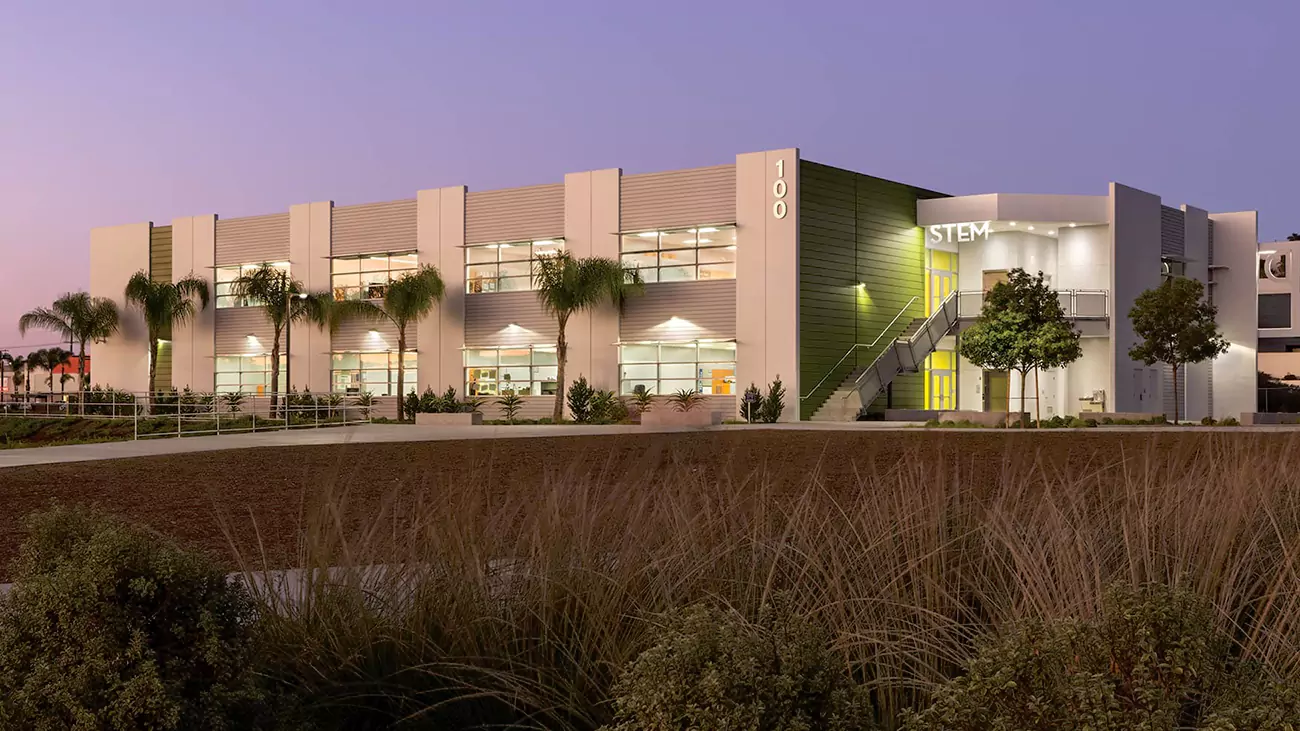
In June 2025, we participated in the lighting renovation project for the Del Dios Academy of Arts and Sciences in California. The client operates an educational campus that includes classrooms, laboratory learning areas, administrative offices, and high-traffic areas. The existing lighting infrastructure had been in operation for many years, primarily relying on fluorescent tube systems.
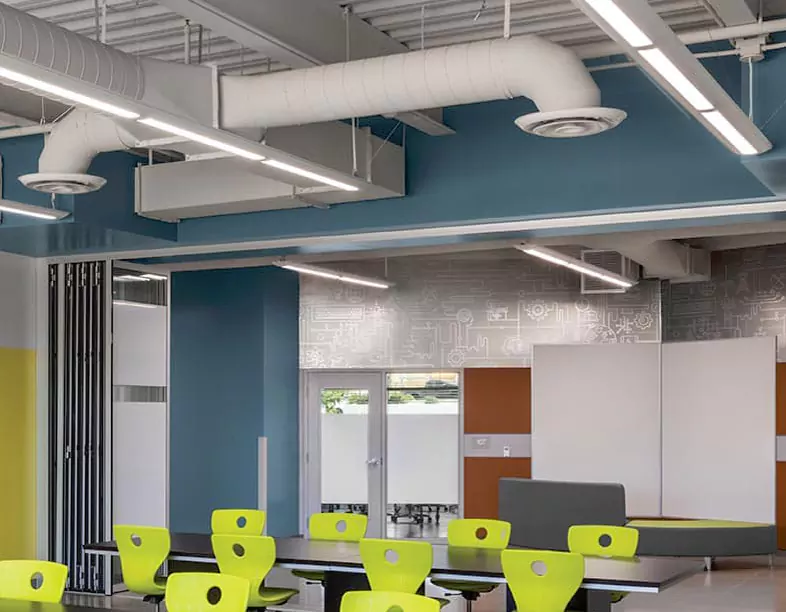
In early discussions, the most prominent point was that the client wasn’t simply looking to reduce electricity bills. At first glance, it seemed like a simple fluorescent-to-LED conversion project. However, as we began assessing the installation environment and usage patterns, we discovered that this was not a simple “bulb replacement” project, but a critical building lighting upgrade with stringent requirements for visual consistency and long-term reliability.
Especially in hallways and stairwells, lighting is more than just visibility—it directly impacts people’s confidence as they move through the space. Any uneven lighting, intermittent shadows, or flickering is immediately perceived as a safety hazard, not a comfort issue.
In the initial on-site feedback, we also noticed some important things: many renovation projects in similar environments failed not because of insufficient brightness, but because the lighting transition behavior (especially dimming and color change stability) did not meet people’s expectations in frequently moving spaces. From an engineering perspective, we immediately viewed it as a continuously operating infrastructure lighting system, rather than an office lighting upgrade.
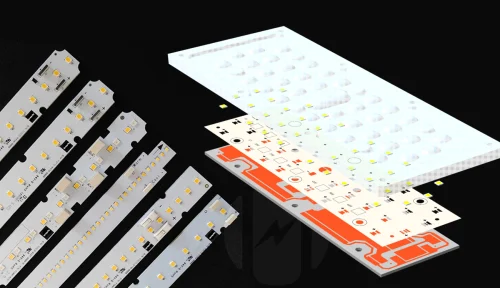
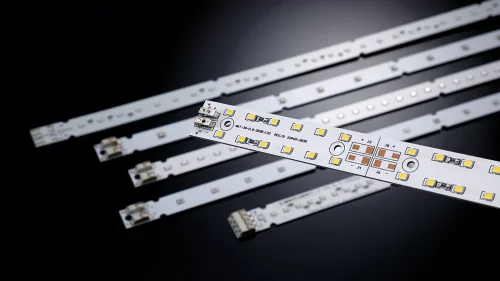
Rather than directly replacing fluorescent tubes with a single LED strip design, we redefined the system architecture based on luminous flux equivalence and fixture geometry. The client required an equivalent of approximately 4000–5000 lumens per fixture, so we implemented a dual-module configuration inside each luminaire. This allowed us to distribute thermal load more evenly while improving optical uniformity across the full fixture length.
Each LED module was designed with a length of 1100mm to match the 1160mm fixture housing, leaving controlled tolerance space for mounting and end-cap integration. We also selected a 2.0mm PCB width, which provided sufficient routing space while improving thermal spreading capability compared to narrower strip designs.
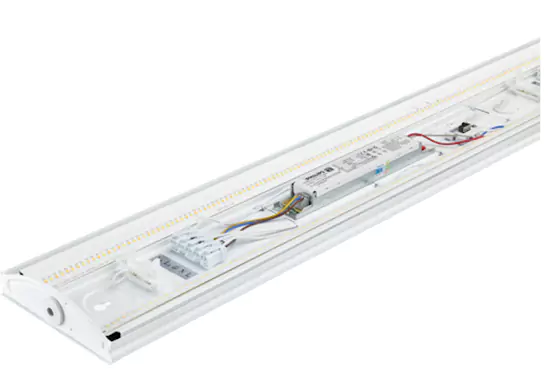
For color temperature control, we adopted a dual-channel architecture (3000K and 4000K), each with independently controlled LED arrays. Instead of mixing phosphors or using spatial blending alone, we intentionally separated the thermal and electrical control paths. This allowed smoother transitions during dimming and reduced visible chromatic instability at intermediate states.
The driver system was designed around a constant current architecture supporting DALI and Push Dim control. One of the key decisions here was ensuring stable low-level dimming performance rather than maximizing peak efficiency, because in real-world corridors and stairwells, systems often operate at reduced brightness for extended periods.
We used high-efficiency 2835 LED packages with LM-80 validation data, focusing on system-level stability rather than theoretical peak efficacy. Each module was designed at approximately 16W, which we found to be the optimal balance between brightness, thermal density, and driver compatibility for this fixture type.
| Item | Specification |
|---|---|
| Module Type | Dual CCT Linear LED Module |
| Length | 1100 mm |
| Width | 20 mm |
| LED Count | 160 pcs per module |
| Color Temperature | 3000K / 4000K |
| Control | DALI + Push Dim |
| Voltage | 60V constant current system |
| Power | 16W per module |
| Efficiency Target | 130–140 lm/W system level |
After installation, the most immediate validation came from visual continuity rather than numerical measurements. In corridor and stairwell environments, the light distribution appeared significantly more continuous compared to the original fluorescent system, particularly in transition zones where lighting artifacts are usually most visible.
One of the most important outcomes was that we successfully matched the perceived brightness level of the fluorescent system while reducing overall energy consumption. The client confirmed that no redesign of the existing lighting plan was required, which is often a major cost factor in retrofit projects.
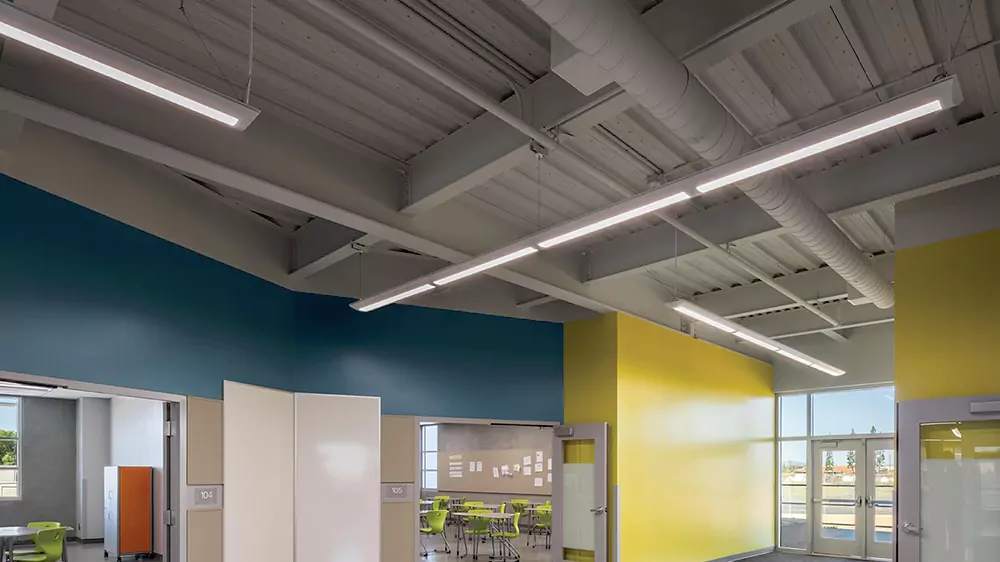
Each module achieved approximately 4000 lm output, and when installed as a dual-module system, the total fixture output reached around 8100 lm, while the entire luminaire system operated at approximately 34W.
From a system engineering perspective, this resulted in a significant efficiency improvement while maintaining lighting consistency across different architectural zones.
Why the Client Chose Higntek?
From the client’s perspective, the decision was not based solely on efficiency gains or product specifications. What mattered more was that we actively participated in redefining the retrofit logic itself.
Instead of simply offering a LED replacement module, we engaged early in discussions around optical behavior in stairwells, dimming stability under DALI systems, and long-term thermal reliability under continuous operation. In other words, we were not treated as a component supplier, but as part of the lighting system engineering process.
If you are working on similar retrofit or architectural lighting projects, we can support:
- Educational building lighting upgrades
- Office corridor and stairwell lighting systems
- Fluorescent-to-LED retrofit engineering
- DALI-compatible linear lighting modules
- Long-term continuous operation lighting design