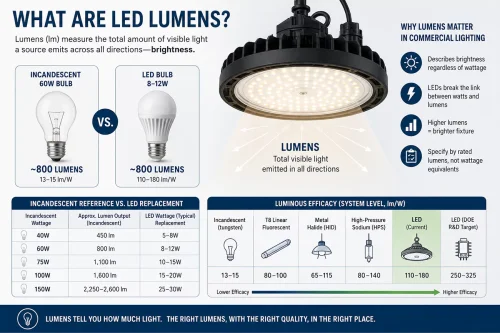
Luminous efficacy (symbol η, unit lm/W) is the ratio of the luminous flux a light source emits, measured in lumens, to the electrical power it consumes, measured in watts. It states how efficiently the source converts electrical energy into visible light: a module rated at 180 lm/W delivers 180 lumens for every watt it draws. Wattage alone says nothing about light delivered; it only measures power drawn, which is why two 50 W fixtures can perform very differently on the same ceiling.
- It cuts operating costs by a calculable margin. Higher lm/W means fewer watts for the same lumens. A high-efficacy module at 200 lm/W produces the same light as a typical fluorescent lamp (about 80 lm/W) while consuming roughly 60% less energy, and the same light as a standard 130 lm/W LED module while using about 35% less power. Across a warehouse running hundreds of fixtures 4,000 hours a year, that gap is the difference between two very different utility budgets.
- It shrinks the thermal budget. Every watt not converted to light becomes heat inside the housing. A higher-efficacy module generates less waste heat at equal output, so the luminaire can use a smaller, lighter, cheaper heat sink without compromising junction temperature or lifespan.
- It gates access to premium markets. In North America, DLC SSL V5.1 sets Premium efficacy thresholds such as 135 lm/W for high-bay luminaires, and many utilities tie cash rebates to DLC-listed products. In the EU, the ErP regulation (EU) 2019/2020 ties energy labeling to efficacy performance. Modules that cannot document high efficacy are excluded from these projects before price is ever discussed.
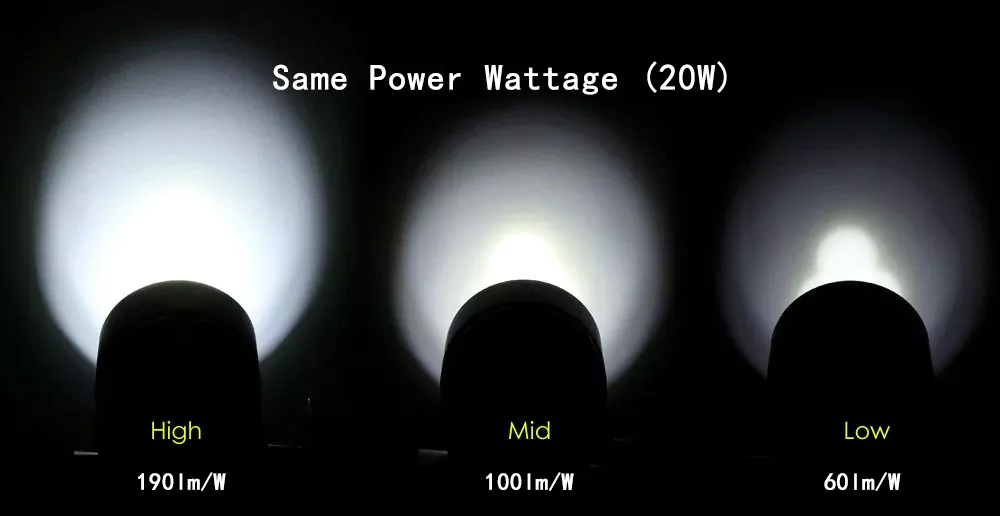
The metric has a hard physical ceiling. Human photopic vision peaks at 555 nm (green), where the theoretical maximum is 683 lm/W; real white LEDs sit far below that limit because of heat, optical, and electrical losses. Some production LED chips currently reach 200 to 220 lm/W under laboratory conditions, and complete modules measure lower. For commercial buyers and contractors, this single number dictates waste heat, long-term utility costs, and project ROI.
After years of research and development, Higntek now offers advanced semiconductor solutions such as NCSP, PCT, PPA, and EMC, achieving an extreme luminous efficacy of 272 lm/w with low current and an ultra-high luminous efficacy of 265 lm/w with high current, covering a full range of applications from 2835 to 5050. Through systematic thermal management and optical design engineering solutions, the luminous efficacy loss of our LED modules can be controlled to within 10%.
Luminous efficacy vs luminous efficiency.
Luminous efficacy measures how well a light source converts electrical power into visible light, expressed in lumens per watt. It is the working metric of commercial lighting: datasheets quote it, rebate programs threshold it, and energy models are built on it.
Luminous efficiency is a different, theoretical quantity. It measures how much of the input power becomes visible radiation relative to a defined maximum, expressed as a percentage, and it belongs to academic physics and lighting research rather than commercial specification.
As commercial LED module manufacturers, the Higntek engineering team specifies and tests against luminous efficacy, because that is the figure that decides a client’s energy bill. Luminous efficiency stays in the lab literature. The table below summarizes the distinction for quick reference.
| Metric | Luminous Efficacy | Luminous Efficiency |
|---|---|---|
| Definition | Ratio of luminous flux to input power | Ratio of visible output to a defined theoretical maximum |
| Unit | lm/W (lumens per watt) | % (percentage, dimensionless) |
| Engineering use | Measuring energy-to-light ROI | Analyzing spectral conversion in research |
| Max limit | About 683 lm/W (monochromatic green, 555 nm) | 100% |
| Commercial relevance | Critical: directly sets energy bills and rebate eligibility | Secondary: theoretical benchmark |
How to Calculate Luminous Efficacy?
Datasheet efficacy figures deserve verification before any comparison, because the data parameters provided for customized LED modules vary depending on their engineering design schemes. The calculation itself uses one standard formula:
Luminous efficacy (lm/W) = Luminous flux (lm) / Power consumed (W)
η = Φ / P
Applied to a real module: if a LED module emits 6,500 lumens while drawing 36 watts at the wall, it operates at 6,500 / 36, or about 180 lm/W. If a second LED module needs 50 watts for the same 6,500 lumens, it delivers only 130 lm/W, and the difference shows up on the electricity meter every hour the installation runs.
Two conditions decide whether a quoted number is meaningful. First, check the measurement level: chip-level ratings are captured at a 25°C junction temperature and low drive current, so module-level efficacy under real operating conditions always sits lower, typically by 10 to 20%. Second, check the thermal state: a credible figure is measured at thermal equilibrium under steady-state operation, not in the first seconds after switch-on. A claimed 225 lm/W is real engineering only when both conditions are stated.
Benchmarks turn an abstract number into a decision. Understanding the luminous efficacy range of standard LED lighting modules (120-210 lm/W), or the peak value of fluorescent tubes approaching 100 lm/W, allows lighting engineering and procurement teams to quantify energy-saving effects, estimate the payback period, and confirm eligibility for subsidies before selecting suppliers. Here is the comparison table based on the IESNA Lighting Handbook, the U.S. Department of Energy (DOE), and mainstream industry standards for solid-state lighting.
| Light Source Type | Efficacy Range (lm/W) | Typical Applications | Technical Characteristics |
|---|---|---|---|
| Incandescent Bulbs | 12.6 –52 | Decorative, vintage residential | 90% of energy is wasted as heat rather than light. |
| Halogen Lamps | 16 – 25 | Spotlights, automotive headlamps | Slightly more efficient than incandescent, but still a major heat generator. |
| Fluorescent Lamps | 50 – 100 | Offices, supermarkets | Relies on mercury vapor discharge; efficient, but carries environmental risks. |
| Arc / HID Lamps | 60 – 120 | Stadiums, street lighting; searchlights | Includes Metal Halide (MH) and High-Pressure Sodium (HPS); slow warm-up times. |
| Standard LED Module | 100 – 150 | General commercial lighting | The most common cost-effective choice in today’s market. |
| High-Efficacy LED | 160 – 265+ | Industrial High-Bays, Higntek projects | Uses top-tier chip binning and precision thermal engineering. |
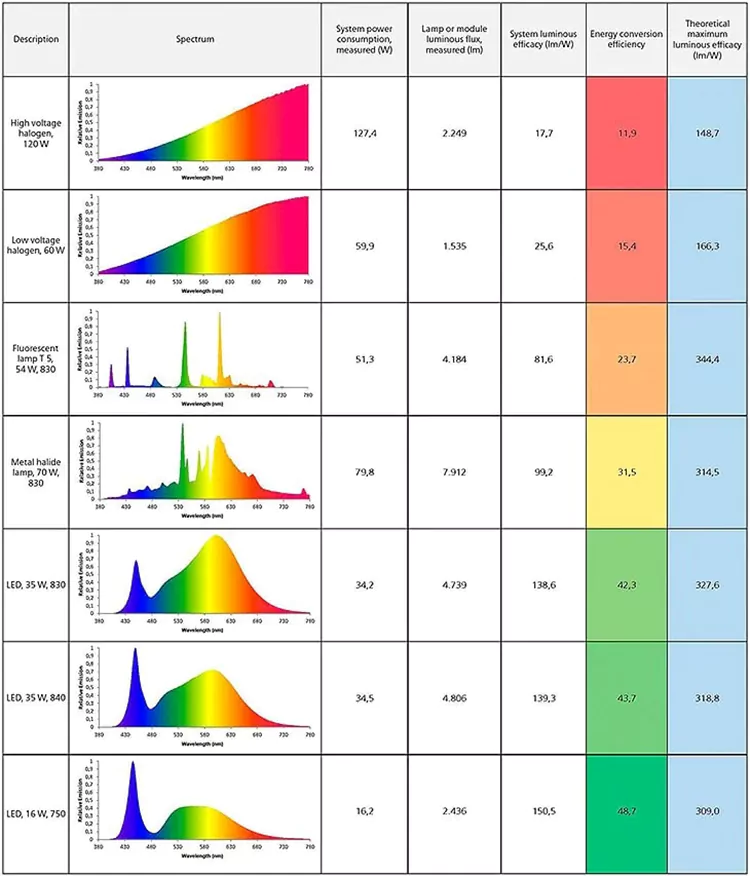
The above chart, from DIAL, reveals a pattern more significant than any single data point: LED performance has far surpassed all traditional technologies, and within LEDs, the gap between standard and high-efficiency modules is the key to project economics. That spread, not the nominal wattage, is what a procurement team should be pricing.
How to Measure Luminous Efficacy?
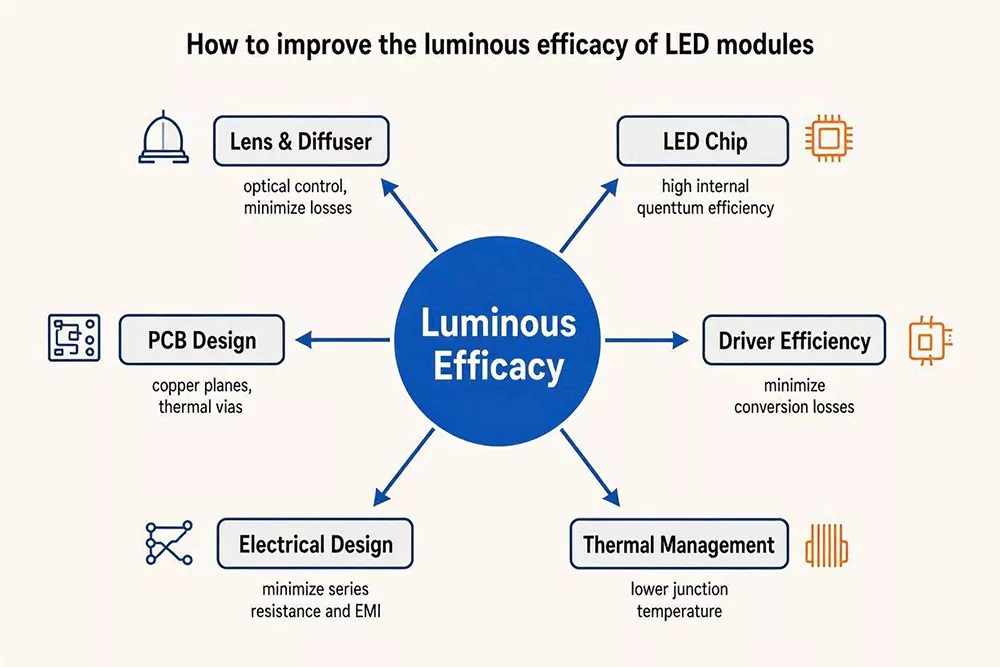
Improving the luminous efficacy of an LED module means cutting every loss between the wall socket and the emitted photon. In practice, our engineering teams work six levers: premium LED chips driven inside their efficacy sweet spot, high-efficiency drivers, system-level thermal management, high-transmittance optics, low-loss electrical design, and a PCB layout engineered for heat flow and current symmetry.
At equal input power, the high-efficacy module delivers about 73% more light (225 vs 130 lm/W). In a real layout, that is the difference between a dim floor and full design lux, or the opportunity to specify fewer fixtures for the same result.
Flipped the other way, the high-efficacy module needs roughly 42% less input power for the same light output (about 69 W instead of 120 W), and waste heat falls in proportion. A standard module may force a 2 kg heat sink to keep junction temperature safe; the high-efficacy design allows a much slimmer housing. On large projects, the savings in aluminum, shipping weight, and installation labor can exceed the price premium of the better modules.
Using inefficient LED lights wastes energy, drives up operating costs, and degrades performance over time. To maximize the luminous efficacy (lm/W) of an LED module, the whole energy conversion chain has to be optimized as one system rather than as isolated components. By controlling the variables below, a module design can deliver measurably lower energy costs and a longer operational lifespan.
Choose High-Efficiency LED Chips.
The core of any LED module is the chip, a semiconductor structure where electrons and holes recombine to release photons. Chip architectures and binning quality vary widely in conversion efficiency, and higher luminous efficacy at chip level translates directly into lower system power. Currently, the highest mainstream level of high-quality commercially available LED chips in daily mass production is 180–220 lm/W. Our independently developed top-tier LED light source achieves a light source-level luminous efficiency of 280 lm/W, while the module-level luminous efficiency based on these LED chips (optimized for thermal management and optical loss) can reach 265 lm/W—we confidently claim this is the upper limit of current high-efficiency design.
Two conditions make that number meaningful. Chip-level ratings are measured at a 25 °C junction temperature and low drive current, so module-level efficacy under real operating conditions will always sit lower. And binning discipline matters as much as the peak figure: a supplier who can lock a specific flux and color bin across batches protects both efficacy and visual consistency in volume production.
Getting the most from those chips is not a numbers game. Adding LEDs to reach an efficacy target raises component count, power density, and thermal-management complexity. High-efficacy module design usually goes the other way: use the fewest high-efficacy chips that still meet the project’s brightness and uniformity requirements, and drive each one inside its efficacy sweet spot — the current range where lm/W peaks before efficiency droop sets in. Chip count follows the optical requirement; it is not the efficacy strategy.
If a project requires higher efficiency and prioritizes cost-effectiveness, we will independently develop high-efficiency LED light sources through specially designed packaging architectures, materials, and processes—currently, our source-level EP reaches a maximum of 280 lm/W, and our module-level EP reaches a maximum of 265 lm/W. Please browse our LED Chip Resources to find chip specifications and architectures that match your target EP.
Use Higher Driver Efficiency.
The LED driver regulates voltage and current for the whole system, and driver sizing needs a precise thermal and electrical balance:
- Under-driving risks: A driver with insufficient capacity cannot supply the matrix properly. System efficacy drops, and the wasted electrical energy turns into heat.
- Over-driving risks: A driver running at excessive power overloads the LEDs, causing overheating, faster lumen depreciation, and premature component failure.
Selecting a high-efficiency driver is not optional for high-power fixtures. A premium driver rated above 90% efficiency is ideal: at equal light output, a 90%-efficient driver wastes about 11% of input power as heat, while an 80%-efficient unit wastes 25%. That is nearly two and a half times the parasitic loss, and the thermal design has to absorb all of it.
The choice of driver depends on the customer’s lighting design, and our responsibility is to ensure the module performs at its best. Higntek’s electrical engineers design the module’s electrical architecture around the customer’s driver requirements — matching the volt-ampere (V-I) characteristics of each LED matrix to the driver’s output window, and adapting the module to the specified dimming protocol, whether DALI, 0-10V, Push Dim, or DMX512. This matching matters more than most buyers expect: even two LED part numbers sharing the same 5050 footprint can peak at very different voltage and power conditions, so the electrical design is what lets the chips run at their highest sustained efficacy under the coolest, most stable operating conditions. Contact us here to align the module design with your driver and dimming plan.
Thermal Management.
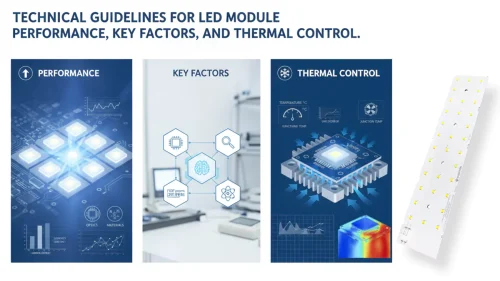
Excessive heat is the primary enemy of efficacy; it accelerates lumen degradation and severely shortens the operating life of the fixture. LED thermal droop describes the physical phenomenon where luminous efficacy falls dynamically as junction temperature rises. As a working rule, white LED output drops roughly 0.1 to 0.3% per °C of junction temperature increase, so a module rated at 25 °C can lose 5 to 10% of its light output once the junction stabilizes at 85 °C inside a sealed luminaire. Severe thermal failure goes further, threatening both operational safety and service life.
Thermal management is a complete engineering discipline, not a single heat-dissipation path. Heat generated at the LED junction must travel through the package, solder joints, PCB, thermal interface materials, and the heatsink or housing before it reaches ambient air, and every interface adds thermal resistance — the weakest link sets the steady-state junction temperature. That is why thermal design should be planned concurrently with electrical, optical, and mechanical design, not checked after the mechanical work is done.
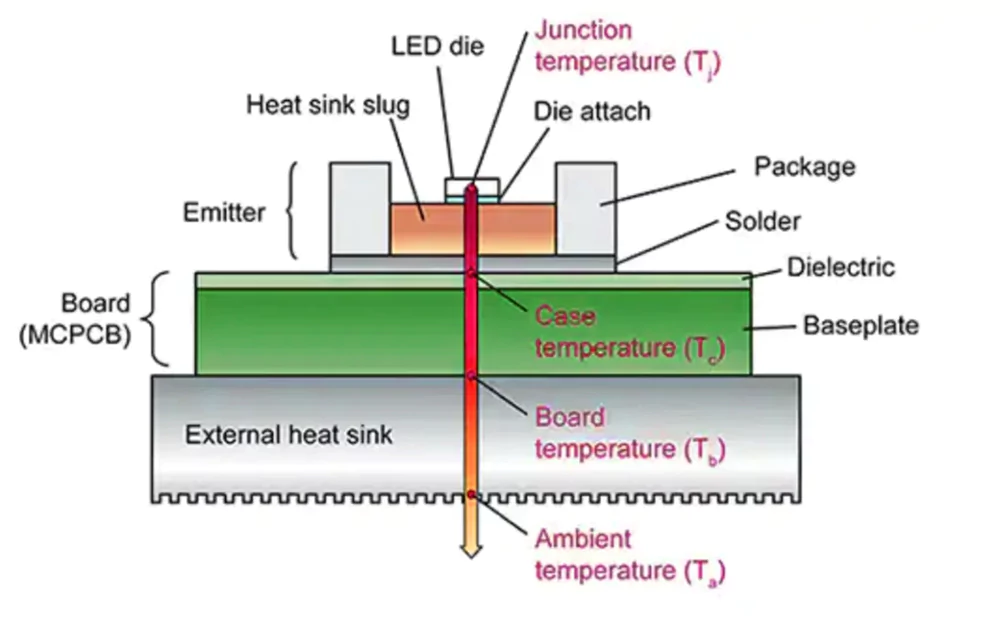
At Higntek, thermal evaluation runs through the entire module development cycle — LED selection, PCB material(1 to 8 W/m·K MCPCB) and layout, thermal interface materials, driver and system thermal integration, and heatsink matching — validated by thermal simulation and steady-state testing before mass production. See how our thermal management engineering works in practice.
Choose High-Transmittance Optics.
Standard and low-quality optical components are prone to severe light trapping, in bad cases absorbing 15% to 20% of a luminaire’s total output. To minimize these losses, high-end industrial lighting avoids inferior plastics in favor of optical-grade PMMA (acrylic) or premium PC (polycarbonate).
Optical-grade PMMA transmits 92 to 93% of visible light, verifiable via the ASTM D1003 haze and transmittance standard; clear polycarbonate typically reaches 88 to 90%. For more demanding applications, an anti-reflective (AR) coating can push transmission past 95%.
When it comes to diffusers, the engineering focus shifts to balancing light transmission with appearance. Diffusion is always a trade-off: stronger diffusion improves uniformity and visual comfort but scatters or absorbs part of the output, typically costing 5 to 13% of luminous flux. A diffuser with 85% transmittance and one with 95% transmittance deliver very different combinations of light loss and uniformity, so the choice has to follow the project’s priority: visual comfort, brightness, or energy efficiency rather than defaulting to the strongest diffusion material. Done well, luminaires achieve a clean, refined aesthetic without boosting power consumption or relying on higher-power LEDs.
Higntek treats optical design as a system engineering stage: LED selection, custom lens and beam-angle optimization from 15° to 120°, diffuser and glare-control engineering, and optical simulation with photometric validation before mass production — all aimed at keeping optical loss low while hitting the application’s distribution and uniformity targets. See our optical design engineering capability.
Optimize electrical design.
Selecting the right LED chip and driver is not enough on its own. If the circuit design is poor, electrical energy is wasted as heat before it reaches the chip. Sound electrical design ensures the LEDs receive a stable power supply and operate at peak efficiency.
To maximize luminous efficacy, the electrical design should focus on precise current control and the minimization of line losses. An effective voltage regulation mechanism prevents power loss by matching the driver output to the specific requirements of the LED matrix. Rigorous constant-current control keeps the chips within their optimal operating range, the “golden operating point,” avoiding the efficacy drop caused by overdriving.
Reducing circuit resistance is equally critical. Premium-grade wiring, high-quality connectors, and thickened copper PCB traces eliminate voltage drops and prevent electrical energy from being lost as heat. By optimizing the series-parallel circuit layout, the design maintains a balanced operating current so that no individual LED string is subjected to an overload condition.
Optimize PCB.
The PCB is both the electrical backbone and the first stage of the thermal path, so PCB design directly shapes systemic luminous efficacy.
On the thermal side, three strategies reliably reduce heat-related issues:
- Increase the copper coverage area and concentrate high-density thermal vias beneath LED components; this creates vertical heat dissipation channels that rapidly conduct heat away from the junction.
- Apply conformal coatings that protect the PCB and components from moisture, dust, and contaminants while still permitting heat dissipation.
- Arrange components to minimize thermal interference between high-heat parts, with adequate LED spacing to prevent localized overheating.
On the electrical side, trace design determines whether current reaches every branch evenly:
- Use heavy copper layers (2 oz or 3 oz), common practice for higher-current LED modules, combined with calculated, consistent trace widths to lower resistance, minimize voltage drops, and keep current distribution uniform.
- Minimize sharp bends and implement teardrop connections at corners to reduce manufacturing defect risk and keep connections robust.
- In multi-string parallel arrays, use strictly symmetrical trace layouts so every branch presents identical impedance; asymmetry invites current crowding, where one branch draws disproportionate current and degrades into uneven light output.
At Higntek, we develop custom LED modules optimized for thermal management, optical performance, and manufacturability. From concept to PCB layout, our one-stop service delivers reliable, real-world solutions to the design challenges above.